
Thermoplastic Striping
In Northwest Houston, TX
Long-Lasting Pavement Markings
1-800-STRIPER provides professional thermoplastic striping in Northwest Houston, TX — heat-applied stop bars, crosswalks, directional arrows, and fire lane legends in a thick retroreflective material that bonds into the pavement instead of drying on top of it, for high-traffic commercial lots.
1-800-STRIPER® of NW Houston PROVIDes Thermoplastic Striping Services NEAR YOU
Want to reduce the maintenance requirements for your parking lot?
Thermoplastic pavement markings are a durable, weather and vehicle-resistant striping option for your parking lot or facility.
You can utilize them for stop bars, ADA stalls, no-parking zones, directional arrows, crosswalks, or your entire parking lot.
Benefits:
What Thermoplastic Is
Paint dries. Thermoplastic fuses. That single difference explains almost everything else about the material.
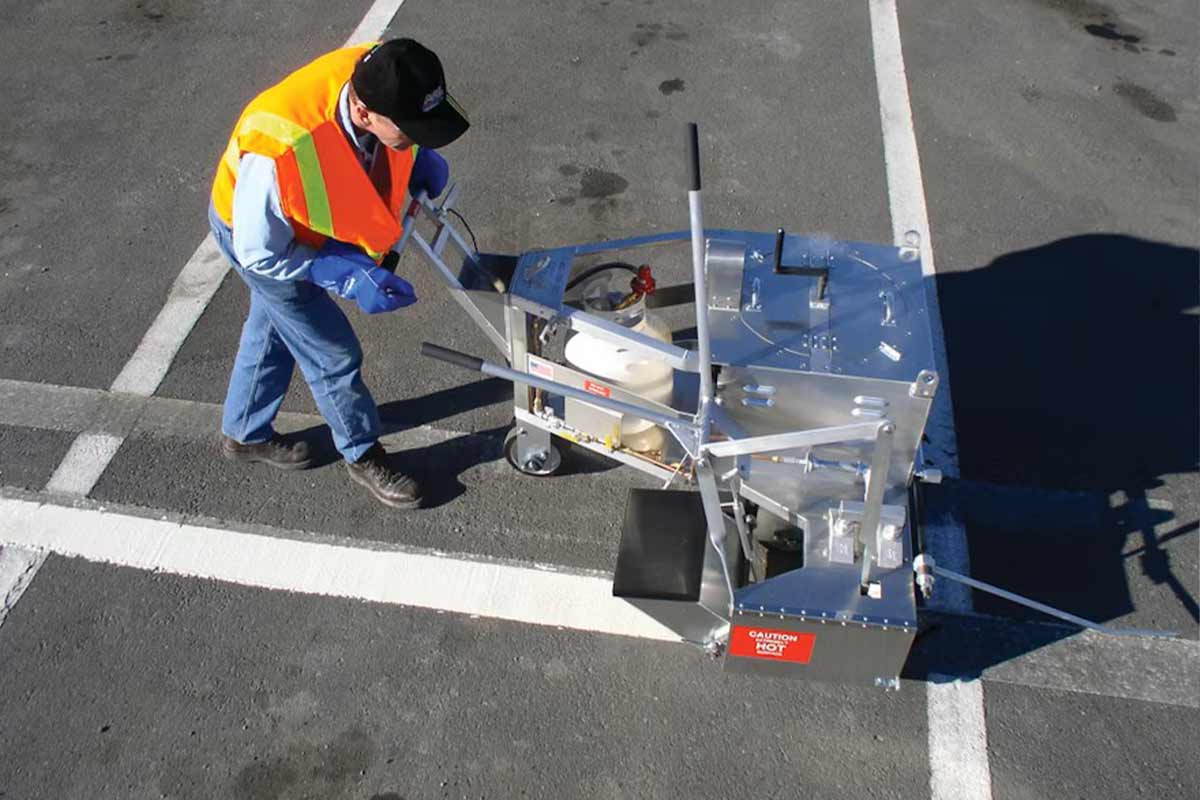
Thermoplastic pavement marking arrives as a solid — powder or preformed shapes — and is heated until it flows, then applied to the pavement where it cools and hardens into place. Instead of a thin film sitting on the surface, you get a marking with real thickness that has bonded into the asphalt. Glass beads are typically included in or applied to the material to give the marking retroreflectivity, which is why thermoplastic legends read so well in headlights and in rain.
It is the material used for highway markings, and it turns up on commercial property wherever a marking has to survive far more traffic than a stall line does.
Thermoplastic vs Traffic Paint
| Thermoplastic | Waterborne traffic paint | |
|---|---|---|
| Applied as | Heated solid, fused to pavement | Liquid film, dries on surface |
| Thickness | Substantially thicker | Thin |
| Retroreflectivity | Glass beads in or on the material | Beads can be added, less durable |
| Service life | Considerably longer under traffic | Shorter |
| Install speed | Slower, needs equipment and conditions | Fast |
| Best for | Stop bars, crosswalks, arrows, legends, fire lanes | Stall lines, general lot markings |
Neither is better in the abstract. On a typical commercial lot the sensible answer is both: thermoplastic where traffic concentrates and paint everywhere else. Putting thermoplastic on every stall line in a retail lot is spending durability where nothing is wearing it out.
Where Thermoplastic Makes Sense
Traffic concentrates in a few predictable places, and those are the places where paint fails first and where thermoplastic pays for itself.
Stop bars at lot exits take every tire that leaves the property. Crosswalks between a parking field and a building entrance take both vehicles and pedestrians. Directional arrows in drive lanes carry the turning traffic that scrubs paint off in arcs. Fire lane legends need to stay legible for a code inspection years after installation. Entrance and exit lanes on a busy retail center or a distribution facility see continuous traffic in the same wheel path.
By contrast, a parking stall line gets driven over twice per visit at low speed. Paint is the right material for that, and thermoplastic there is over-specification.
Application and Surface Requirements
Thermoplastic is less forgiving than paint about conditions, and most failures trace to the surface rather than the material.
The pavement has to be sound, clean and dry. Asphalt needs its full cure before it takes thermoplastic. Seal coat is a genuine complication — thermoplastic bonds to the pavement, and a seal coat layer between the two changes that relationship, so the sequencing needs to be agreed rather than assumed. Existing markings usually have to come off, because thermoplastic bonds to pavement, not to old paint.
Weather matters more than for paint. The material needs a dry surface and suitable ambient conditions, which in a Gulf Coast summer means working around afternoon storms and morning humidity. We schedule thermoplastic against a forecast, not against a calendar.
Application requires heated equipment and trained crew, which is why it is quoted separately from striping rather than as a line item on a restripe.
Service Life and Retroreflectivity
Thermoplastic markings outlast paint substantially under the same traffic — that is the whole reason to specify it. What we will not do is put a number of years on your page.
There is no primary source that publishes a universal service life for thermoplastic, because it depends on traffic volume and type, the pavement it is bonded to, surface preparation, application quality, and climate. The product’s own manufacturer datasheet is the document that states expected performance for a specific material, and that is the honest place to get a figure for your job. Anyone quoting you a flat multiplier against paint is generalizing.
Retroreflectivity works the same way. Glass beads make the marking return headlight illumination toward the driver, and thermoplastic holds beads far better than a thin paint film does, which is why the material dominates on roadways. Measured retroreflectivity values decline with wear, and the specific values that apply to a public roadway project come from the governing highway specification rather than from us.
Areas We Serve
We install thermoplastic markings across Harris, Montgomery, Waller and Fort Bend counties — Cypress, Katy, Tomball, Spring, northwest Houston, The Woodlands, Conroe, Magnolia, Brookshire, Pattison and Fulshear. The work concentrates in high-traffic retail centers, distribution facilities along the Grand Parkway corridor, and municipal and school properties where markings need to survive years rather than seasons. Where a project falls under a public specification, the Texas Manual on Uniform Traffic Control Devices is the state reference for traffic control device standards.
For a full list of our pavement marking services, visit our parking lot striping in Northwest Houston page.
Businesses We Serve




How it Works

GET A FREE ESTIMATE
Contact us today and we’ll have a quote to you in 24 hours

SCHEDULE AN INSTALLATION
We’ll have your installation scheduled restriped in less than 7 days, without affecting your business hours

GET A PARKING LOT THAT POPS
For a budget-friendly price, you’ll get a parking lot that looks like new
We proudly work with:


We proudly work with:

Frequently Asked Questions About Thermoplastic Striping in Northwest Houston, TX
What is thermoplastic striping?
A pavement marking applied as a heated solid rather than a liquid. The material — supplied as powder or preformed shapes — is heated until it flows, laid onto the pavement, and cools into a thick marking bonded into the surface. Glass beads in or on the material make it retroreflective. It is what highway markings are made of, and it shows up on commercial lots wherever a marking has to take heavy traffic.
How long does thermoplastic striping last?
Considerably longer than paint under the same traffic — that is why it exists. We do not publish a number of years, because no primary source sets a universal one. Actual service life depends on traffic volume, the pavement, surface preparation, install quality and climate. The manufacturer’s datasheet for the specific product is what states expected performance, and we will point you to it for your job rather than repeating a rule of thumb.
What are the disadvantages of thermoplastic?
Several, and they are worth knowing before you specify it. It costs more to install than paint and needs heated equipment and trained crew. It is fussier about surface condition, cure and weather. Removing or changing it is harder than repainting — thermoplastic has to be ground off rather than painted over. It is over-specification for ordinary stall lines. And on pavement that is failing structurally, a durable marking bonded to a failing surface fails with it.
Thermoplastic or paint — which is right for my lot?
Usually both, in different places. Thermoplastic where traffic concentrates: stop bars, crosswalks, drive-lane arrows, fire lane legends, entrance and exit lanes. Waterborne paint for stall lines and general lot markings, where wear is light and the ability to restripe cheaply is worth more than durability. We will mark up your lot and show you which elements justify the upgrade.
What temperature is thermoplastic applied at?
We do not publish a figure, and here is why that is the honest answer rather than a dodge. No primary standard sets a single application temperature for thermoplastic pavement marking — it varies by material formulation and by manufacturer. The number that governs your job is the one on that product’s datasheet, and our crews work to it. Any page quoting one universal temperature is repeating something rather than citing it.
Can thermoplastic go over existing paint?
Generally no. Thermoplastic is designed to bond to the pavement itself, and a layer of old paint between the two undermines that bond. Existing markings usually need to be removed first so the material meets clean pavement. That removal step is part of why thermoplastic installs take longer than a repaint, and it is a real cost we would rather explain up front than discover mid-job.
Does thermoplastic work on concrete as well as asphalt?
It is used on both, but they are not the same job. Thermoplastic bonds naturally into asphalt, which is warm, bituminous and receptive. Concrete is a different substrate and typically needs a primer or sealer for the material to bond reliably. If your lot is concrete, or part concrete and part asphalt, tell us at the estimate — the preparation differs and so does the sequence.