ADA Parking Lot Striping
In Northwest Houston, TX
ADA-Compliant Accessible Parking
1-800-STRIPER provides professional ADA parking lot striping in Northwest Houston, TX — accessible stalls, van-accessible spaces, access aisles, International Symbol of Accessibility markings, and post-mounted signage per the 2010 ADA Standards for Accessible Design and the Texas Accessibility Standards.
1-800-STRIPER® of NW Houston PROVIDes ADA Parking Lot Striping Services NEAR YOU
Need to make your property more accessible?
Upgrade your facility to become fully ADA compliant by partnering with us to create clear, accessible parking for all your visitors.
Our ADA Compliant line striping services include:
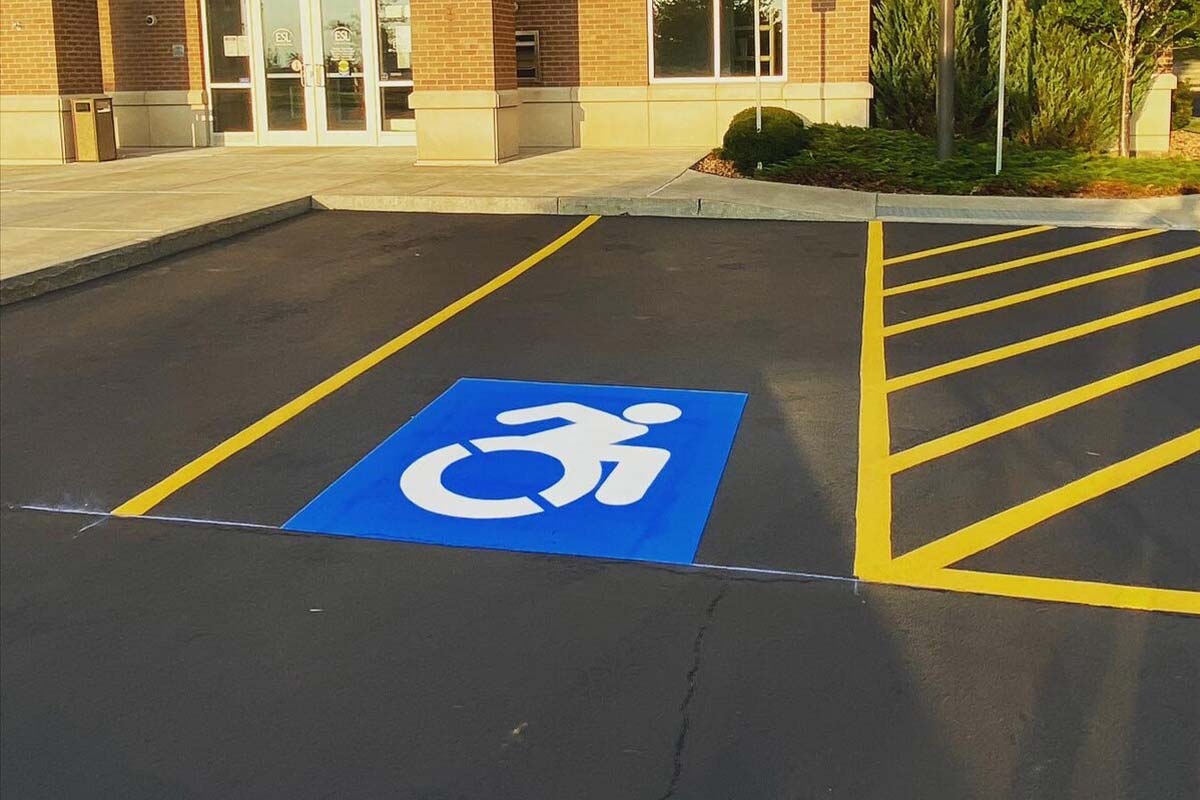
What an Accessible Space Requires
Ninety-six inches. That is the minimum width of a car accessible space under the 2010 ADA Standards for Accessible Design, and almost every other requirement on this page is a number just as fixed.
| Element | 2010 ADA Standards requirement |
|---|---|
| Car accessible space width | 96 inches minimum |
| Van accessible space width | 132 inches minimum — or 96 inches where the access aisle is also 96 inches minimum |
| Access aisle width | 60 inches minimum |
| Access aisle length | Full length of the spaces it serves |
| Shared aisle | Two spaces may share one access aisle |
| Aisle position | Must not overlap the vehicular way; on angled van spaces, on the passenger side |
| Aisle marking | Marked to discourage parking — method and color not specified |
| Sign mounting | 60 inches minimum to the bottom of the sign |
| Measurement | Widths measured from the centerline of the markings |
Two of those rows surprise people. The access aisle can be shared between two spaces, which changes the geometry of a paired accessible bay. And the federal standard does not tell you what color to paint the aisle hatching — more on that below.
How Many Accessible Spaces a Lot Needs
The count comes from a table, not a percentage, until the lot gets large. Under Table 208.2, a facility with 1 to 25 spaces needs 1 accessible space; 26 to 50 needs 2; 51 to 75 needs 3; 76 to 100 needs 4; 101 to 150 needs 5; 151 to 200 needs 6; 201 to 300 needs 7; 301 to 400 needs 8; and 401 to 500 needs 9. From 501 to 1000 spaces the requirement becomes 2 percent of the total. Above 1000, it is 20 spaces plus one for each 100, or fraction thereof, over 1000.
Two property types carry higher requirements. Hospital outpatient facilities require ten percent of patient and visitor spaces to be accessible. Rehabilitation facilities specializing in conditions that affect mobility, and outpatient physical therapy facilities, require twenty percent.
One detail that changes answers on multi-building sites: where more than one parking facility is provided on a site, the number of accessible spaces is calculated separately for each facility, not pooled across the whole property.
Texas Accessibility Standards and the Federal Standard
Texas has its own accessibility standard as well as the federal one. The 2012 Texas Accessibility Standards are administered by the Texas Department of Licensing and Regulation, and TDLR registers projects, reviews plans and conducts inspections through Registered Accessibility Specialists.
The practical position for a property owner in Cypress or Tomball is that your lot has to satisfy both. The dimensional requirements we mark to — space widths, aisle width, sign height — are the federal numbers quoted above. Where a project is large enough to trigger Texas review, a Registered Accessibility Specialist is the authority on how the state standard applies to your specific work, and on any point where the two standards need to be reconciled.
Signage and Mounting
A compliant space is not finished when the paint dries. Parking space identification signs must include the International Symbol of Accessibility, and signs identifying van parking spaces must contain the designation “van accessible.”
Mounting height is the requirement most often missed on repaint jobs: signs must be 60 inches minimum above the finish floor or ground surface, measured to the bottom of the sign. Measured to the bottom — not to the middle, and not to the top of the post. A sign that sits low enough to be hidden by a parked pickup fails the purpose and the number.
We install signage as part of the striping work rather than leaving it as somebody else’s follow-up, because a marked space without its sign is an incomplete space.
Areas We Serve
We mark accessible parking across Harris, Montgomery, Waller and Fort Bend counties — Cypress, Katy, Tomball, Spring, northwest Houston, The Woodlands, Conroe, Magnolia, Brookshire, Pattison and Fulshear. Medical and professional offices, retail centers, schools, churches, municipal facilities and HOA communities all carry accessible-parking obligations, and all of them get the same measured layout.
For a full list of our pavement marking services, visit our parking lot striping in Northwest Houston page.
Businesses We Serve




How it Works

GET A FREE ESTIMATE
Contact us today and we’ll have a quote to you in 24 hours

SCHEDULE AN INSTALLATION
We’ll have your installation scheduled in less than 7 days, without affecting your business hours

GET A PARKING LOT THAT POPS
For a budget-friendly price, you’ll get a parking lot that looks like new!
We proudly work with:


We proudly work with:


Frequently Asked Questions About ADA Parking Lot Striping in Northwest Houston, TX
What are the requirements for ADA parking in Texas?
Both the federal 2010 ADA Standards and the Texas Accessibility Standards apply. The federal standard sets the numbers we mark to: car spaces at least 96 inches wide, van spaces at least 132 inches, access aisles at least 60 inches running the full length of the space, signs mounted at least 60 inches to the bottom of the sign, and the number of accessible spaces taken from Table 208.2. Texas adds its own review process through TDLR for projects that trigger it.
How do you stripe an accessible parking space?
Measure and lay out the space and its access aisle first, working from the centerline of the markings. The space is marked to define its width — 96 inches minimum for a car space, 132 for a van space unless the aisle is also 96 inches. The access aisle runs the full length of the space, at least 60 inches wide, marked to discourage parking, and it cannot overlap the vehicular way. The International Symbol of Accessibility goes in the space, and the post-mounted sign at 60 inches minimum to its bottom edge.
How many accessible spaces are required, and how many must be van accessible?
The total comes from Table 208.2 — 1 space for a lot of 1 to 25, 2 for 26 to 50, and so on up to 9 for 401 to 500. The van ratio is the part people get wrong: for every six, or fraction of six, accessible spaces required, at least one must be a van space. That is one van space per six required accessible spaces — not one per six spaces in the lot. A 60-space lot needs 3 accessible spaces, and because 3 is a fraction of 6, one of them must be van accessible.
Do the Texas Accessibility Standards differ from the federal standard?
They are separate instruments and your project has to satisfy both. TDLR administers the Texas standard and handles registration, plan review and inspection through Registered Accessibility Specialists. We mark to the federal dimensions because those are fixed and published; where a specific point needs reconciling between the two, a Registered Accessibility Specialist is the person who can give you a defensible answer for your property.
Does an older lot have to be brought up to current standards?
Not automatically, and not because you repainted it. Accessibility obligations attach to defined events rather than to the passage of time, and whether your particular project creates one is a legal determination about that property, its history and the scope of work — not something a striping contractor should decide for you. What we can do is measure what is on the ground, show you exactly where it sits against the current federal dimensions, and mark what you direct. For a determination you can rely on, use a Registered Accessibility Specialist.
How high must an accessible parking sign be mounted?
At least 60 inches above the finish floor or ground surface, measured to the bottom of the sign — not to its middle and not to the top of the post. The sign must carry the International Symbol of Accessibility, and a van space’s sign must carry the “van accessible” designation. The measurement point is what most repaint jobs get wrong: a sign set low enough to disappear behind a parked pickup fails both the requirement and its purpose.
What is an access aisle, and can two spaces share one?
The access aisle is the marked stripe of pavement beside an accessible space that gives someone room to deploy a ramp or lift and get to the accessible route. It must be at least 60 inches wide, run the full length of the space it serves, be marked so as to discourage parking, and it must not overlap the vehicular way. And yes — two accessible spaces are permitted to share a common access aisle, which is why you often see them arranged in pairs around a single hatched strip.
Who enforces accessible parking on a private lot in Texas?
More than one body, depending on what is at issue. The federal standard is enforced through the Americans with Disabilities Act, including private civil action. In Texas, TDLR administers the state accessibility program and Registered Accessibility Specialists conduct the reviews and inspections. Local law enforcement handles misuse of the spaces themselves. If you are trying to get ahead of a complaint, an inspection by a Registered Accessibility Specialist is the route.