
Parking Lot Pressure Washing
In Northwest Houston, TX
Surface Prep Before Restriping
1-800-STRIPER provides professional parking lot pressure washing in Northwest Houston, TX — removing oil staining, tire marking, gum, and organic growth from asphalt and concrete with wash-water containment that keeps discharge out of the municipal storm sewer system.
1-800-STRIPER® of NW Houston PROVIDes Parking Lot Pressure Washing Services NEAR YOU
Need to blast away years of grime?
If your parking lot or parking garage looks dull and dirty, our professional crew can wash away grime, oil, stains, and slippery buildup to restore the appearance of your property.
Benefits:
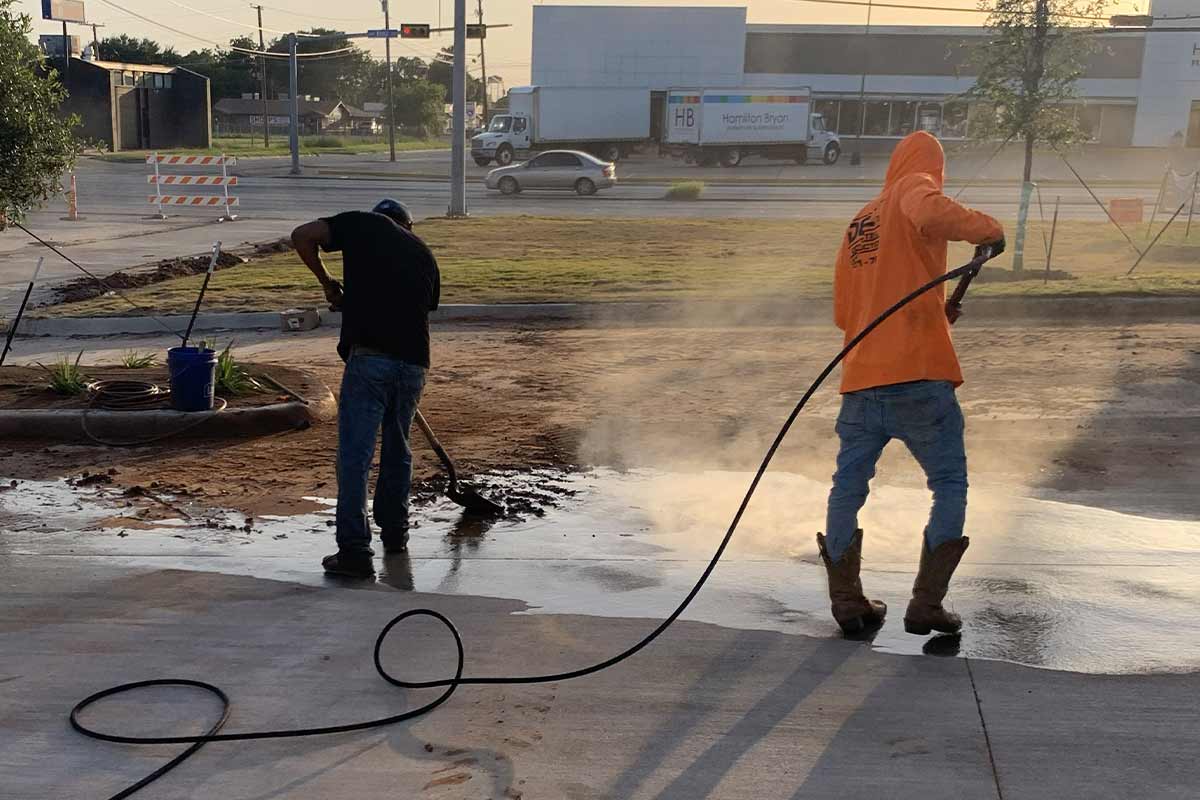
What We Remove
A lot that looks neglected costs a tenant conversation, and most of what makes it look neglected sits on the surface rather than in the pavement.
Oil and transmission staining — Under the parking bays. The most common complaint on a commercial lot, and the most stubborn to lift.
Tire marking and rubber scuff — Builds up in the turning lanes and at the entrances, where vehicles brake and steer.
Gum — Welds itself to concrete walkways and entry aprons.
Organic growth — Algae, mold and mildew, which thrive in a humid Gulf Coast climate anywhere the pavement stays shaded and damp. A slip hazard as well as a stain.
Everything else the surface collects — Bird and pest fouling under canopies and light poles, dirt and silt film after a wet season, spilled paint and drink stains near retail entrances, and the general gray haze that makes a five-year-old lot read as a fifteen-year-old one.
Power washing and pressure washing are the same service under two names. We use the pressure term throughout because that is what our customers search for, but if your maintenance contract says power washing, it is this.
Wash Water, Storm Drains, and Why It Matters
Here is the part almost nobody in this trade puts on their website, and it is the part that can land a property owner in an awkward conversation.
Wash water from a parking lot is not clean water. By the time it leaves the surface it carries oil, grease, sediment, rubber and whatever detergent was used. A storm drain is not a treatment system — it is a conveyance that discharges to local waterways, largely untreated.
In Texas, stormwater discharge permitting is administered by the Texas Commission on Environmental Quality through the Texas Pollutant Discharge Elimination System. Municipal storm sewers are permitted as Municipal Separate Storm Sewer Systems — the MS4 program, TCEQ permit TXR040000 — alongside separate general permits covering industrial facilities and construction sites. The equivalent federal program is the EPA’s National Pollutant Discharge Elimination System.
What that means practically: the inlet in your parking lot belongs to a permitted system, and the operator of that system has an interest in what goes into it. Requirements for non-stormwater discharges vary by municipality across our four counties, so the right question before a wash is not “can we?” but “what does this jurisdiction require?”
Our default is containment. We block or protect inlets before work starts, capture wash water, recover it, and dispose of it appropriately rather than letting it run to the nearest grate. On sites where full containment is impractical we say so before the job rather than after.
Washing Before Restriping
Sequence matters more than most property managers expect, and getting it backwards wastes the striping budget.
Paint bonds to clean, dry pavement. Laying traffic paint over oil film, algae or embedded dirt produces lines that look fine for a week and then lift, peel or ghost. If a lot needs both services, the wash comes first and the surface gets time to dry properly before layout — which in a humid Houston summer means planning for it rather than assuming it.
The other direction is worth knowing too. Pressure washing an already-striped lot is routine maintenance and does not have to damage the markings, provided pressure and technique are matched to the paint’s age and condition. Fresh markings and heavily weathered ones both need a lighter hand.
When we quote both services together we build the drying window into the schedule as a line item, not as an assumption.
Areas We Serve
We pressure wash commercial pavement across Harris, Montgomery, Waller and Fort Bend counties — Cypress, Katy, Tomball, Spring, northwest Houston, The Woodlands, Conroe, Magnolia, Brookshire, Pattison and Fulshear. Retail centers, restaurant lots, medical offices, apartment and HOA properties, parking structures and industrial aprons all come through, and most of them are washing to protect an appearance standard or to prepare for striping.
For a full list of our pavement marking services, visit our parking lot striping in Northwest Houston page.
Businesses We Serve




How it Works

GET A FREE ESTIMATE
Contact us today and we’ll have a quote to you in 24 hours

SCHEDULE AN INSTALLATION
We’ll have your installation scheduled in less than 7 days, without affecting your business hours

GET A PARKING LOT THAT POPS
For a budget-friendly price, you’ll get a parking lot that looks like new
We proudly work with:


We proudly work with:
Frequently Asked Questions About Parking Lot Pressure Washing in Northwest Houston, TX
Do you need a permit to pressure wash in Texas?
There is no single statewide pressure-washing permit. What is regulated is the discharge — where the wash water ends up. Municipal storm sewers in Texas operate under TCEQ’s MS4 stormwater permit program, and individual municipalities set their own requirements for non-stormwater discharges into those systems. Requirements differ across the cities and counties we cover, so we check what applies at your address before we schedule.
What do you need to pressure wash a parking lot?
Water supply, power, access to the area with vehicles cleared, and a plan for the wash water. The last one is the one that separates a professional job from a hose-and-hope job — inlet protection, capture and recovery equipment. From your side, we need the area free of parked cars, access to a water source if one is available on site, and a window that suits your operating hours.
Where does the wash water go?
Not into the storm drain if we are doing it properly. We protect inlets, contain and recover the wash water, and dispose of it appropriately. The reason is simple: a storm drain conveys to local waterways rather than to treatment, and your parking-lot runoff carries oil, sediment, rubber and detergent. TCEQ administers stormwater discharge permitting in Texas through TPDES, and municipal systems are permitted under the MS4 program. Very few pressure-washing quotes mention any of this, and it is worth asking whoever you hire what their plan is.
Which stains come out, and which don’t?
Surface contamination generally comes out: tire marking, gum, algae and mold, dirt film, bird fouling, most drink and food staining. Fresh oil comes out well. Old oil that has penetrated deep into asphalt binder is a different matter — pressure alone will lift the surface layer and leave a shadow, because the staining is in the material rather than on it. Rust and some chemical staining on concrete may lighten rather than disappear. We will tell you which category your problem areas fall into when we walk the site.
Is pressure washing safe for existing striping?
Yes, when the pressure and technique are matched to the markings. Sound, cured traffic paint handles a properly executed commercial wash. Very fresh paint and badly weathered paint both need lower pressure and a wider fan. Where markings are already failing, washing will accelerate what was going to happen anyway — which is often a useful signal that the lot is due a restripe.
Should the lot be washed before restriping?
If both are on the list, yes, and in that order. Traffic paint bonds to clean, dry pavement; oil film, algae and embedded dirt are the most common reasons new lines fail early. The one thing to plan for is drying time — a washed lot in a humid Houston summer needs a real window before layout, and squeezing it is how you get paint that ghosts within a season.
How often should a commercial lot be washed?
It depends on what the lot carries and what standard you are holding it to. Restaurant and grocery frontage, drive-throughs and high-traffic retail entrances collect staining fastest. Shaded and damp areas grow algae year-round in this climate. Office and industrial lots with steady, lighter traffic go much longer. Rather than a calendar, use the lot itself: visible staining at the entrances, dark growth in the shaded runs, or a surface that has gone gray are all cues.