Wheel Stop Installation
In West Fort Worth, TX
Concrete and Rubber Parking Stops
1-800-STRIPER provides professional wheel stop installation in West Fort Worth, TX — anchoring concrete, recycled-rubber, and plastic-composite wheel stops at stall heads to protect sidewalks, storefronts, and ADA accessible routes for commercial properties throughout Tarrant and Parker counties.
1-800-STRIPER® of West Fort Worth PROVIDes Wheel Stops Services NEAR YOU
Need to protect vehicles or walls from accidental damage?
Wheel stops (also called parking blocks) protect your property, enhance safety, and improve parking lot organization.
Benefits:
Wheel stops prevent vehicles from parking too far into a space or overextending into other spots, pedestrian walkways, and other areas, while also helping with vehicle alignment. They can prevent damage to buildings, curbs, or landscaping. Wheel stops also serve as clear visual cues for proper parking and are sometimes used on slopes to prevent cars from rolling.
What Wheel Stops Do for Your Property
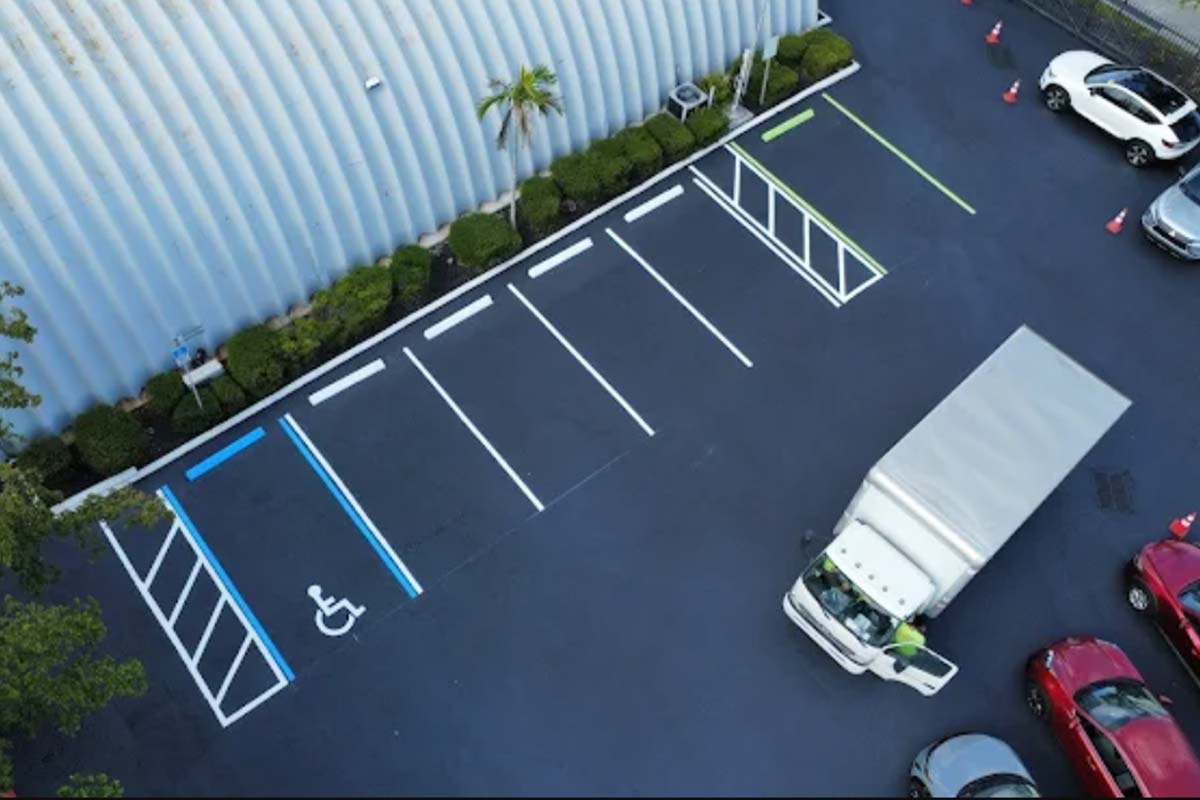
Wheel stops are the parking blocks set at the head of each stall that stop a vehicle before its front end goes where it shouldn’t. They protect sidewalks, storefront glass, building façades, and landscaping from the slow grind of front-bumper overhang. On a busy commercial lot in West Fort Worth, that overhang adds up fast — a few inches of creep per car, hundreds of cars a day.
The protection that matters most is the ADA accessible route. When a vehicle parks nose-in without a stop, its front overhang can intrude on the clear width of the path that wheelchair users need to reach the building entrance. A correctly placed wheel stop holds the vehicle back so the accessible route stays open and compliant with the 2010 ADA Standards for Accessible Design.
Wheel stops also do quiet day-to-day work owners notice only when it’s missing. They keep cars off curb landscaping, protect irrigation heads and storefront columns, and cue drivers on where the stall ends. For property managers across Aledo, Weatherford, and Benbrook, that means fewer repair calls and a lot that looks managed.
Which Wheel Stop Material Is Right for North Texas
There are three common wheel stop materials, and the right one depends on your lot’s traffic, budget, and how hard you want it to hold up to the North Texas climate. Concrete is the heaviest and cheapest. Recycled rubber and plastic-composite cost more upfront but shrug off the freeze-thaw and heat cycling that crack rigid concrete over time.
That climate factor is the one most owners underestimate. Concrete wheel stops in this region sit through winter freeze-thaw cycles and brutal summer pavement heat, and rigid concrete cracks, spalls, and chips under that stress as it ages. Recycled-rubber and composite stops flex instead of fracture, which is exactly why they’ve become the durable choice on lots where a crew won’t be back to replace a cracked block for years.
| Material | Weight | Cost | Durability in TX climate |
|---|---|---|---|
| Concrete | Heavy, rigid | Lowest | Can crack/spall under freeze-thaw + summer heat |
| Recycled rubber | Lighter, flexible | Mid | Won’t crack or chip; absorbs impact |
| Plastic-composite | Lightweight | Mid–higher | UV-stable; resists fading and cracking |
For low-turnover lots where first cost rules, concrete still makes sense. For high-traffic retail, medical, and HOA properties where you’d rather not re-block a row in five years, recycled rubber or plastic-composite is usually the better cost-per-year call. We’ll walk through the trade-off during the free estimate.
How We Install and Anchor Wheel Stops
When 1-800-STRIPER installs wheel stops, the work is straightforward — but anchoring and placement are where a job either lasts or works loose by the next season. Anchoring depends on the surface: asphalt takes driven rebar pins or steel spikes through the block, while concrete takes epoxy-set or through-bolted anchors. Get the anchor wrong and the stop walks out of position the first time a delivery truck clips it.
Placement is the other half of the job, and it’s governed by code. We set each stop back from the curb or wall far enough that a parked vehicle’s front overhang doesn’t intrude on the required accessible-route clear width per §403 of the 2010 ADA Standards for Accessible Design. In Texas, that accessible-route layer is also governed by the 2012 Texas Accessibility Standards, which we verify against on every lot in this market.
Here’s the process we follow on a typical West Fort Worth installation:
- Layout and measure. We mark each stop’s position at the stall head, measuring setback so front overhang stays clear of the accessible route and adjacent walkways.
- Surface check. We confirm whether each anchor point lands in asphalt or concrete, since that decides the anchor type and bit.
- Drill anchor points. Two anchor holes per stop, drilled to depth for the pin or bolt the surface calls for.
- Set and anchor. Asphalt gets driven rebar pins or spikes; concrete gets epoxy-set or bolted anchors seated flush and tight.
- Verify and clean up. We confirm each stop is square, level, and immovable, then clear debris so the lot is ready for traffic.
For larger lots — distribution centers, big-box retail, medical campuses across Parker and Johnson counties — we stage the work row by row so the property stays open while we install. To get a stall-by-stall plan and a free estimate, call (682) 262-7612 and we’ll come measure your lot.
For a full list of our pavement marking services, visit our parking lot striping in West Fort Worth page.
Businesses We Serve




How it Works

GET A FREE ESTIMATE
Contact us today and we’ll have a quote to you in 24 hours

SCHEDULE AN INSTALLATION
We’ll have your installation scheduled restriped in less than 7 days, without affecting your business hours

GET A PARKING LOT THAT POPS
For a budget-friendly price, you’ll get a parking lot that looks like new
We proudly work with:


We proudly work with:

Frequently Asked Questions About Wheel Stop Installation in West Fort Worth, TX
How far back from the curb should a wheel stop be installed?
Setback isn’t a fixed number — it’s measured so a parked vehicle’s front overhang stays clear of the accessible route, sidewalk, and any wall behind the stall. We measure each stall head against §403 of the 2010 ADA Standards for Accessible Design and the 2012 Texas Accessibility Standards to confirm the route’s clear width is preserved. On most stalls that lands the stop a couple of feet off the curb face, but we verify it per lot rather than assume.
Are concrete or rubber wheel stops better for the West Fort Worth climate?
It depends on how long you want them to last without re-blocking. Concrete is cheapest upfront, but North Texas freeze-thaw cycles and summer pavement heat crack and spall rigid concrete over the years. Recycled-rubber and plastic-composite stops flex and stay UV-stable instead of fracturing, so they hold up far better on lots that see heavy traffic or that you won’t revisit soon. For low-turnover lots on a tight first budget, concrete still works fine.
How do you anchor wheel stops so they don’t move?
The surface decides the anchor. In asphalt, we drive rebar pins or steel spikes through the block into the pavement. In concrete, we use epoxy-set or through-bolted anchors so the stop can’t walk or rock loose. Two anchor points per stop is standard, drilled to the depth the surface requires. Done right, the stop stays square and immovable even when a delivery truck nudges it.
Will wheel stops help keep my parking lot ADA compliant?
Yes — a correctly placed wheel stop is part of keeping the accessible route clear. Without a stop, a nose-in vehicle’s front overhang can creep into the path width that wheelchair users need to reach the entrance. By holding vehicles back, the stop preserves the clear width the 2010 ADA Standards for Accessible Design and the 2012 Texas Accessibility Standards require. We measure placement against both on every install so compliance isn’t left to chance.
What’s the difference between plastic-composite and rubber wheel stops?
Both are lighter than concrete and both resist cracking, but they’re built differently. Recycled rubber is flexible and absorbs impact well, which makes it a good fit for lots with heavy or careless traffic. Plastic-composite is the lightest option and is engineered to be UV-stable, so it resists fading and brittleness under constant Texas sun. Between the two, the choice usually comes down to impact tolerance versus long-term UV exposure on your specific lot.
Do you install wheel stops outside the city of Fort Worth?
Yes. We install across western Tarrant County and out into Parker, Johnson, and Hood counties and the surrounding North Texas area. That covers Aledo, Weatherford, Willow Park, Hudson Oaks, Granbury, Cleburne, Azle, and Benbrook. Whether it’s a single retail strip or a multi-row distribution lot, we’ll come measure the property and lay out a wheel stop plan that fits the traffic and the surface you’ve got.