Fire Lane Striping
In West Fort Worth, TX
Code-Compliant Fire Lane Markings
1-800-STRIPER provides professional fire lane striping in West Fort Worth, TX — marking compliant fire lanes, curbs, and no-parking zones per the International Fire Code (IFC), adopted by the City of Fort Worth (Fort Worth Code §13-1), for commercial properties throughout Tarrant and Parker counties.
1-800-STRIPER® of West Fort Worth PROVIDes Fire Lane Striping Services NEAR YOU
Is your parking lot ready for first responders?
Our team is well-versed in local fire regulations and will parter with you to design a fire lane striping plan that creates unobstructed emergency access to protect your customers and property.
Core Services:
What Makes a Fire Lane Compliant in West Fort Worth
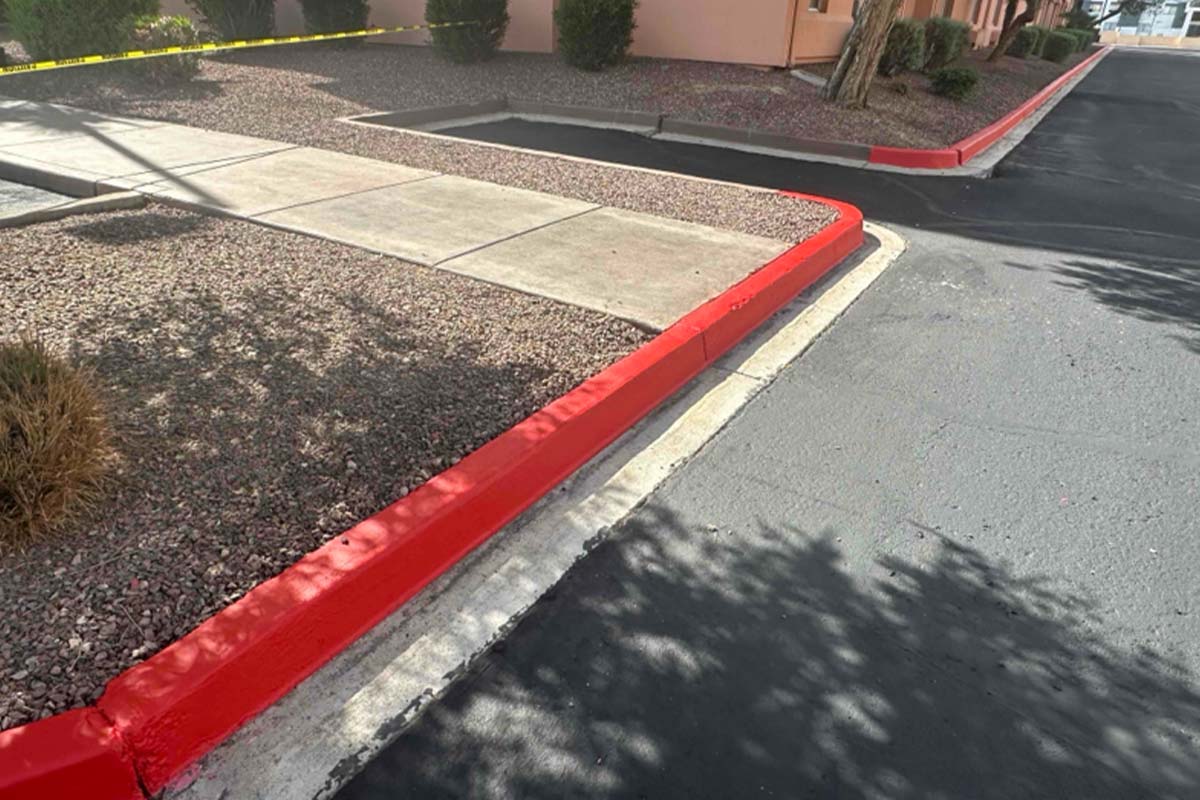
A compliant fire lane comes down to three visible parts — a red-painted curb, the words “FIRE LANE — NO PARKING” stenciled where drivers can read them, and enough unobstructed width for a fire truck to pass. Get any one of those wrong and the fire marshal can fail the inspection. We mark all three to the standard your authority enforces, not to a generic template.
The red curb is the baseline. We paint the full vertical face and top of the curb red along the entire designated fire lane, then add white block lettering that reads “FIRE LANE — NO PARKING.” Most local fire codes call for lettering at least 3 inches tall, repeated at intervals of roughly 25 to 50 feet so the message stays visible no matter where a driver stops. Where there is no curb, we stripe a red boundary line on the pavement and place the same lettering inside it.
Spacing and legibility are what inspectors actually check. Faded letters, gaps longer than the code allows, or lettering too small to read from a moving vehicle are the most common reasons a lot fails reinspection. 1-800-STRIPER lays out every fire lane against the spacing and height your jurisdiction adopted, so the marking passes the first walkthrough instead of the second.
How Wide and Tall a Fire Apparatus Access Road Must Be
Fire lanes are not just paint — they protect a clear path for the fire truck itself, and the International Fire Code sets hard minimums. Under IFC §503, a fire apparatus access road must have an unobstructed width of at least 20 feet and an unobstructed vertical clearance of at least 13 feet 6 inches. Those numbers exist because a pumper or ladder truck needs room to drive, set up, and deploy without clipping a parked car or a low awning.
Width is measured edge to edge of the usable driving surface, and parked vehicles, dumpsters, planters, and bollards all count against it. If a 24-foot drive aisle has cars parked along one side, the remaining 16 feet no longer meets the 20-foot minimum — which is exactly why the no-parking striping matters. The marking is what keeps that 20 feet open in practice, not just on the site plan.
Vertical clearance trips up properties with canopies, drive-through structures, and parking decks. The 13-foot-6-inch minimum applies the full width of the access road, so a low sign or a sagging banner inside the fire lane is a violation even if the pavement below is clear. We mark the ground-level boundary precisely so the access road stays defined, and we flag overhead obstructions we spot during layout so you can address them before the inspection.
Who Enforces Fire Lanes in Texas — Your Local AHJ
In Texas the authority that enforces your fire lane is the local city fire marshal or fire department, not the state. Texas has no single statewide fire code that applies to commercial parking lots. Instead, each city adopts its own edition of the International Fire Code by ordinance, and the fire marshal becomes the Authority Having Jurisdiction — the AHJ — who interprets and enforces it. That means the rules for your lot are set by the city your property sits in.
For most of West Fort Worth, the operative document is the Fort Worth Fire Code, which is the city’s locally adopted and amended edition of the IFC. It governs fire lane width, marking, lettering, and the penalties for non-compliance inside Fort Worth city limits. The amendments matter — a city can tighten the base IFC, so the exact lettering interval or curb-paint detail can differ from the unamended national text. We mark to the adopted local edition, not the generic one.
The served towns around Fort Worth each run their own AHJ. Weatherford in Parker County, Granbury in Hood County, and Cleburne in Johnson County each adopt their own IFC edition through their own city fire marshal, and Aledo, Willow Park, Azle, Benbrook, Crowley, and Saginaw do the same. A fire lane that passes in Fort Worth may need a different lettering interval in Granbury. 1-800-STRIPER confirms the governing edition for your specific address before we stripe.
Paint vs. Thermoplastic for Fire Lane Curbs
For fire lane curbs and lettering, durability is the whole question — and the honest answer is that paint and thermoplastic each fit a different curb. Traffic paint goes down fast, cures in under two hours, and re-coats a faded curb cleanly, which makes it the practical choice for the vertical curb faces that make up most fire lanes. Thermoplastic, applied hot and bonded to the surface, lasts far longer on flat pavement but does not adhere well to a vertical curb face, so it is rarely the right tool for curb red.
That is why fire lane work splits by surface. We use Graco airless line stripers with Sherwin-Williams traffic paint for the red curb faces and the “FIRE LANE — NO PARKING” lettering, where the surface is vertical and re-coatability matters. For pavement-level fire lane boundary lines on long flat runs that take heavy tire wear, thermoplastic becomes worth the cost because it can outlast paint by several years before it needs replacement.
Under the North Texas sun the trade-off tilts toward shorter repaint cycles regardless of material. High UV exposure fades red pigment faster than white or yellow, so a fire lane curb in West Fort Worth typically needs a fresh coat every 12 to 24 months to stay legible — sooner on south-facing curbs that bake all afternoon. We size the material to the curb and the traffic so you are not repainting before you have to, and not failing an inspection because the red has gone pink.
How We Stripe a Fire Lane
Our fire lane work follows a five-step process built to pass the AHJ inspection on the first walkthrough.
- Code confirmation. We identify the AHJ for your address — Fort Worth Fire Code inside city limits, or the adopting city’s edition for Weatherford, Granbury, Cleburne, and the surrounding towns — and pull the governing fire lane spec for lettering height, interval, and curb detail.
- Layout and measurement. We walk the designated fire lane, confirm the access road holds the IFC §503 minimum 20-foot unobstructed width, note any overhead clearance issues against the 13-foot-6-inch minimum, and chalk the curb runs and lettering positions.
- Surface prep. We power-sweep the curb and pavement and pressure-wash oil-stained or heavily soiled sections. Red curb paint and lettering only bond to a clean, dry surface — skipping prep is the top cause of early peeling.
- Paint application. Graco airless stripers lay the red curb face and top, then we stencil “FIRE LANE — NO PARKING” in white block letters at the code-required height and interval. Pavement boundary lines go down in the same pass where the lane has no curb.
- Cure and reopen. Traffic paint sets to touch in about 30 minutes and is traffic-ready in 60 to 90 minutes depending on temperature, so most fire lanes reopen the same day.
For larger campuses — medical complexes, distribution centers, and multi-building retail — we section the work so the rest of the property stays open while the active fire lane cures.
Why Fire Lane Marking Is Worth Doing Right
A correctly marked fire lane does two jobs — it keeps the access road clear for a fire truck, and it keeps your property out of citation range. Both matter, and both come down to legible, code-compliant paint. A faded curb or a missing stencil is the kind of detail a fire marshal writes up on a routine inspection, and the fix is far cheaper than carrying the violation.
The life-safety side is the reason the codes exist. The fire-apparatus access requirements in the IFC are written so a responding crew can reach a building and deploy without a parked car blocking the path. The national framework for fire-apparatus access comes from the National Fire Protection Association, and your city’s adopted IFC turns that framework into the enforceable local rule. Clear striping is what makes the standard real on the ground instead of a line on a plan.
Re-marking on a schedule is the practical takeaway. Because North Texas UV fades red pigment fast, the smart move is a standing repaint cadence rather than waiting for a failed inspection to force the issue. To set that up for a property in Tarrant, Parker, Johnson, or Hood county, call 1-800-STRIPER at (682) 262-7612 for a free estimate and a marking plan matched to your local AHJ.
For a full list of our pavement marking services, visit our parking lot striping in West Fort Worth page.
Businesses We Serve




How it Works

GET A FREE ESTIMATE
Contact us today and we’ll have a quote to you in 24 hours

SCHEDULE AN INSTALLATION
We’ll have your installation scheduled in less than 7 days, without affecting your business hours

GET A PARKING LOT THAT POPS
For a budget-friendly price, you’ll get a parking lot that looks like new
We proudly work with:


We proudly work with:

Frequently Asked Questions About Fire Lane Striping in West Fort Worth, TX
How tall does fire lane lettering have to be in West Fort Worth?
Most adopted fire codes in the area call for “FIRE LANE — NO PARKING” lettering at least 3 inches tall in white block letters on a red curb or red boundary line, repeated roughly every 25 to 50 feet. The exact height and interval depend on your city’s adopted IFC edition, since Fort Worth and the surrounding towns each amend the base code. We confirm the governing spec for your address before striping so the marking passes inspection.
How wide does a fire lane have to be?
The International Fire Code §503 sets the minimum at 20 feet of unobstructed width for a fire apparatus access road, measured across the usable driving surface. Parked vehicles, dumpsters, and bollards all count against that width, which is why the no-parking striping matters — it keeps the full 20 feet open in practice. There is also a 13-foot-6-inch minimum vertical clearance for the truck. We confirm both during layout.
Who enforces fire lanes in Fort Worth and the surrounding towns?
Your local city fire marshal is the Authority Having Jurisdiction. Texas has no single statewide fire code, so each city adopts its own edition of the IFC by ordinance. Inside Fort Worth, the Fort Worth Fire Code governs; in Weatherford, Granbury, Cleburne, Aledo, and Azle, the city’s own adopted edition applies through its own fire marshal. We confirm which authority governs your specific address.
How often should fire lane curbs be repainted in North Texas?
Plan on a fresh coat every 12 to 24 months for a fire lane curb in the West Fort Worth area. High UV exposure fades red pigment faster than white or yellow, so south-facing curbs that take full afternoon sun often need repainting toward the shorter end of that range. A faded curb that has gone from red to pink, or lettering you can no longer read from a moving vehicle, is the signal it is time — and the signal a fire marshal looks for too.
Should I use paint or thermoplastic on my fire lane?
For the red curb faces and “FIRE LANE — NO PARKING” lettering that make up most fire lanes, traffic paint is the practical choice — it bonds to vertical curb surfaces, re-coats faded curbs cleanly, and cures fast. Thermoplastic does not adhere well to vertical curbs, so it is reserved for long flat pavement boundary lines that take heavy tire wear and benefit from a longer life. We match the material to each surface during the estimate.
Can you stripe fire lanes without closing the whole property?
Yes. Traffic paint is traffic-ready in 60 to 90 minutes depending on temperature, so most single fire lanes reopen the same day. On larger sites — medical complexes, distribution centers, multi-building retail — we section the work and stripe one access road at a time, coning off the active section so the rest of the property stays open. For after-hours needs, early-morning and evening starts are both options.