
Parking Lot Layout Design
In West Fort Worth, TX
Customized Parking Lot Layouts
1-800-STRIPER provides professional parking lot layout design in West Fort Worth, TX — custom-engineered layouts that maximize parking capacity, ensure ADA compliance per the 2010 ADA Standards for Accessible Design, and meet MUTCD pavement marking specifications using Graco LineLazer precision striping equipment.
1-800-STRIPER® of West Fort Worth PROVIDes New Layouts Services NEAR YOU
Are you ready to create a great first impression?
A proper parking lot layout with clear markings is critical for any business that serves the public. Let us help you make a great first impression with an attractive, well-organized, and safe parking lot.
Benefits:
The Three Constraints Every Layout Has to Balance
Good parking lot layout balances three competing constraints — stall count, traffic flow, and accessibility — inside the fixed boundary of your existing lot footprint. Push one too hard and the other two suffer. A layout that crams in maximum stalls but starves the drive aisles will gridlock at peak hours; a layout that flows beautifully but skips an accessible-route requirement will fail inspection. The job is to find the arrangement that serves all three at once.
Stall count is driven by lot geometry and by your local zoning code’s minimum parking-ratio requirements. Tarrant County and Parker County suburban codes around Aledo, Weatherford, and Benbrook generally require 4 to 5 stalls per 1,000 square feet of retail space, 3 to 4 per 1,000 square feet of medical-office space, and 1 stall per dwelling unit plus visitor allotment for residential. We design to the ratio your jurisdiction enforces, then fit as many compliant stalls as the footprint allows.
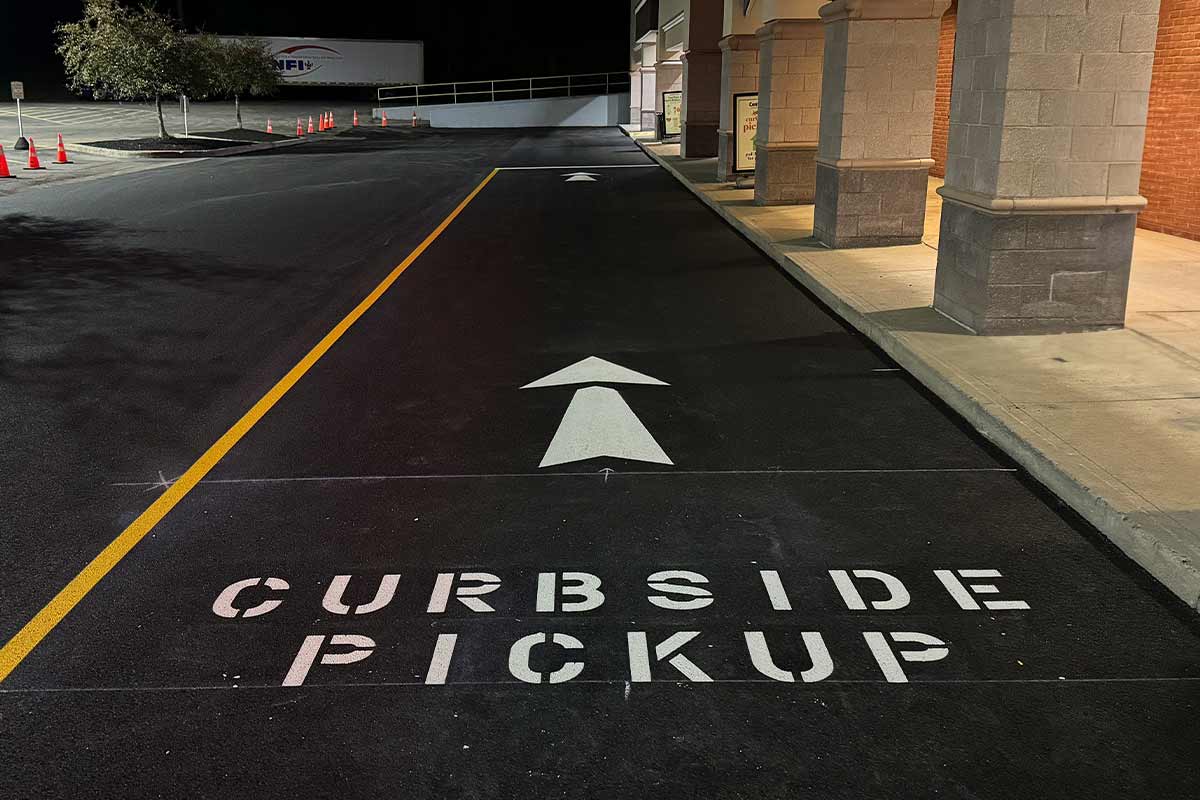
Traffic flow is the difference between a lot that fills smoothly and one where drivers double back hunting for the next open aisle. One-way circulation, clear directional arrows, and a logical entry-to-exit path keep cars moving and cut the vehicle-pedestrian conflict points that turn a busy lot into a fender-bender magnet. Accessibility is the third constraint, and it is not negotiable — it is fixed by federal and Texas code, which the next two sections cover in detail.
Stall Geometry and Drive-Aisle Widths
Stall geometry starts from a standard stall roughly 9 feet wide by 18 feet deep, then varies by the parking angle you choose. The angle decision is the single biggest lever on how many cars fit and how traffic moves. A 90-degree layout maximizes total capacity for a given lot area and supports two-way drive aisles; 60-degree and 45-degree angled layouts trade roughly 10 to 15 percent of that capacity for easier one-way flow on narrow or oddly shaped lots, because angled stalls are quicker to pull into and pull out of.
Drive-aisle width is set by the stall angle. A 90-degree two-way aisle needs about 24 feet of clear width so two cars can pass while a third backs out; a one-way angled aisle can drop to roughly 18 feet because traffic only moves one direction and the angle reduces the backing distance. Under-width aisles violate local zoning and create the conflict points that lead to scrapes and blocked lanes. The table below summarizes the standard tradeoffs we work from.
| Layout angle | Drive-aisle width | Traffic flow | Relative capacity |
|---|---|---|---|
| 90° (perpendicular) | ~24 ft, two-way | Two-way | Highest |
| 60° angled | ~18 ft, one-way | One-way | ~10% lower |
| 45° angled | ~18 ft, one-way | One-way | ~15% lower |
For a tight infill lot in Willow Park or Hudson Oaks, the angled one-way option often recovers usable space that a 90-degree grid would waste on oversized aisles. For a big-box pad in Granbury or Cleburne with room to spare, 90-degree perpendicular stalls win on raw count. We model both against your footprint before recommending one.
ADA and Texas Accessibility Requirements
Accessibility is governed first by the 2010 ADA Standards for Accessible Design, and your designed layout has to clear it before anything else. Section 208 sets the accessible-stall count by total lot size: 1 accessible stall for 1 to 25 total spaces, 2 for 26 to 50, 3 for 51 to 75, 4 for 76 to 100, and climbing on the published schedule for larger lots. Section 502 fixes the dimensions — a standard accessible stall pairs a 96-inch-wide stall with a 60-inch access aisle, while a van-accessible stall uses a 132-inch stall with a 60-inch aisle, or a 96-inch stall with a 96-inch aisle. At least one in every six accessible stalls must be van-accessible.
Placement is just as regulated as count. Section 206.2 requires accessible stalls to sit on the shortest accessible route to the building entrance — not parked at the back of the lot to keep the front rows full. A layout that meets the count but puts the accessible stalls 200 feet from the door still fails, so we place them at the accessible entrance and run a compliant route, free of curbs and steep slopes, straight to it.
Texas adds a state layer on top of the federal floor. The 2012 Texas Accessibility Standards, administered by the Texas Department of Licensing and Regulation, govern accessibility for most building and parking projects in the state and apply alongside the federal standards. For projects that trip the review threshold, the TAS path can require a registered accessibility specialist to review the plans, so we design accessible parking to satisfy both the 2010 ADA Standards and the 2012 Texas Accessibility Standards from the first draft rather than reworking a layout after a TDLR flag.
Fire-Lane Access and Texas Pavement-Marking Standards
A layout that ignores the fire marshal will not get built, so fire-apparatus access is a constraint we design around from the start. Under the International Fire Code adopted across Tarrant, Parker, Johnson, and Hood counties, a fire-apparatus access road must keep an unobstructed width of at least 20 feet, and the layout has to preserve the apparatus turning radius the fire marshal requires at corners and dead ends. That means the stall grid and drive aisles get arranged so a ladder truck can reach the building and swing through without a parked car in the way — fire lanes get curb-painted and signed so they stay clear.
Pavement markings follow the Texas Manual on Uniform Traffic Control Devices, the TxDOT-administered Texas edition of the national MUTCD. The TMUTCD governs line widths, directional arrows, stop bars, crosswalk markings, and the standard colors — white for stall and lane lines, yellow for two-way separation and curbs, blue reserved for accessible-stall markings and the International Symbol of Accessibility. We specify every mark on the striping plan to the TMUTCD so the finished lot reads clearly to drivers and holds up to inspection.
Our layout work runs from field survey to install-ready striping plan in four steps:
- Site survey. We field-measure the existing lot footprint, drive-aisle widths, entry and exit points, the accessible route from stalls to the building entrance, and any adjacent traffic-control devices already on site.
- CAD layout. We place stalls in CAD, run the traffic-flow analysis for one-way versus two-way aisles and arrow placement, and locate accessible stalls on the shortest accessible route per §206.2.
- Striping plan. We mark up paint specifications to TMUTCD standards — line widths, fire-lane curb paint, directional arrows, stop bars, and the ISA symbol in each accessible stall.
- Installation. We chalk-line the layout from the CAD plan and apply it with Graco LineLazer equipment and Sherwin-Williams traffic paint, verifying every ADA dimension against the plan before paint goes down.
To start a layout design for a property anywhere from Azle to Granbury, call 1-800-STRIPER at (682) 262-7612 for a free estimate, and our West Fort Worth team will walk the lot with you.
For a full list of our pavement marking services, visit our parking lot striping in West Fort Worth page.
Businesses We Serve




How it Works

GET A FREE ESTIMATE
Contact us today and we’ll have a quote to you in 24 hours

SCHEDULE AN INSTALLATION
We’ll have your installation scheduled in less than 7 days, without affecting your business hours

GET A PARKING LOT THAT POPS
For a budget-friendly price, you’ll get a parking lot that looks like new
We proudly work with:


We proudly work with:


Frequently Asked Questions About Parking Lot Layout Design in West Fort Worth, TX
What is the standard parking stall size for a commercial lot?
A standard commercial stall runs roughly 9 feet wide by 18 feet deep, which fits the typical passenger vehicle with room to open doors. The exact figure can shift with your local zoning code and the parking angle you choose, since angled stalls measure differently along the aisle. Accessible stalls follow separate, larger dimensions set by the 2010 ADA Standards for Accessible Design — 96 inches wide for a standard accessible stall, with a 60-inch access aisle alongside.
How many accessible parking spaces does my lot need?
The count is set by Section 208 of the 2010 ADA Standards based on your total stall count: 1 accessible stall for the first 1 to 25 spaces, 2 for 26 to 50, 3 for 51 to 75, 4 for 76 to 100, and more on the published schedule as the lot grows. At least one in every six accessible stalls must be van-accessible. In Texas, the 2012 Texas Accessibility Standards apply on top of the federal count, so we design to both.
Does 90-degree or angled parking fit more cars?
A 90-degree perpendicular layout fits the most cars for a given lot area and supports two-way drive aisles, so it wins on raw capacity when the footprint has room. Angled layouts at 60 or 45 degrees give up about 10 to 15 percent of that capacity in exchange for easier one-way flow and quicker, safer parking on narrow lots. The right answer depends on your lot shape and how traffic needs to move, which is exactly what the CAD layout step works out.
How wide do parking lot drive aisles need to be?
A two-way drive aisle serving 90-degree stalls needs roughly 24 feet of clear width so cars can pass while another backs out. A one-way aisle serving angled stalls can drop to about 18 feet, since traffic moves in a single direction and the angle shortens the backing distance. Local zoning sets the enforceable minimum, and under-width aisles both violate code and create the conflict points that lead to scrapes and blocked lanes.
Do parking lots have to include a fire lane?
Yes. Under the International Fire Code adopted across Tarrant, Parker, Johnson, and Hood counties, fire-apparatus access roads must keep an unobstructed width of at least 20 feet, and the layout has to preserve the turning radius the fire marshal requires at corners and dead ends. Fire lanes get curb-painted and signed so they stay clear. We design the stall grid and aisles around fire access from the start so the plan clears the fire marshal the first time.
What rules govern parking lot pavement markings in Texas?
In Texas, pavement markings follow the Texas Manual on Uniform Traffic Control Devices, the TxDOT edition of the national MUTCD. It governs line widths, directional arrows, stop bars, crosswalk markings, and the standard colors — white for stall and lane lines, yellow for two-way separation and curbs, and blue for accessible-stall markings and the International Symbol of Accessibility. We specify every mark on the striping plan to the TMUTCD so the finished lot reads clearly and passes inspection.