Thermoplastic Striping
In West Fort Worth, TX
Long-Lasting Pavement Markings
1-800-STRIPER provides professional thermoplastic striping in West Fort Worth, TX — long-service-life pavement markings for stop bars, crosswalks, directional arrows, and fire lanes applied at roughly 400°F per AASHTO M249 specifications for high-traffic commercial lots across Tarrant and Parker counties.
1-800-STRIPER® of West Fort Worth PROVIDes Thermoplastics Services NEAR YOU
Want to reduce the maintenance requirements for your parking lot?
Thermoplastic pavement markings are a durable, weather and vehicle-resistant striping option for your parking lot or facility.
You can utilize them for stop bars, ADA stalls, no-parking zones, directional arrows, crosswalks, or your entire parking lot.
Benefits:
What Thermoplastic Striping Is
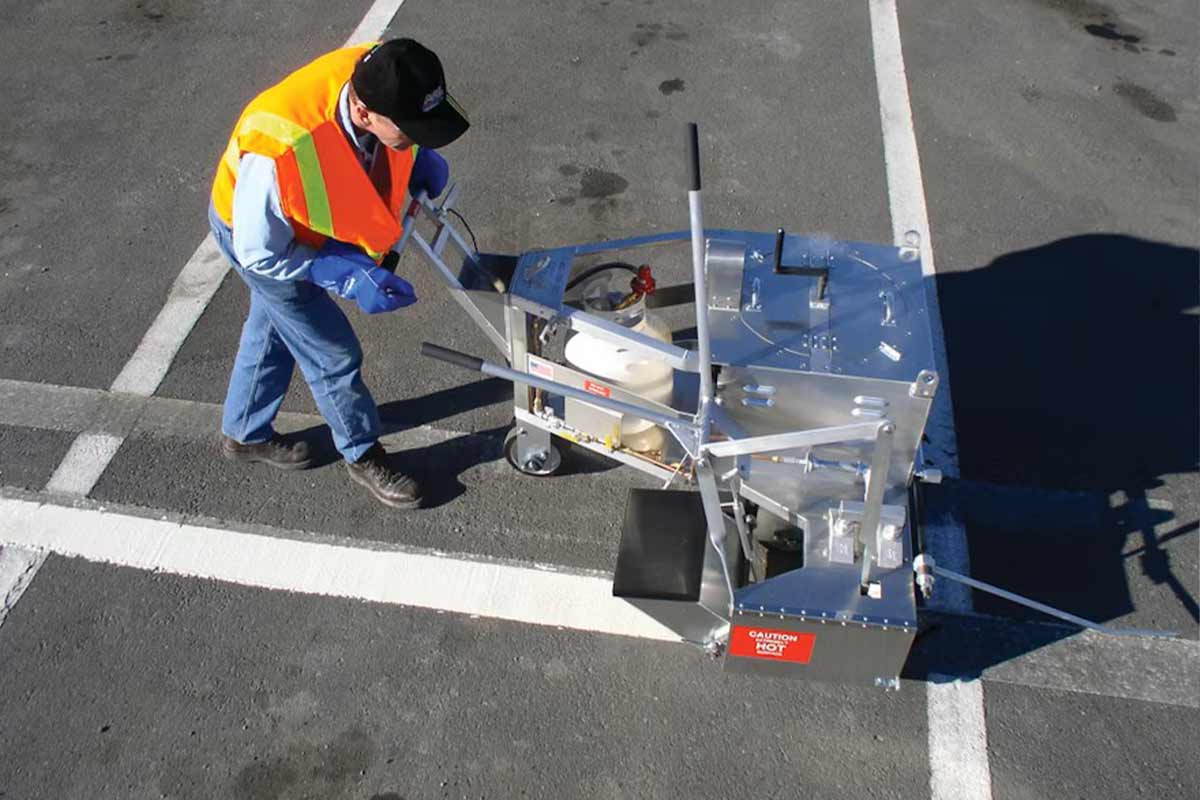
Thermoplastic striping is a hot-applied pavement marking that melts onto the asphalt and fuses with it instead of drying on top like paint. The material arrives as a dry, factory-formulated blend of resin, pigment, filler, and glass beads. A heated kettle melts that blend to roughly 400°F, and the molten compound is screeded, extruded, or sprayed onto the surface in a controlled thickness.
As the marking cools it sets into a hard, durable line that is mechanically bonded to the pavement. The AASHTO M249 standard governs the material itself — the resin chemistry, bead content, and heat-application properties — so a thermoplastic stop bar in West Fort Worth meets the same material spec a state highway crew works to. That is why thermoplastic is the standard choice for high-wear markings on commercial lots, distribution yards, and retail centers across Tarrant and Parker counties.
The factory-formulated bead content is what makes thermoplastic reflective at night. Glass beads are blended into the material and also dropped onto the surface as it sets, so the line keeps throwing light back at headlights long after the day-one finish. We match the thickness and bead load to the marking’s job — a fire lane edge takes a different spec than a parking stall border.
Thermoplastic vs. Paint — Which One Belongs On Your Lot
Thermoplastic outlasts paint by a wide margin, and that service-life gap is the whole reason to choose it. Traffic paint is fast, affordable, and right for a lot of work — but on a North Texas commercial lot it typically holds up for a season or two before UV, tire scrub, and summer heat fade it. Thermoplastic, applied to spec, holds its line and its retroreflectivity for multiple years on the same traffic load.
The trade-off is upfront effort versus cost-per-year. Paint goes down faster and costs less per linear foot on day one. Thermoplastic costs more to apply because it needs a heated kettle and a clean, warm, dry surface — but spread that cost across the years it lasts, and the cost-per-year on a high-traffic marking usually lands in thermoplastic’s favor. Here is how the two compare on the factors that decide it.
| Factor | Thermoplastic | Traffic Paint |
|---|---|---|
| Service life (high-traffic) | Multiple years | A season or two |
| Application | Hot melt, ~400°F | Cold spray, ambient |
| Retroreflectivity | Embedded + drop-on glass beads | Drop-on beads only, fades faster |
| Bond to pavement | Fuses / mechanically bonds | Surface film |
| Best fit | Stop bars, crosswalks, arrows, fire lanes | Stall fields, fast turnarounds, budget refresh |
| Cost-per-year | Lower over the life of the marking | Higher on high-wear markings |
The honest answer for most lots is a mix. We put thermoplastic where wear is highest and reflectivity matters most, and we keep paint in play for broad stall fields where a faster, lower-day-one-cost refresh makes sense. If you are weighing the two for a property in Aledo, Weatherford, Granbury, or anywhere across western Tarrant, Parker, Johnson, and Hood counties, the 1-800-STRIPER crew can walk the lot and lay out which markings earn thermoplastic — reach the West Fort Worth team at (682) 262-7612 for a free estimate.
Where Thermoplastic Fits Best
Thermoplastic belongs on the markings that take the most punishment and carry the most safety weight. Stop bars, crosswalks, directional arrows, and fire-lane markings all sit in wheel paths or at conflict points where vehicles brake, turn, and stop — exactly where paint wears off first. Putting the durable material there protects the markings that matter most for traffic flow and life-safety.
It is not always the right call for an entire stall field. A large lot of standard parking stalls may see far less wear per line, and a paint refresh can serve that area well at a lower day-one cost. We walk the lot, look at where traffic actually concentrates, and target thermoplastic to the high-value markings rather than blanket-coating the whole surface.
For markings that must meet a public-facing standard — crosswalks, stop bars, and lane arrows — we follow the conventions in the Texas Manual on Uniform Traffic Control Devices so the layout and symbol shapes read the way drivers expect. Consistency is what makes a marking work; a crosswalk has to look like a crosswalk from a moving vehicle.
How We Apply Thermoplastic
Our application follows a clear sequence built around the one thing thermoplastic demands — a clean, warm, dry surface to bond to. Here is the process from arrival to reopening.
- Surface assessment and cleaning. We sweep and clean the marking footprint to bare, sound pavement. Loose debris, dust, and oil all block the bond, so the prep here is not optional — it is the step that decides whether the line lasts years or fails early.
- Surface and temperature check. We confirm the pavement is dry and within the material’s temperature spec before any material goes down. Thermoplastic bonds to warm, dry pavement; a cold or damp substrate is a no-go regardless of the calendar.
- Heat the material. The thermoplastic compound is melted in a hot-melt kettle to roughly 400°F, the working range AASHTO M249 is written around.
- Apply by screed, extrude, or spray. We screed or extrude wide markings like stop bars and crosswalks, and spray thinner lines, controlling thickness to spec as the molten material lays down.
- Embed glass beads and cool. Drop-on glass beads are applied as the line sets, locking in retroreflectivity. The marking cools and hardens in minutes and is ready for traffic far faster than a long paint cure.
Because the material sets as it cools rather than drying over hours, a thermoplastic marking is typically trafficable quickly — a real advantage on lots that cannot stay closed long.
The Texas Summer Application Window
North Texas summer heat works in thermoplastic’s favor — warm pavement is exactly what the material wants to bond to. Thermoplastic fuses best to warm, dry pavement, and Tarrant and Parker county surface temperatures through the long Texas warm season sit comfortably in the favorable range. The summer pavement-temperature window is one of the better times of year to put thermoplastic down in West Fort Worth.
That said, warm weather alone does not clear the marking. The substrate still has to be clean and dry and within the material’s temperature spec at the moment of application — a sudden pop-up storm, morning dew, or a recently sealed surface can all push a job to another day. We check surface conditions on site rather than assuming the forecast, because a bond made on a damp or dirty surface is the most common reason a marking fails early.
Thickness and reflectivity are spec-driven, not eyeballed. TxDOT Item 666 Retroreflectorized Pavement Markings sets Texas requirements for retroreflectivity and marking thickness — including a 0.100-inch thickness for new thermoplastic — and we apply to those numbers. Meeting the thickness and the embedded-plus-drop-on bead load is what gives the finished line its night visibility and its multi-year service life.
For a full list of our pavement marking services, visit our parking lot striping in West Fort Worth page.
Businesses We Serve




How it Works

GET A FREE ESTIMATE
Contact us today and we’ll have a quote to you in 24 hours

SCHEDULE AN INSTALLATION
We’ll have your installation scheduled restriped in less than 7 days, without affecting your business hours

GET A PARKING LOT THAT POPS
For a budget-friendly price, you’ll get a parking lot that looks like new
We proudly work with:


We proudly work with:

Frequently Asked Questions About Thermoplastic Striping in West Fort Worth, TX
How long does thermoplastic striping last compared to paint?
On a high-traffic commercial lot, thermoplastic typically lasts multiple years where traffic paint often fades within a season or two. The durability comes from the material fusing to the pavement and from its thicker, harder line that resists tire scrub and UV. That longer service life is why thermoplastic usually wins on cost-per-year for stop bars, crosswalks, arrows, and fire lanes — the markings that take the most wear and matter most for safety.
Why is thermoplastic applied so hot?
Thermoplastic is a hot-applied material — it has to be melted to roughly 400°F so it flows onto the pavement and bonds as it cools. That heat-application property is part of the AASHTO M249 material spec the compound is formulated to. When the molten material meets clean, warm, dry pavement and then cools, it fuses into a hard, durable line rather than sitting on top as a surface film the way paint does, which is the source of its longer service life.
Is summer a good time to apply thermoplastic in West Fort Worth?
Yes — North Texas summer surface temperatures are favorable for thermoplastic, because the material bonds best to warm, dry pavement. The warm season across Tarrant and Parker counties puts pavement in a good range for application. The catch is that the surface still has to be clean and dry and within the material’s temperature spec at the moment of application, so we check site conditions directly rather than rely on the forecast.
What makes thermoplastic lines reflective at night?
Glass beads. Thermoplastic has beads blended into the material at the factory, and we also drop beads onto the surface as the line sets. Headlights strike those beads and bounce light back toward the driver, which is what makes the marking visible at night. TxDOT Item 666 sets the retroreflectivity minimums for Texas markings, and the embedded-plus-drop-on bead approach is how a properly applied line keeps meeting them as the surface wears.
Does my whole lot need thermoplastic?
Usually not. Thermoplastic earns its place on high-wear, high-value markings — stop bars, crosswalks, directional arrows, and fire lanes — where durability and reflectivity matter most. Broad fields of standard parking stalls often see less wear per line and can be served well by a paint refresh at a lower day-one cost. We walk the lot, find where traffic actually concentrates, and target thermoplastic where it pays off rather than blanket-coating everything.
How thick should thermoplastic markings be?
TxDOT Item 666 sets a 0.100-inch thickness for new thermoplastic pavement markings in Texas, and we apply to that spec. Thickness matters because it carries the embedded glass beads that provide night reflectivity and gives the line the body it needs to survive years of tire scrub and weather. Applying to the correct thickness, on a clean and properly heated surface, is what separates a marking that lasts from one that fails early.