ADA Parking Lot Striping
In West Fort Worth, TX
ADA-Compliant Accessible Parking
1-800-STRIPER provides ADA-compliant parking lot striping in West Fort Worth, TX — installing accessible spaces, van-accessible stalls, access aisles, ISA symbols, and required signage per the 2010 ADA Standards for Accessible Design and the 2012 Texas Accessibility Standards.
1-800-STRIPER® of West Fort Worth PROVIDes ADA Compliance Services NEAR YOU
Need to make your property more accessible?
Upgrade your facility to become fully ADA compliant by partnering with us to create clear, accessible parking for all your visitors.
Our ADA Compliant line striping services include:
How Many Accessible Stalls Does Your West Fort Worth Lot Need?
The number of accessible stalls is set by your total parking count, and it scales in fixed steps. Under the 2010 ADA Standards for Accessible Design §208, a lot with 1 to 25 total spaces needs one accessible stall, 26 to 50 spaces needs two, and 51 to 75 spaces needs three. After that the requirement climbs by one accessible stall for every additional 50 spaces — a rule most West Fort Worth property owners undercount on their own.
The detail that trips up retail and medical lots is the van-accessible share. For every six accessible stalls (or fraction of six), at least one must be van-accessible per §208.2.4. So a 200-space lot needs at least seven accessible stalls, and at least two of those must be van-accessible. We count your striped spaces, run the §208.2 table, and stripe exactly what your space total requires across markets like Aledo, Weatherford, Benbrook, and Saginaw.
The table below shows the minimums most West Fort Worth commercial lots fall into:
| Total spaces in lot | Min. accessible stalls (§208.2) | Min. van-accessible (§208.2.4) |
|---|---|---|
| 1–25 | 1 | 1 |
| 26–50 | 2 | 1 |
| 51–75 | 3 | 1 |
| 76–100 | 4 | 1 |
| 101–150 | 5 | 1 |
| 151–200 | 6 | 1 |
| 201–300 | 7 | 2 |
| 301–400 | 8 | 2 |
| 401–500 | 9 | 2 |
What Are the Stall and Access-Aisle Dimensions?
Accessible stalls and their access aisles have fixed widths under §502, and getting them wrong is the most common citation we correct. A standard car-accessible stall is 11 feet wide paired with a 5-foot access aisle. The van-accessible option is an 8-foot stall paired with an 8-foot access aisle — either configuration gives a van the side clearance it needs to deploy a lift or ramp.
The access aisle is not optional striping; it is part of the parking space. Per §502.3 it must run the full length of the stall it serves, and per §502.3.3 two adjacent accessible stalls may share a single access aisle between them. We stripe the aisle with hash marks so drivers read it as a no-park zone, not as an unused gap they can squeeze a cart or a vehicle into.
Slope matters as much as width. Section §502.4 caps both the running slope and the cross slope of accessible stalls and aisles at 2 percent in any direction. On a West Fort Worth lot with drainage fall built toward catch basins, that 2 percent ceiling means stall placement has to be planned around the grade — we check the slope before we commit a stall location, because a perfectly striped space on a 3 percent slope still fails inspection.
Where Do the ISA Symbol and Signage Go?
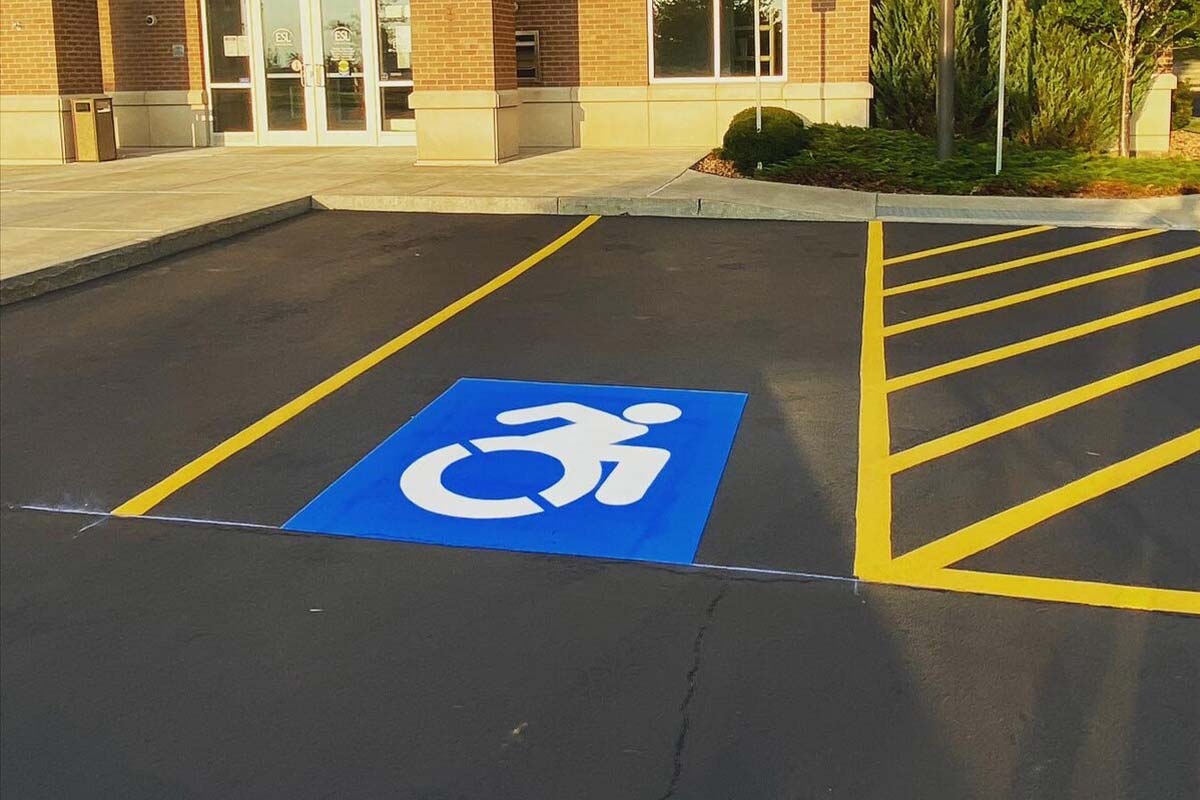
Every accessible stall carries the International Symbol of Accessibility, and its placement is specified, not freehand. Under §502.6 each accessible space must be marked with a sign bearing the ISA, mounted so the sign’s bottom edge sits at least 60 inches above the ground — high enough to stay visible when a vehicle is parked in front of it. Van-accessible stalls get an added “van accessible” designation on the same sign.
The painted ISA on the pavement is a supplement, not a substitute. The vertical sign is what satisfies §502.6, and the symbol itself must match the proportions in §703.7.2.1. We stencil the ground symbol in the standard blue-and-white scheme and mount the vertical sign at the head of the stall, because an inspector looking for compliance is looking up at the sign, not down at the paint.
Signage faults are quiet failures. A faded ground stencil still reads as “accessible” to most owners, but a missing or low-mounted vertical sign is a clean citation under federal and Texas review. When we restripe an existing West Fort Worth lot, the signage audit runs alongside the paint — there’s no point laying a crisp new ISA on the asphalt if the post sign behind it is bent, faded, or gone.
How Do the Texas Accessibility Standards Add to Federal ADA?
Texas runs an accessibility layer on top of federal ADA, and West Fort Worth commercial construction has to clear both. The 2012 Texas Accessibility Standards are administered by the Texas Department of Licensing and Regulation through its Architectural Barriers program, and for qualifying commercial projects they add a state plan-review and inspection step that federal ADA alone does not.
In practice, that means a new or substantially renovated lot above the TDLR cost threshold gets its accessibility design reviewed by a Registered Accessibility Specialist before construction and inspected after. The parking provisions in the 2012 TAS track the federal §208 counts and §502 dimensions closely, so a lot striped to the 2010 ADA Standards is the right foundation — but the TAS inspection is the gate that actually clears the project in Texas.
We stripe to the stricter reading of both standards. Where the federal and state language line up, we follow the shared requirement; where Texas adds review or documentation, we stripe so the lot is ready for the TDLR inspection rather than only the federal minimum. That keeps a Tarrant, Parker, Johnson, or Hood county property owner from passing a federal self-check and then failing the state barrier review.
What Does the ADA Striping Process Look Like?
Our accessible-striping work follows a five-step sequence that keeps a typical commercial lot compliant from layout to final inspection.
- Count and assess. We total your existing spaces, run the §208.2 table to find the required accessible and van-accessible counts, and flag any current stalls that miss the §502 dimensions or the 2 percent slope cap.
- Locate the stalls. Accessible spaces go on the shortest accessible route to the entrance per §208.3, on grade that holds under 2 percent. We mark stall and aisle positions before any paint goes down.
- Stripe stalls and aisles. Standard accessible stalls at 11 feet with a 5-foot aisle, van-accessible at 8 feet with an 8-foot aisle, all hash-marked so the access aisle reads as no-park.
- Symbols and signage. ISA ground stencils per §703.7.2.1, vertical signs mounted at 60 inches minimum per §502.6, with the van-accessible designation added where required.
- Verify against both standards. A final walk confirms counts, widths, slope, and signage against the 2010 ADA Standards and the 2012 Texas Accessibility Standards before we call the lot done.
For larger lots — shopping centers, medical office parks, distribution sites near Weatherford and Granbury — we stage the accessible stalls first so the compliant spaces are in service even while the rest of the lot is being striped.
What Paint and Equipment Do We Use?
Accessible striping has to stay legible for years, so the paint and line quality carry weight. We run Graco LineLazer airless line stripers, which hold a straight, sharp edge across the irregular asphalt textures common on older West Fort Worth commercial lots. Clean edges matter on accessible work because the access-aisle hash marks and the ISA stencil have to read clearly to drivers and inspectors alike.
For the paint itself we use Sherwin-Williams traffic marking formulations rated for parking-lot service in the North Texas heat. Blue is the standard color for accessible-stall borders and ISA symbols, paired with white for the access-aisle hash marks and the standard stall lines around them. The blue has to stay saturated through summers where lot-surface temperatures climb well past air temperature, so the formulation choice is part of keeping the stall compliant past its first season.
Line width and color are not stylistic. The contrast between the blue accessible markings, the white hash marks, and the surrounding asphalt is what makes the accessible space readable at a glance — which is the entire point of the ISA system under §703. We stripe to that contrast standard, not to whatever paint happens to be on the truck.
Which West Fort Worth Areas Do We Serve?
1-800-STRIPER stripes ADA-compliant lots across western Tarrant County and the surrounding North Texas counties. That covers Parker, Johnson, and Hood counties alongside the western edge of Tarrant, reaching commercial properties in Aledo, Weatherford, Willow Park, Hudson Oaks, Granbury, Cleburne, Azle, Benbrook, Saginaw, and Crowley.
The mix of property types out here is broad — retail centers, medical and dental offices, churches, self-storage, and light-industrial sites all carry accessible-parking obligations under the same §208 counts. A small professional office in Willow Park and a 300-space retail center in Benbrook follow the same federal table; only the stall totals change. We size each lot’s accessible requirement to its own space count.
If you manage a property anywhere in this footprint and you’re not sure your accessible stalls clear current standards, the fastest answer is a count and a measure. You can reach our West Fort Worth crew at (682) 262-7612 to walk a lot and confirm where it stands against the §208 counts and §502 dimensions.
For a full list of our pavement marking services, visit our parking lot striping in West Fort Worth page.
Businesses We Serve




How it Works

GET A FREE ESTIMATE
Contact us today and we’ll have a quote to you in 24 hours

SCHEDULE AN INSTALLATION
We’ll have your installation scheduled in less than 7 days, without affecting your business hours

GET A PARKING LOT THAT POPS
For a budget-friendly price, you’ll get a parking lot that looks like new!
We proudly work with:


We proudly work with:


Frequently Asked Questions About ADA Parking Lot Striping in West Fort Worth, TX
How many accessible parking spaces does my West Fort Worth lot need?
It depends entirely on your total space count under §208.2. A lot of 1 to 25 spaces needs one accessible stall, 26 to 50 needs two, and 51 to 75 needs three, then one more for every additional 50 spaces. So a 100-space lot needs four accessible stalls, and a 200-space lot needs six. We count your spaces and run the table so the number is exact rather than estimated.
How many of my accessible stalls have to be van-accessible?
At least one in every six. Section §208.2.4 requires that for each six accessible stalls — or any fraction of six — at least one must be van-accessible. A lot with one to six accessible stalls needs a single van stall; a lot with seven to twelve needs two. The van-accessible stall uses the wider 8-foot-stall-plus-8-foot-aisle layout so a side or rear lift has room to deploy.
What are the required dimensions for an accessible stall and its access aisle?
Under §502, a standard accessible stall is 11 feet wide with a 5-foot access aisle, while the van-accessible option is an 8-foot stall with an 8-foot access aisle. The access aisle runs the full length of the stall, and two adjacent stalls can share one aisle. Both the stall and the aisle have to stay under a 2 percent slope in every direction per §502.4.
Does Texas have parking accessibility rules beyond federal ADA?
Yes. The 2012 Texas Accessibility Standards, administered by TDLR’s Architectural Barriers program, add a state plan-review and inspection layer above federal ADA for qualifying commercial construction. The parking counts and dimensions track the federal standards closely, but Texas adds a Registered Accessibility Specialist review and inspection step that the federal standard alone does not require. We stripe to clear both.
Where does the accessible-parking sign have to be mounted?
The vertical ISA sign must sit with its bottom edge at least 60 inches above the ground per §502.6, high enough to stay visible when a vehicle is parked in the stall. Van-accessible stalls add a “van accessible” line to that same sign. The painted ground symbol is a supplement — the mounted vertical sign is what actually satisfies the requirement, so a faded stencil with no post sign is still a compliance gap.
Can you bring my older West Fort Worth lot up to current ADA standards?
Yes — restriping is the standard moment to correct an older lot. We re-measure stall and aisle widths against §502, check the slope against the 2 percent cap, confirm the accessible and van-accessible counts against the §208.2 table, refresh the ISA stencils per §703, and audit the vertical signage. If the lot is short on accessible stalls or missing a van-accessible space, the restripe is the right time to add them so it clears both the federal and Texas standards.