Wheel Stop Installation
In North Dallas, TX
Concrete and Rubber Parking Stops
1-800-STRIPER provides professional wheel stop installation in North Dallas, TX — anchoring concrete and recycled-rubber parking stops, also called parking blocks or curb stops, at stall heads to protect sidewalks, storefronts, and ADA accessible routes for commercial properties across Collin, Dallas, and Denton counties.
1-800-STRIPER® of North Dallas PROVIDes Wheel Stops Services NEAR YOU
Need to protect vehicles or walls from accidental damage?
Wheel stops (also called parking blocks) protect your property, enhance safety, and improve parking lot organization.
Benefits:
Wheel stops prevent vehicles from parking too far into a space or overextending into other spots, pedestrian walkways, and other areas, while also helping with vehicle alignment. They can prevent damage to buildings, curbs, or landscaping. Wheel stops also serve as clear visual cues for proper parking and are sometimes used on slopes to prevent cars from rolling.
What Wheel Stop Installation Covers
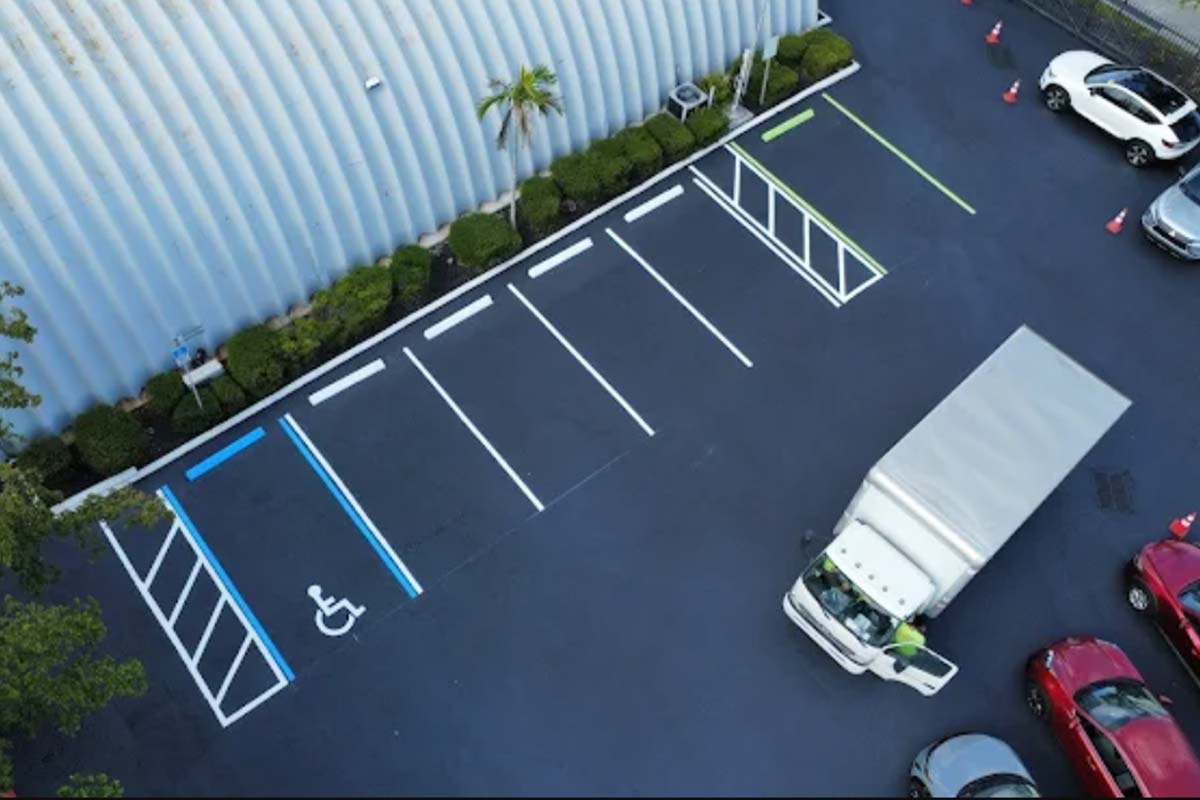
Wheel stops, parking stops, parking blocks, curb stops — four names for the same thing, and every property manager in North Texas uses a different one. It is the low barrier at the head of a stall that tells a driver where to stop. We supply and install them, replace the ones that have broken up, re-anchor the ones that have worked loose, and reposition rows that were set in the wrong place to begin with. On most jobs it happens alongside striping, because the stripe and the stop have to agree with each other: a block set to the old stall spacing on a freshly relaid lot is worse than no block at all.
Concrete vs Recycled-Rubber vs Plastic-Composite
| Concrete | Recycled rubber | Plastic composite | |
|---|---|---|---|
| Weight | Heavy — resists being shifted, hard to move | Light — one person can carry it | Light |
| Failure mode | Chips, cracks, and spalls; rebar eventually shows | Deforms and rebounds; tends to survive impacts that crack concrete | Can crack in extreme cold, otherwise stable |
| Appearance over time | Weathers gray, stains, needs repainting | Holds its color; reflective inserts available | Holds its color |
| Best fit | Heavy-vehicle lots, permanent layouts | High-turnover retail, snow-plow routes, anywhere blocks get hit | Lots where appearance and low weight matter |
Concrete is still the default on lots with truck traffic because mass is the point. Rubber and composite win where blocks get struck often, where crews need to lift and reset them for maintenance, or where a cracked gray block would look bad in front of a storefront. We will say which one earns its keep on your lot instead of quoting whatever is on the truck.
Placement, Vehicle Overhang, and the Accessible Route
Placement is not decoration, and on some stalls it is a compliance question.
A vehicle nosed into a stall overhangs the block by roughly two to three feet. If that stall faces a sidewalk, the overhang lands on the walkway. The 2010 ADA Standards address this directly: parking spaces and access aisles have to be designed so that parked cars and vans cannot obstruct the required clear width of an adjacent accessible route. A wheel stop set at the right distance is the ordinary way to guarantee that, and a row of stalls fronting a building walk is exactly where it matters.
The same logic applies without the regulation on the rest of the lot: blocks set too far forward let bumpers reach the building, landscaping, or the next row; set too far back they push the vehicle into the drive aisle. We measure the stall depth, the walk width behind it, and the overhang you actually have, then set the row from those numbers.
Sources: 2010 ADA Standards for Accessible Design; U.S. Access Board — Chapter 5: Parking Spaces.
Anchoring on Asphalt vs Concrete
Asphalt and concrete want different anchors, and using the wrong one is why blocks end up sliding around a lot.
On asphalt, steel spikes or rebar pins driven through the block’s cast holes hold well because asphalt grips the pin along its whole length. Length matters more than diameter — a short pin in hot summer asphalt walks out. On concrete, spikes are the wrong tool: the correct method is drilling and setting anchor bolts or epoxy-set dowels into the slab, which holds far better and does not spall the surface the way driven pins do. Either way the block goes down on a clean, sound surface, and where the pavement underneath has failed, the pavement gets addressed first.
When to Replace a Failing Parking Block
A parking block is finished when it stops doing its job or starts creating a new hazard. The signals are consistent: a crack all the way through, corners broken off, exposed rebar, a block that rocks when you push it, one that has migrated out of line with the row, or a rubber unit whose anchors have pulled through. Any of those on a stall that fronts a walkway is worth doing sooner, because the overhang protection is gone. We replace individual failures and we replace whole rows where the lot has reached the point that spot fixes are just a schedule of return visits. Call (940) 298-0200 for a free estimate.
For a full list of our pavement marking services, visit our parking lot striping in North Dallas page.
Businesses We Serve




How it Works

GET A FREE ESTIMATE
Contact us today and we’ll have a quote to you in 24 hours

SCHEDULE AN INSTALLATION
We’ll have your installation scheduled restriped in less than 7 days, without affecting your business hours

GET A PARKING LOT THAT POPS
For a budget-friendly price, you’ll get a parking lot that looks like new
We proudly work with:


We proudly work with:

Frequently Asked Questions About Wheel Stop Installation in North Dallas, TX
What does a wheel stop actually do?
It tells a driver where to stop, and it keeps the front of the vehicle out of whatever is beyond the stall. On most lots that means protecting a sidewalk, a storefront, landscaping, or the next row of cars from a two-to-three-foot bumper overhang. On stalls fronting a walkway it does something more specific: it is the ordinary way of keeping a parked vehicle from obstructing the clear width of an accessible route.
Is a parking stop, a parking block, or a curb stop the same thing as a wheel stop?
Yes — four names, one product. Wheel stop, parking stop, parking block, and curb stop all describe the low barrier at the head of a stall. Which one you hear depends on who you are talking to, and property managers in North Texas use all four. We use them interchangeably here for that reason. The only term worth separating out is bollard, which is a vertical post doing a different job entirely.
Concrete, rubber, or composite — which should I choose?
Concrete is the default on lots with truck traffic, because mass is the point and it resists being shifted. It also chips, cracks, and eventually shows rebar. Recycled rubber and plastic composite are light enough to lift and reset, hold their color without repainting, and deform and rebound through impacts that would crack concrete. Rubber and composite win on high-turnover retail and anywhere blocks get struck regularly. We recommend by lot and never by stock.
Where should a wheel stop be placed in the stall?
Far enough back that the vehicle stops before its bumper reaches whatever is behind the stall, and far enough forward that it does not push the car into the drive aisle. A parked vehicle overhangs the block by roughly two to three feet, so on stalls fronting a sidewalk that distance decides whether the overhang lands on the walkway. We measure stall depth, walk width, and actual overhang instead of working from a rule of thumb.
How are they anchored on asphalt versus concrete?
Differently, and using the wrong method is why blocks end up sliding around a lot. On asphalt, steel spikes or rebar pins driven through the cast holes work well because asphalt grips the pin along its length — length matters more than diameter, since a short pin walks out of hot summer asphalt. On concrete, driven spikes are wrong; the correct method is drilling and setting anchor bolts or epoxy dowels into the slab.
When should a cracked parking block be replaced?
When it stops doing its job or starts creating a new one. A crack all the way through, broken corners, exposed rebar, a block that rocks when pushed, one that has migrated out of line with the row, or a rubber unit whose anchors have pulled through — any of those is finished. On a stall fronting a walkway it is worth doing sooner, because the overhang protection is already gone.