
Bollard Installation
In North Dallas, TX
Safety and Security Bollards
1-800-STRIPER provides professional bollard installation in North Dallas, TX — setting fixed, removable, and sleeved bollards at storefronts, drive lanes, and loading docks, where low-speed impact performance is graded by ASTM F3016 for commercial properties across Collin, Dallas, and Denton counties.
1-800-STRIPER® of North Dallas PROVIDes Bollard Installation Services NEAR YOU
Want to prevent accidents and protect your property?
Bollards provide physical protection for your customers and your property.
Safety and security:
Bollards create a physical barrier between vehicles and pedestrians, protecting people in walking areas from accidental or intentional vehicle intrusions.
Bollards act as a protective barrier around storefronts, gas stations, and other vulnerable areas, minimizing the risk of costly damage from vehicle impacts.
Strategic Placement Locations:
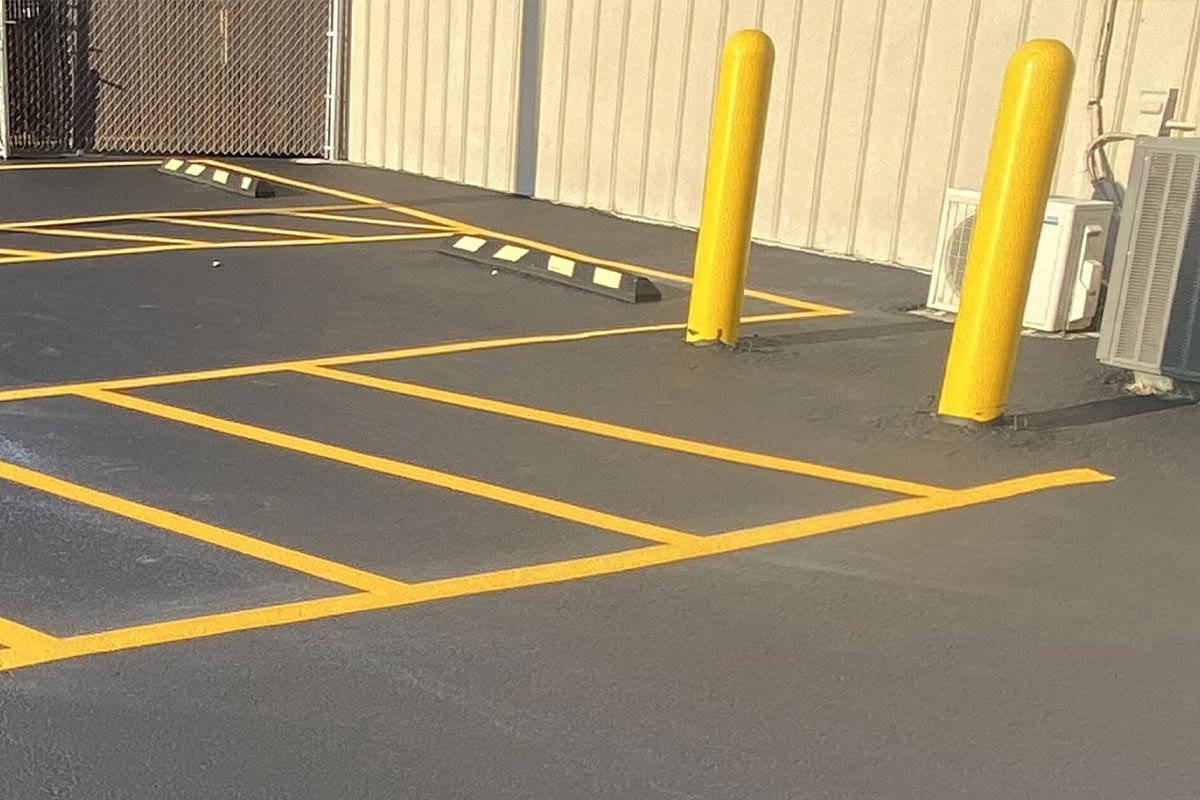
What Bollard Installation Covers
A bollard is a post set in the ground to stop a vehicle going somewhere a vehicle should not go. On a commercial property that usually means the glass front of a building, a gas meter, a propane cage, a drive-through window, an electrical transformer, a loading dock corner, or the pedestrian path between a parking row and the front door. We handle the whole job: walking the property to work out what needs protecting and from which direction, confirming what is underground before anything is cut, coring or excavating, setting the posts, filling and finishing them, and cleaning up the site. Installations run alongside striping and signage work on the same visit where it makes sense, so the lot is disturbed once instead of three times.
Bollard Types: Fixed, Removable, and Sleeved
Fixed bollards are set permanently in concrete and are the right answer wherever the protection has to be there every hour of every day, which covers most storefronts. Removable bollards drop into a ground socket and lift out with a key, so a fire lane, a delivery gate, or an emergency access point can be opened when it needs to be and closed the rest of the time. Sleeved bollards are a steel pipe with a decorative cover slipped over it — the cover takes the scuffs and gets replaced, and the pipe underneath keeps doing the work. Which one belongs on your property is usually decided by whether anything ever needs to drive through that spot.
Where Bollards Go on a Commercial Property
Storefronts come first, because a vehicle entering a building is the failure with the worst outcome. After that: anywhere a driver could mistake reverse for drive next to something expensive or dangerous. Utility equipment, meters, and transformers. Drive-through lanes where the menu board and the ordering window sit exposed. Loading dock corners and dock levelers. The ends of pedestrian walkways where they cross a drive aisle. Fuel islands and charging stations. We look at the direction of travel in each aisle and not just the object, because a post placed on the wrong side of an obstacle is decoration.
Impact Ratings: ASTM F3016 vs ASTM F2656
This is where most bollard quotes go wrong, in both directions. There are two different ASTM standards and they answer two different questions.
ASTM F3016 is the low-speed test method, written for exactly the conditions a parking lot produces: a driver who hits the accelerator instead of the brake in a stall or a drive aisle. It rates devices at nominal impact speeds of 10, 20, and 30 miles per hour — the S10, S20, and S30 designations — and pairs each with a penetration class describing how far the test vehicle got past the device.
ASTM F2656 is the anti-ram standard, developed for perimeter security against a deliberate high-speed attack. Its designations describe much larger vehicles at much higher speeds, with their own penetration classes.
| ASTM F3016 | ASTM F2656 | |
|---|---|---|
| Written for | Accidental low-speed impact | Deliberate high-speed ram |
| Typical setting | Storefronts, drive-throughs, parking lots | Embassies, data centers, secure perimeters |
| Speed designations | S10 / S20 / S30 | Much higher speed classes |
| Also rates | Penetration class | Penetration class |
A storefront in a shopping center is an F3016 question. Specifying an F2656 device for it is not extra safety, it is a foundation and a budget you did not need. We say which standard applies to your situation before quoting, and if neither rating is required for your property we will say that too.
Sources: ASTM F3016; ASTM F2656.
Embedment, Footing, and Spacing
A bollard is only as good as what is under it. The post has to be embedded deep enough, in a footing wide enough, that the load ends up in the ground instead of ripping the post out of a thin slab. Depth and footing size come from the manufacturer’s installation instructions for the specific product, and for a rated device those instructions are part of what was tested — install it shallower and the rating no longer describes what you own. Spacing is the other half. Posts have to sit close enough together that a vehicle cannot pass between them, and far enough apart to leave the accessible route clear where one crosses. We set both from the product data and the site, never from a rule of thumb.
New Concrete vs Existing Pavement
On new construction the footings go in with the slab, which is the cheapest time to do it and the only time it is easy. On an existing lot we core the pavement, excavate to depth, set and plumb the post, pour, and patch back. Asphalt and concrete behave differently here — concrete cores cleanly and patches tidily, asphalt needs more care around the collar so water does not start working at the edge. Either way we locate what is underground first. Conduit, irrigation, gas, and fiber all live at bollard depth in a commercial lot, and an 811 utility locate request is how that gets confirmed before anyone cuts.
Bollard Covers, Repainting, and Replacement
Bollards take hits, and the ones doing their job look like it. Bent or leaning posts, rust at the collar, a cracked footing, or a cover that has been clipped once too often are all worth addressing before the next impact and not after. Repainting is straightforward maintenance and keeps the posts visible, which is most of what makes them effective on a dark lot. Sleeved installations replace the cover and keep the core. Where a post has taken enough of a hit to move the footing, replacement is the answer.
How It Works
- Free estimate. We walk the property with you, look at what needs protecting and how vehicles approach it, and put a count and a layout on paper.
- Locates and scheduling. Utility locates go in, and we schedule around your hours so the drive aisles stay usable.
- Installation. Cores or excavations, posts set and plumbed, footings poured.
- Finish and clean-up. Fill, caps or covers, paint, patch back, and the site left clean.
Areas We Serve in Collin, Dallas, and Denton Counties
We install bollards across 46 ZIP codes and 22 towns in Collin, Dallas, and Denton counties, from our office in McKinney. That covers retail centers, industrial parks, medical campuses, self-storage sites, restaurants, and multi-family properties. Call (940) 298-0200 for a free estimate.
For a full list of our pavement marking services, visit our parking lot striping in North Dallas page.
Businesses We Serve




How it Works

GET A FREE ESTIMATE
Contact us today and we’ll have a quote to you in 24 hours

SCHEDULE AN INSTALLATION
We’ll have your installation scheduled in less than 7 days, without affecting your business hours

GET A PARKING LOT THAT POPS
For a budget-friendly price, you’ll get a parking lot that looks like new
We proudly work with:


We proudly work with:


Frequently Asked Questions About Bollard Installation in North Dallas, TX
What types of bollards do you install?
Three main families. Fixed bollards are set permanently in concrete and cover most storefront and utility protection. Removable bollards drop into a ground socket and lift out with a key, which is what you want at a fire lane, a delivery gate, or any point that occasionally has to open. Sleeved bollards are a structural steel pipe with a decorative cover over it; the cover takes the scuffs and gets swapped, and the pipe keeps working.
What do the S10, S20, and S30 ratings on a bollard mean?
They are impact speed designations from ASTM F3016, the low-speed test method written for the conditions a parking lot produces. S10, S20, and S30 correspond to nominal test impacts at 10, 20, and 30 miles per hour, and each is paired with a penetration class describing how far the test vehicle got past the device. A higher number is a harder impact survived; which one you need depends on approach speed and what sits behind the post.
What is the difference between ASTM F3016 and ASTM F2656?
They are written for different threats. ASTM F3016 is the low-speed test method covering accidental impacts of the kind a parking lot produces — a driver hitting the accelerator instead of the brake. ASTM F2656 is the anti-ram standard, developed for perimeter security against a deliberate high-speed attack with a much larger vehicle. A storefront in a shopping center is an F3016 question. Specifying F2656 for it buys a foundation and a budget the property does not need.
How deep does a bollard footing need to be?
It depends on the product, and the honest answer is that the manufacturer’s installation instructions set it. For an impact-rated bollard those instructions are part of what was actually tested — install it shallower, or in a smaller footing, and the rating no longer describes what you own. We install to the product data and to what the site will take, and where the existing pavement or base will not support the footing, we say so before quoting.
How far apart should bollards be spaced in front of a storefront?
Close enough together that a vehicle cannot pass between them, and no closer than the accessible route across the frontage needs. There is no single national number, because the answer depends on the width of what you are protecting, the angle vehicles approach from, and whether pedestrians and wheelchair users have to pass through the line. We set spacing from the product data and the site geometry, and we keep the accessible route clear.
Can bollards be added to an existing parking lot?
Yes, and it is most of what we do. On an existing lot we locate underground utilities first, then core or excavate through the pavement, set and plumb the post, pour the footing, and patch back. Concrete cores cleanly; asphalt needs more care at the collar so water does not start working at the edge. Utility locates matter here — conduit, irrigation, gas, and fiber all live at bollard depth in a commercial lot.
Do you need a permit to install a bollard?
Sometimes. It depends on the city, on where the bollards go, and on whether the work touches anything already permitted — fire lane access, an accessible route, or a structure. There is no single Texas answer, because permitting is municipal and this service area covers twenty-two towns. We check the requirement for the jurisdiction the property sits in before scheduling, and we will tell you plainly if your project needs one.
What happens to a bollard that has been hit?
It depends on what moved. A post that is scuffed or has lost its paint is straightforward maintenance, and repainting keeps it visible, which is most of what makes a bollard work on a dark lot. A sleeved unit gets a new cover and keeps its core. A post that is bent, leaning, or has cracked its footing has spent its capacity, and replacement is the answer; straightening it and hoping is not.