Warehouse Line Painting
In North Dallas, TX
OSHA-Compliant Safety Markings
1-800-STRIPER provides professional warehouse line painting in North Dallas, TX — laying out aisle lines, pedestrian walkways, floor markings, and safety zones to the OSHA marked-aisle requirement, for distribution centers and trucking facilities across Collin, Dallas, and Denton counties.
1-800-STRIPER® of North Dallas PROVIDes Warehouse Floor Markings Services NEAR YOU
Want your indoor space to operate more efficiently?
Warehouse and interior markings ensure clear traffic lanes, organized storage zones, and designated spaces designed to help your business operate safely and efficiently.
Benefits:
What Warehouse Line Painting Covers
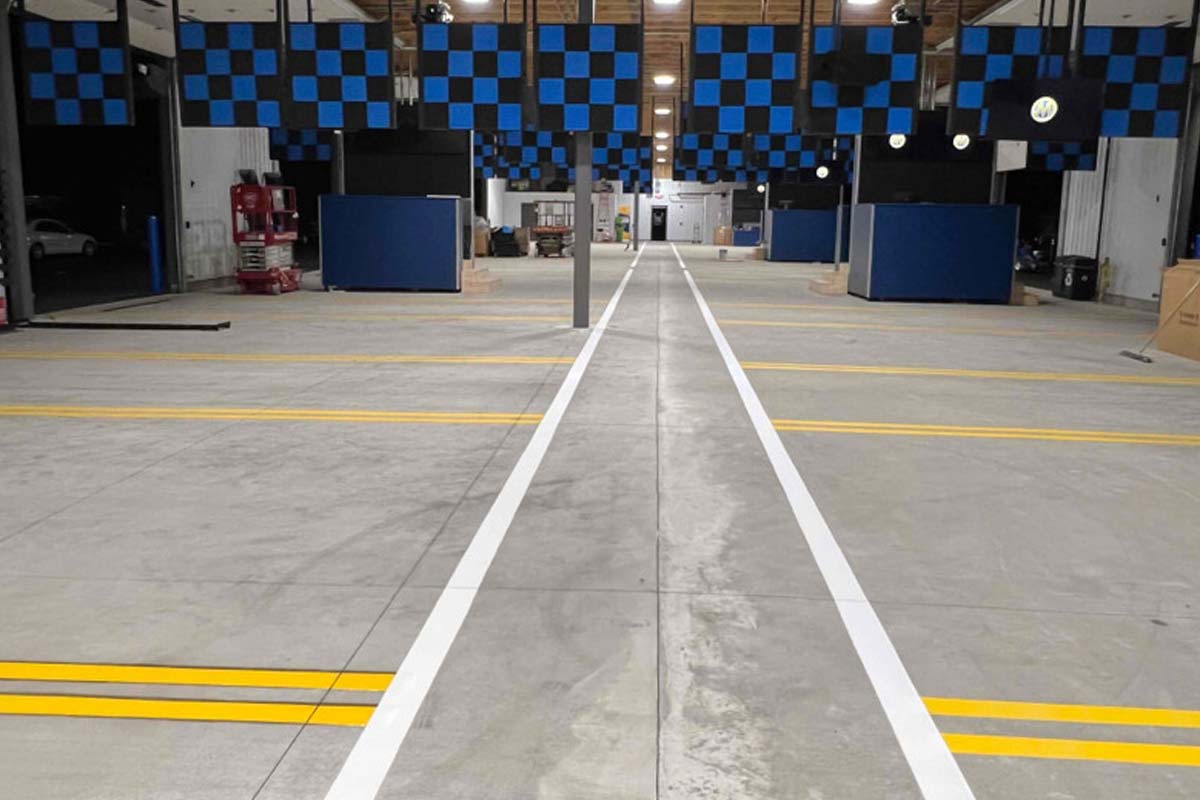
Warehouse line painting and warehouse floor marking are the same trade under two names, and between them they cover everything that gets painted on an interior slab. Aisle lines and cross-aisles. Pedestrian walkways and crossings. Staging, racking, and hold areas outlined so stock does not creep into the lane. Dock approaches and trailer positions. Equipment footprints, charging bays, and keep-clear zones around electrical panels, eyewash stations, and fire equipment. Numbers, letters, and directional arrows. We lay out and paint all of it, and we do it around your operation — sections at a time, over a weekend or a shutdown, so the building keeps running.
OSHA’s Marked-Aisle Rule — and What It Does Not Say
Almost every page on this subject cites the wrong section, so here is the actual text.
The duty lives in 29 CFR 1910.176(a), which deals with materials handling. Where mechanical handling equipment is used, it requires sufficient safe clearances for aisles, at loading docks, through doorways, and wherever turns or passage must be made; it requires aisles and passageways to be kept clear and in good repair with no obstruction that could create a hazard; and it closes with the sentence that matters here — permanent aisles and passageways shall be appropriately marked.
That is the whole obligation. Read what it does not contain. It gives no line width. It gives no color. It does not say which aisles count as permanent — that is a judgment about how your building operates. Nor is it 1910.22, the walking-working-surfaces section that gets cited on page after page: the word aisle does not appear in it at all.
Color is a separate question with a separate source. OSHA’s safety color code at 29 CFR 1910.144 assigns red to fire protection equipment and apparatus, to danger, and to emergency stops, and yellow to caution and to marking physical hazards such as striking against, stumbling, falling, tripping, and being caught in between. Nothing there dictates the color of an aisle line either.
| Question | Where the answer comes from |
|---|---|
| Must permanent aisles be marked? | Yes — 29 CFR 1910.176(a) |
| How wide must the line be? | Not specified in the regulation. OSHA interpretation letters have suggested lines of roughly two inches or more; that is guidance, not a rule |
| What color must the line be? | Not specified. 1910.144 governs red and yellow safety colors for hazards and fire equipment; aisle striping is unaddressed |
| Which aisles are permanent? | A facility judgment; the standard gives no number |
Sources: OSHA 29 CFR 1910.176 — Handling Materials, General; OSHA 29 CFR 1910.144 — Safety Color Code.
The useful consequence: consistency inside your building matters more than matching some national color chart. We agree a scheme with you, document it, and paint to it.
Layouts for Distribution Centers and Trucking Facilities
Distribution centers and trucking facilities move differently from a general warehouse, and the paint should reflect that. Trailer stalls and dock positions want numbering that matches your yard system so a driver reads the same identifier on the paperwork and on the ground. Approach lanes and turning areas need width for a tractor-trailer swing and not a forklift turn. Yard striping continues the interior logic outside — trailer parking, staging rows, guard-shack queues, and truck-only routes kept clear of employee parking. Inside, cross-dock buildings need the pedestrian route treated as seriously as the equipment lane, because that is where people and forklifts meet at speed.
We map your traffic before painting: where product enters, where it stages, where it leaves, and where people walk across all of it.
Coatings, Tape, and Surface Prep
Three real choices. Paint is the workhorse — fast, repairable, and the cheapest to change when a layout moves. Two-part epoxy and urethane coatings last longest under heavy forklift traffic and wash-down, and they take the most downtime and the most preparation. Tape goes down instantly and lifts instantly, which makes it right for a layout you expect to move and wrong for a main aisle under wheel loads.
Preparation decides which of those actually survives. A sealed or previously coated slab needs abrading so the new marking has something to key into; a dusty or oily floor needs cleaning first; new concrete needs to have cured. Skipping that step is why floor markings peel in strips, and no product choice fixes it after the fact. Call (940) 298-0200 for a free estimate.
For a full list of our pavement marking services, visit our parking lot striping in North Dallas page.
Businesses We Serve




How it Works

GET A FREE ESTIMATE
Contact us today and we’ll have a quote to you in 24 hours

SCHEDULE A STRIPING
We’ll have your space restriped in less than 7 days, without affecting your business hours

GET A PARKING LOT THAT POPS
For a budget-friendly price, you’ll get a parking lot that looks like new
We proudly work with:


We proudly work with:

Frequently Asked Questions About Warehouse Line Painting in North Dallas, TX
What does warehouse line painting cover?
Aisle lines and cross-aisles, pedestrian walkways and crossings, staging and racking outlines, hold and quarantine areas, dock approaches and trailer positions, equipment footprints, charging bays, and keep-clear zones at electrical panels, eyewash stations, and fire equipment — plus numbers, letters, and directional arrows. We lay it out and paint it, working in sections around your operation so the building keeps running instead of shutting down for the duration.
Is warehouse line painting the same as warehouse floor marking?
Same trade, two names. Warehouse floor marking is the term most safety managers use; warehouse line painting is what most facilities managers search for. Both describe painting the traffic and safety layout onto an interior slab — aisles, walkways, staging areas, and hazard zones. We use both terms on this page for exactly that reason. The only distinction anyone really draws is that floor marking sometimes includes tape as well as paint.
Does OSHA require warehouse aisles to be marked?
Yes, where mechanical handling equipment is used. The duty is in 29 CFR 1910.176(a), which requires sufficient safe clearances for aisles, at loading docks, through doorways and wherever turns or passage must be made, requires aisles and passageways to be kept clear and in good repair, and states that permanent aisles and passageways shall be appropriately marked. Note the word permanent — which aisles qualify is a judgment about how your building actually operates.
Does OSHA specify a line width or color for aisle markings?
No. The regulation says appropriately marked and stops there — no width, no color. OSHA interpretation letters have suggested lines of roughly two inches or more, but that is guidance and not a rule. Color comes from a different place: 29 CFR 1910.144 assigns red to fire protection equipment, danger, and emergency stops, and yellow to caution and physical hazards. Neither dictates aisle line color, so internal consistency matters more.
Do you stripe trucking facilities and dock areas?
Yes — distribution centers and trucking facilities are a large part of this work, and they mark differently from a general warehouse. Trailer stalls and dock positions want numbering that matches your yard paperwork so a driver reads the same identifier in both places. Approach lanes and turning areas are sized for a tractor-trailer swing and not a forklift turn. Yard striping continues the same logic outside: staging rows, truck routes, and queuing areas.
How long does the building have to be shut down?
Usually not at all. Most of this work happens in sections, over a weekend, or on an off shift, so the building keeps operating. What sets the schedule is cure time and preparation and never the painting itself: paint returns to service fastest, epoxy and urethane coatings need the most downtime and the most surface preparation, and tape goes down instantly. We plan the sequence with your operations team before the first line.