ADA Parking Lot Striping
In North Dallas, TX
ADA-Compliant Accessible Parking
1-800-STRIPER provides ADA parking lot striping in North Dallas, TX — installing accessible and van-accessible stalls, access aisles, ISA symbols, and required handicap parking signage per the 2010 ADA Standards for Accessible Design and the 2012 Texas Accessibility Standards for commercial properties across Collin, Dallas, and Denton counties.
1-800-STRIPER® of North Dallas PROVIDes ADA Compliance Services NEAR YOU
Need to make your property more accessible?
Upgrade your facility to become fully ADA compliant by partnering with us to create clear, accessible parking for all your visitors.
Our ADA Compliant line striping services include:
What ADA Parking Lot Striping Includes
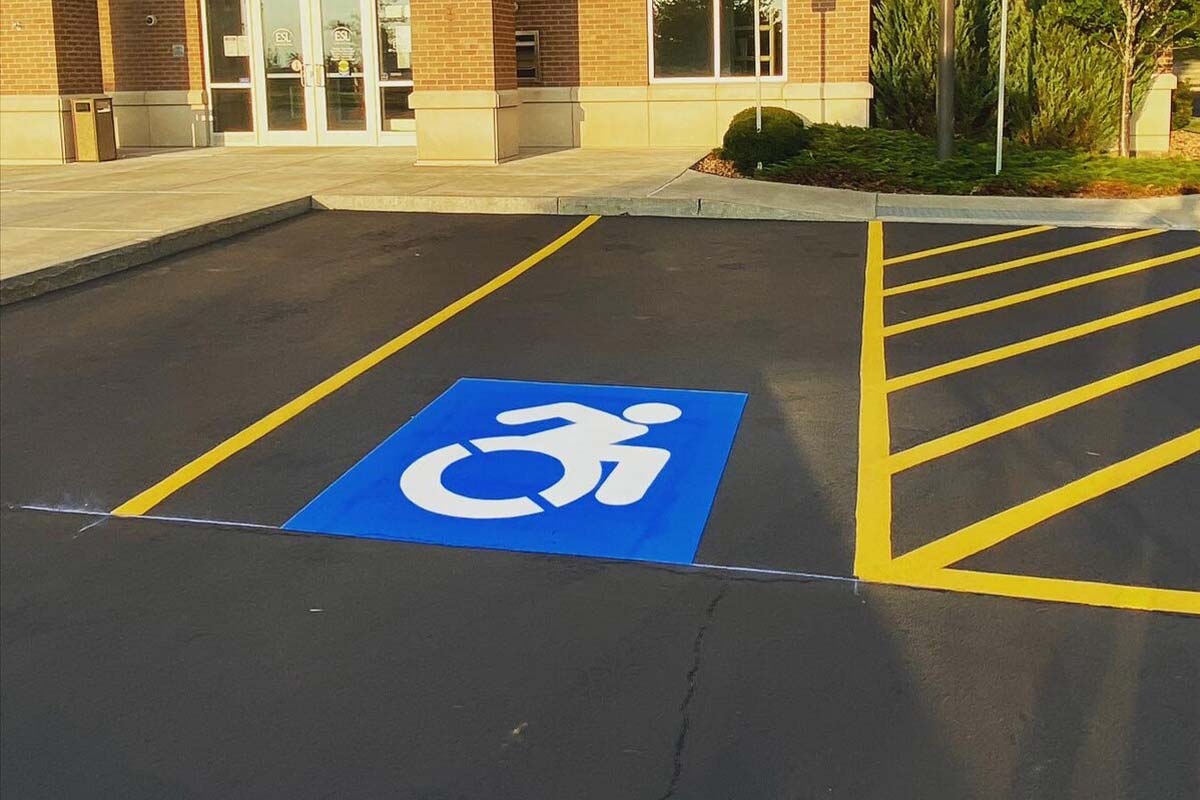
Most people call it handicap striping. The federal standard calls it accessible parking, and on a commercial lot it is a package of five things and not one: the right number of accessible stalls for the size of the lot, stalls at the right width, a marked access aisle beside each one, the International Symbol of Accessibility painted on the pavement, and a sign at each space mounted where a parked vehicle cannot hide it. Get any one of those wrong and the space does not count. We lay out and stripe the whole package — layout, paint, symbols, aisle hatching, and the signs and posts that go with it — so the accessible parking on your lot is a complete installation and never just a blue stall.
Accessible Stall Counts by Lot Size
How many accessible spaces a lot needs comes straight from the count table in the 2010 ADA Standards for Accessible Design. It scales with total spaces provided; square footage and occupancy do not enter into it.
| Total parking spaces in lot | Minimum accessible spaces |
|---|---|
| 1 to 25 | 1 |
| 26 to 50 | 2 |
| 51 to 75 | 3 |
| 76 to 100 | 4 |
| 101 to 150 | 5 |
| 151 to 200 | 6 |
| 201 to 300 | 7 |
| 301 to 400 | 8 |
| 401 to 500 | 9 |
| 501 to 1,000 | 2 percent of total |
| 1,001 and over | 20, plus 1 for each 100 over 1,000 |
Where a site has more than one lot, the count is worked per lot instead of across the whole property. We count what is actually striped on the ground before quoting, because the number of stalls a lot has and the number the site plan says it has are frequently different.
Source: 2010 ADA Standards for Accessible Design.
Van-Accessible Spaces, Access Aisles, and Signage
This is the part that fails inspection most often, and none of it is guesswork.
Van spaces. One in every six accessible spaces, or fraction of six, has to be van accessible. A van space is either 132 inches wide, or 96 inches wide beside a 96-inch access aisle.
Car spaces. 96 inches minimum width.
Access aisles. 60 inches minimum width, running the full length of the space they serve, marked so people do not park in them. Two spaces may share one aisle. The aisle has to connect to an accessible route to the building entrance, and it cannot be part of the drive lane.
Slope. Spaces and aisles must not slope more than roughly one unit in forty-eight in any direction, which in practice rules out the corner of a lot that drains hard.
Signs. Each space gets a sign carrying the International Symbol of Accessibility, with a van accessible designation added at van spaces, mounted so the bottom of the sign sits at least 60 inches above the ground.
Source: U.S. Access Board — Chapter 5: Parking Spaces.
Texas Adds a Layer: the 2012 TAS and TDLR Architectural Barriers Review
Federal ADA is not the only standard that reaches a Texas parking lot. The 2012 Texas Accessibility Standards, administered by the Texas Department of Licensing and Regulation under the Architectural Barriers program, apply to buildings and facilities in Texas, and above a state-set construction-cost threshold a project has to be registered for TAS review and inspection by a Registered Accessibility Specialist. TAS is built on the 2010 federal standard, so the counts and the one-in-six van ratio track it, and the differences are in the administrative layer, and the stripe widths are unchanged.
Worth knowing before you assume someone else has checked: the McKinney Fire Marshal’s Office states plainly that its plan review does not cover ADA or TAS compliance. A fire-code sign-off is not an accessibility sign-off, and on more than one property that assumption is the whole gap.
Source: 2012 Texas Accessibility Standards.
Safe Harbor: When an Existing Lot Actually Has to Change
Here is the question we get asked, and the honest answer to it.
Accessibility duties attach to new construction, to alteration, and to change of occupancy. They are not a standing order to repaint every lot in Texas this year. Under the 2010 safe harbor provision, elements that already complied with the 1991 federal standard do not have to be brought up to the 2010 standard until that element is altered. That matters here because some Texas city tables still show one van space in every eight, which tracks the older 1991 figure — a legacy lot striped to that ratio may be sitting perfectly lawfully.
So: we stripe new and altered lots to one in six. We tell you plainly when your lot predates that and the city table says otherwise. And we do not tell you whether restriping your lot is itself an alteration that triggers the upgrade — that is the hinge of the whole question, it turns on facts about your specific project, and it belongs with a Registered Accessibility Specialist rather than a striping contractor. Anyone who answers it for you off a phone call is selling.
Our ADA Striping Process
- Measure and count. Total spaces, existing accessible spaces, aisle widths, slopes, and the route from the aisle to the door.
- Compare to the standard. What the count table requires, what is on the ground, and where the gap is.
- Lay out on paper. Stall positions, aisle placement, symbol and sign locations, marked before any paint moves.
- Stripe and install. Layout paint, ISA symbols, aisle hatching, then signs and posts.
- Walk it with you. Call (940) 298-0200 for a free estimate.
For a full list of our pavement marking services, visit our parking lot striping in North Dallas page.
Businesses We Serve




How it Works

GET A FREE ESTIMATE
Contact us today and we’ll have a quote to you in 24 hours

SCHEDULE AN INSTALLATION
We’ll have your installation scheduled in less than 7 days, without affecting your business hours

GET A PARKING LOT THAT POPS
For a budget-friendly price, you’ll get a parking lot that looks like new!
We proudly work with:


We proudly work with:


Frequently Asked Questions About ADA Parking Lot Striping in North Dallas, TX
What does ADA parking lot striping include?
Five things that have to be right together: the correct number of accessible stalls for the size of the lot, stalls at the required width, a marked access aisle beside each one, the International Symbol of Accessibility on the pavement, and a sign at each space mounted where a parked vehicle cannot hide it. Get one wrong and the space does not count. We stripe and sign the whole package and not just a blue stall.
Is handicap striping the same thing as ADA parking lot striping?
Yes. Handicap striping, handicap parking, accessible parking — they all describe the same work. The federal standard uses the word accessible, and the symbol painted on the stall is formally the International Symbol of Accessibility, but nobody calling to ask about handicap spaces is asking about something different. We use both terms because property managers do. What matters is the layout underneath: counts, widths, access aisles, symbols, and signs.
How many accessible parking spaces does my lot need?
It scales with the total number of spaces you provide. The count table in the 2010 ADA Standards runs from one accessible space for a lot of one to twenty-five spaces, up to nine for a lot of four hundred and one to five hundred, then two percent of the total up to a thousand spaces, and twenty plus one for each additional hundred above that. Where a site has several lots, the count is worked per lot.
How wide does a van-accessible space and its access aisle have to be?
A van-accessible space is either 132 inches wide, or 96 inches wide beside a 96-inch access aisle. A car accessible space is 96 inches minimum. Access aisles are at least 60 inches wide, run the full length of the space, and have to be marked so people do not park in them. Two spaces can share one aisle. The aisle must also connect to an accessible route to the entrance instead of emptying into a drive lane.
Does an older lot have to be brought up to the current standard?
Not automatically. Accessibility duties attach to new construction, alteration, and change of occupancy — they are not a standing order to repaint every lot in Texas. Under the 2010 safe harbor, elements that complied with the 1991 federal standard do not have to be upgraded until that element is altered. Whether your specific project counts as an alteration is the hinge of the whole question, and it belongs with a Registered Accessibility Specialist.
What do the 2012 Texas Accessibility Standards add on top of federal ADA?
Mostly an administrative layer rather than different dimensions. The 2012 Texas Accessibility Standards are built on the 2010 federal standard, so the counts and the one-van-in-six ratio track it closely. What Texas adds is the Architectural Barriers program administered by the Texas Department of Licensing and Regulation: above a state-set construction cost threshold, a project has to be registered for TAS review and inspection by a Registered Accessibility Specialist.
How high do accessible parking signs have to be mounted?
The bottom of the sign has to sit at least 60 inches above the ground. It is measured to the bottom edge and never the top, and the reason is practical — a sign lower than that disappears behind a parked vehicle. Each accessible space needs a sign carrying the International Symbol of Accessibility, and van spaces carry an added van accessible designation. Worth knowing: a fire code plan review does not cover accessibility at all.