Parking Lot Pressure Washing
In North Dallas, TX
Surface Prep Before Restriping
1-800-STRIPER provides professional parking lot pressure washing in North Dallas, TX — removing oil, tire marks, and grime from lots, parking garages, and multi-level parking structures, where wash-water discharge is regulated under TCEQ stormwater permitting, for commercial properties across Collin, Dallas, and Denton counties.
1-800-STRIPER® of North Dallas PROVIDes Parking Lot Power Washing Services NEAR YOU
Need to blast away years of grime?
If your parking lot or parking garage looks dull and dirty, our professional crew can wash away grime, oil, stains, and slippery buildup to restore the appearance of your property.
Benefits:
What Parking Lot Pressure Washing Removes
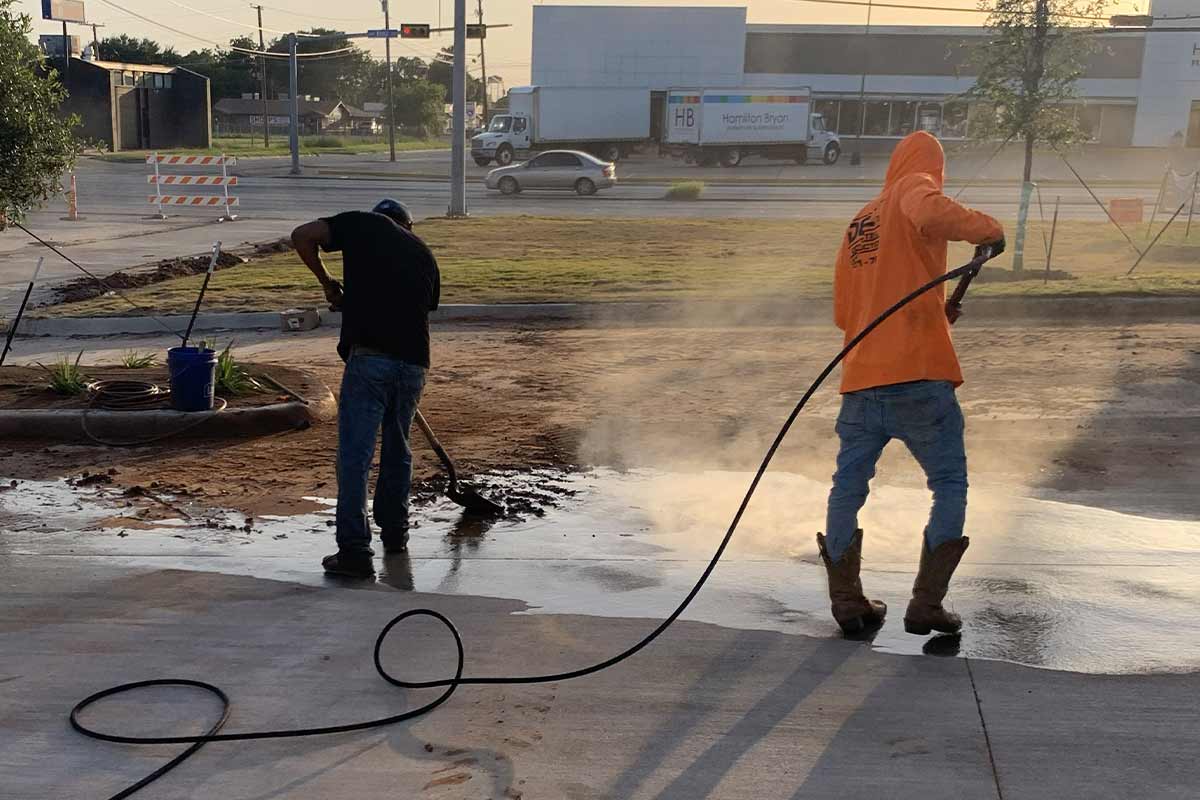
A commercial lot collects things that a broom will not touch. Oil and transmission drips under every stall. Tire rubber and skid marks at the turns. Grease trails behind restaurants and dumpster pads that have been leaking for a season. Gum, bird droppings, algae on the shaded north side, red clay tracked in off a construction entrance, and the gray film that settles on everything between rains. We clean all of it. The point is not only appearance — oil and algae are the two things that make a lot slippery, and a stained entrance drive is the first thing a customer sees and the last thing a property manager gets asked about.
Parking Garage and Multi-Level Structure Cleaning
Structures are their own job. A parking garage is enclosed, it drains to a designed system, and grass is not an option, and the deck above someone’s car is not a place to be casual with water. Multi-level parking structures also collect what an open lot does not: exhaust film on the ceilings and walls, tire rubber ground into the ramps, and standing residue in the drive lanes where the sun never reaches. We work structures deck by deck so half the building stays open, control where the water goes at each level, and coordinate with property management on which bays close when. Stairwells, entry ramps, and elevator lobbies get cleaned as part of the same visit, because those are the surfaces people actually touch.
Pressure Washing vs Power Washing
The two terms get used interchangeably, and there is a real difference underneath them. Power washing heats the water; pressure washing does not. Heat helps on grease, oil, and anything organic that has bonded to the surface, which is why it earns its place behind a restaurant or on a dumpster pad. Unheated pressure at the right setting handles most of what an open parking lot accumulates, and it is gentler on older asphalt. We carry both and pick per surface and never per marketing term. If someone quotes you one word or the other as though it were a different service, it is worth asking what they are actually bringing.
Surfaces: Asphalt, Concrete, and Sealed Decks
| Surface | What it takes | What to watch |
|---|---|---|
| Asphalt | Moderate pressure, wide fan | Too much pressure lifts the binder and leaves a scoured patch that never matches |
| Concrete | Higher pressure, surface cleaner attachment | Stains sit deeper; oil often needs a pre-treatment dwell rather than more pressure |
| Sealed or coated decks | Low pressure, coating-safe method | The coating is the asset; stripping it costs far more than the cleaning saved |
| Painted markings | Reduced pressure, angled away from the line edge | Fresh paint and thermoplastic edges lift if hit square on |
The judgment is in the pressure and the angle, never the machine. We set both for the pavement in front of us and never crank them to maximum.
Wash-Water Capture and TCEQ Stormwater Rules
This is the part most quotes never mention, and it is the reason a cheap wash can become a property manager’s problem.
Rainwater running off a lot into a storm drain is what the system is designed for. Wash water carrying oil, grease, and detergent is not — it is a non-stormwater discharge, and the federal framework for that is the National Pollutant Discharge Elimination System, which in Texas is administered by the Texas Commission on Environmental Quality as the Texas Pollutant Discharge Elimination System. The practical consequence for a commercial lot is straightforward: contaminated wash water should be contained and disposed of properly and never pushed into the nearest storm inlet, and the municipal separate storm sewer system operator for your city sets the local expectations on top of that.
So we block and berm inlets where the work warrants it, recover water, and dispose of it properly. On a garage deck that means working with the structure’s drainage instead of against it. If your property sits under a specific municipal stormwater requirement, tell us and we will work to it.
Sources: TCEQ Texas Pollutant Discharge Elimination System; EPA NPDES — National Pollutant Discharge Elimination System.
Cleaning Before Striping or Sealcoating
Paint bonds to the surface. It does not bond to what is sitting on top of it. Striping over an oily, dusty, or algae-covered lot is the single most common reason lines fail early — they look fine on the day and lift within a season. Where we are striping or sealcoating a lot that has not been cleaned in years, washing first is not an upsell, it is what makes the rest last. Oil spots in particular want a dedicated pre-treatment before any coating goes down, because a spot that has soaked into asphalt will bleed back through fresh sealer.
How Often Commercial Lots and Garages Need Cleaning
It depends on what the property does. Restaurants, grocery anchors, and anything with a dumpster pad or a drive-through generate grease continuously and are usually on an annual or twice-yearly cycle. Office and medical lots go longer. Parking garages tend to need more frequent attention than the open lot beside them, because nothing rinses them. The honest test is not a calendar: look at your entrance drive and your dumpster pad, and if either is visibly darker than the rest of the lot, it is due.
Our Cleaning Process
- Walk and quote. We look at surfaces, stains, drainage, and access, and put a scope on paper.
- Protect and prepare. Inlets protected, vehicles cleared, pre-treatments applied where oil warrants it.
- Clean by surface. Pressure and method set per surface, working in sections so the property keeps operating.
- Recover and dispose. Wash water controlled, recovered, and disposed of properly.
- Final walk. Call (940) 298-0200 for a free estimate.
For a full list of our pavement marking services, visit our parking lot striping in North Dallas page.
Businesses We Serve




How it Works

GET A FREE ESTIMATE
Contact us today and we’ll have a quote to you in 24 hours

SCHEDULE AN INSTALLATION
We’ll have your installation scheduled in less than 7 days, without affecting your business hours

GET A PARKING LOT THAT POPS
For a budget-friendly price, you’ll get a parking lot that looks like new
We proudly work with:


We proudly work with:
Frequently Asked Questions About Parking Lot Pressure Washing in North Dallas, TX
What does parking lot pressure washing remove?
Oil and transmission drips, tire rubber and skid marks, grease trails behind restaurants and around dumpster pads, gum, bird droppings, algae on the shaded side of a building, red clay tracked in from a construction entrance, and the general film that settles between rains. Appearance is part of it, but oil and algae are also the two things that make a lot slippery, so cleaning them is a safety item as much as a cosmetic one.
What is the difference between pressure washing and power washing?
Power washing heats the water; pressure washing does not. Heat earns its place on grease, oil, and anything organic that has bonded to the surface, which is why it belongs behind a restaurant or on a dumpster pad. Unheated pressure at the right setting handles most of what an open lot accumulates and is gentler on older asphalt. We carry both and choose per surface. Anyone selling the two words as different services is selling vocabulary.
Can you pressure wash a parking garage or multi-level structure?
Yes, and structures are their own job. A parking garage drains to a designed system instead of to grass, and there is usually a deck with cars on it below. We work multi-level parking structures deck by deck so half the building stays open, control where the water goes at every level, and coordinate with management on which bays close when. Exhaust film, ramp rubber, stairwells, and elevator lobbies are part of the same visit.
Where does the wash water go?
Not into the nearest storm inlet. Rainwater running off a lot is what the storm system is designed for; wash water carrying oil, grease, and detergent is a non-stormwater discharge. The federal framework is the National Pollutant Discharge Elimination System, administered in Texas by the Texas Commission on Environmental Quality. Practically, we protect inlets, contain and recover the water, and dispose of it properly, plus whatever your city’s stormwater rules add.
Do you need a permit to pressure wash in Texas?
There is no statewide Texas permit to operate a pressure washer. The regulated question is where the water ends up, and that is set by the stormwater rules of the municipality your property sits in, sitting on top of the state and federal discharge framework. Some cities are specific about wash water from commercial cleaning; others are not. We check the requirement for your jurisdiction before the job instead of afterwards.
Should a lot be washed before it is striped?
Yes, wherever the lot has not been cleaned in a while. Paint bonds to the surface and never to what is sitting on top of it, and striping over oil, dust, or algae is the most common reason fresh lines fail within a season. They look fine on the day and lift later. Oil spots in particular want a dedicated pre-treatment before any coating, because a spot soaked into asphalt bleeds back through new sealer.