
Wheel Stop Installation
In Central Dallas, TX
Concrete and Rubber Parking Stops
1-800-STRIPER provides professional wheel stop installation in Central Dallas, TX — anchoring concrete, recycled-rubber, and plastic-composite wheel stops at stall heads to protect sidewalks, storefronts, and ADA accessible routes for commercial properties across the DFW metroplex.
1-800-STRIPER® of Central Dallas PROVIDes Wheel Stops Services NEAR YOU
Need to protect vehicles or walls from accidental damage?
Wheel stops (also called parking blocks) protect your property, enhance safety, and improve parking lot organization.
Benefits:
Wheel stops prevent vehicles from parking too far into a space or overextending into other spots, pedestrian walkways, and other areas, while also helping with vehicle alignment. They can prevent damage to buildings, curbs, or landscaping. Wheel stops also serve as clear visual cues for proper parking and are sometimes used on slopes to prevent cars from rolling.
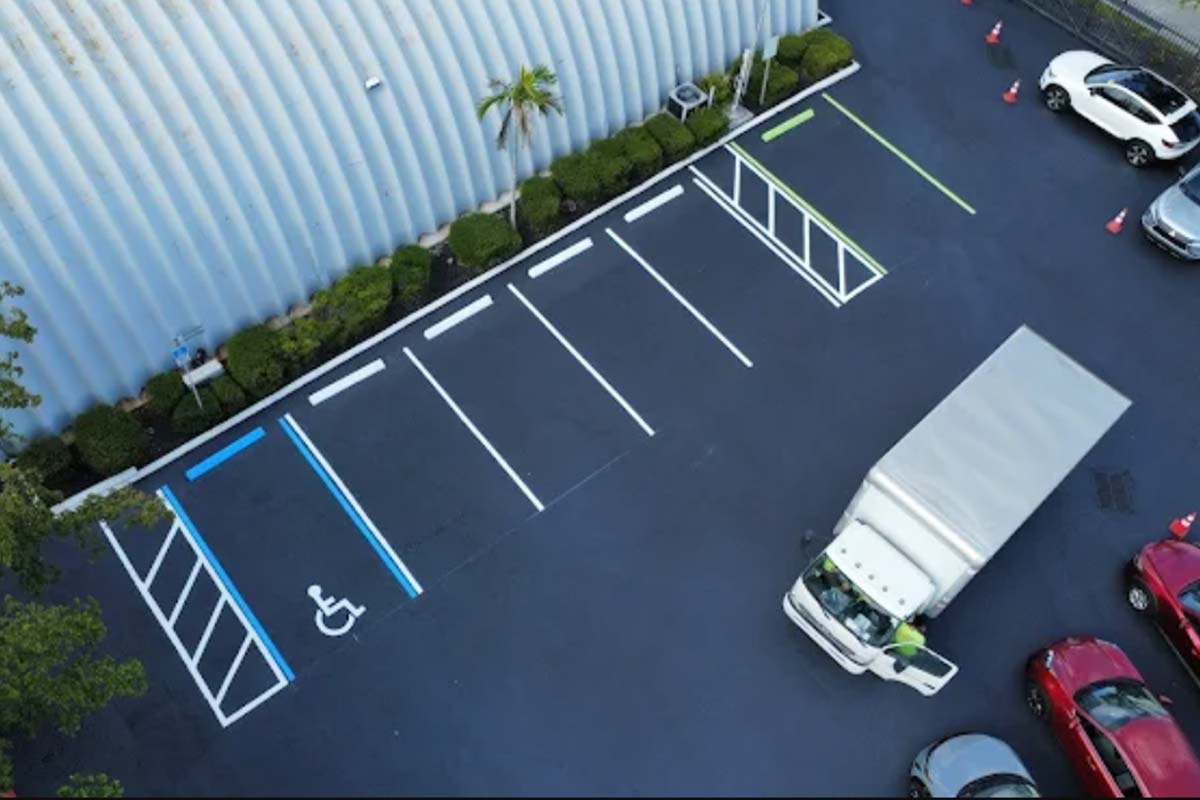
Why Wheel Stops Matter
Vehicles that overrun parking stalls without a physical barrier cause repeatable, predictable damage. Sidewalk concrete cracks under repeated bumper contact. Storefront glass panels and exterior wall cladding absorb direct vehicle strikes that a properly installed wheel stop would have deflected at the stall head. Landscaping, utility cabinets, and ground-mounted signage at lot perimeters are all vulnerable to stall overshoot.
ADA accessible routes are a specific concern. The ADA Standards for Accessible Design, Section 402, establishes minimum clear width requirements for accessible routes adjacent to or crossing through parking areas. When a vehicle overhangs a stall into an access aisle or pedestrian path, the effective clear width narrows — compromising access for wheelchair users and others. Wheel stops positioned at the correct setback contain overhang within the stall boundary and keep the adjacent accessible route clear.
The Institute of Transportation Engineers — ite.org — publishes guidance on parking facility design, including context-appropriate wheel stop placement recommendations that inform commercial lot layouts.
Concrete bumpers at building facades, metal cart corrals, and landscaping borders all serve barrier functions, but none are designed to absorb repeated low-speed vehicle contact. Wheel stops are the dedicated stall-termination device and the correct solution at the stall head.
Wheel Stop Materials
Three materials account for nearly all commercial wheel stop installations in the DFW market. Material selection affects installed weight, handling requirements, resistance to chip-out, and long-term maintenance.
| Material | Weight (6 ft unit) | Lifespan | Typical Use |
|---|---|---|---|
| Concrete | ~250 lb | 15–25+ years | High-traffic lots, permanent installations |
| Recycled Rubber | ~30 lb | 10–15 years | Retrofit installs, lots with freeze-thaw cycling |
| Plastic Composite | ~15 lb | 7–12 years | Low-traffic areas, short-term or seasonal lots |
Concrete wheel stops are the heaviest and most durable option. At approximately 250 pounds per six-foot unit, they resist displacement from vehicle contact under normal commercial parking conditions. Concrete doesn’t compress or deform on impact, and it holds its dimensions through Central Texas heat. The trade-off is chip-out at anchor holes and edges over time, particularly on high-traffic surfaces.
Recycled-rubber wheel stops weigh approximately 30 pounds per unit, making them practical for retrofit projects where lifting equipment is limited. The rubber surface absorbs repeated bumper contact without cracking or spalling, which eliminates the chip-out failure mode that affects concrete in high-cycling applications. Rubber also handles temperature cycling and freeze-thaw conditions well.
Plastic-composite wheel stops are the lightest option at approximately 15 pounds per unit. UV-stabilized formulations resist color fading and surface degradation from prolonged sun exposure. Plastic composite suits lower-traffic applications or temporary installations where weight savings and handling speed matter more than long-term durability.
Wheel Stop Dimensions and Placement
Standard commercial wheel stops are six feet in length. Height options are typically four inches or six inches. Four-inch units are the common specification for standard passenger vehicle stalls; six-inch units provide additional visual prominence and are sometimes used at perimeter stalls adjacent to pedestrian zones or at locations with a history of overshoot.
Placement setback from the front edge of the stall is four inches. This setback accommodates bumper overhang so the vehicle’s bumper contacts the wheel stop at tire level without the front of the vehicle overhanging the sidewalk, pedestrian path, or landscaping beyond. Setting a wheel stop flush to the stall edge eliminates the overhang allowance and moves the vehicle-stopping point rearward into the stall, reducing effective stall depth.
Wheel stops are centered laterally within the stall, parallel to the stall front edge. In angled stall configurations, the wheel stop is set perpendicular to the stall centerline — not to the lot drive aisle. Correct angular alignment keeps the stop perpendicular to the vehicle’s travel direction at the point of contact.
Anchoring Methods
Anchor selection depends on the surface material. The wrong anchor in the wrong substrate produces a wheel stop that lifts, rotates, or walks out of position under repeated vehicle contact.
Rebar pin into asphalt. Asphalt installations use steel rebar pins, typically 10 to 18 inches in length, driven through pre-drilled holes in the wheel stop and into the asphalt below. Pin length is selected based on asphalt thickness and base-course depth. Two pins per unit are standard — one at each end, positioned inboard of the ends to avoid edge splitting.
Bolt-and-anchor into concrete. Concrete surface installations use a sleeve anchor or wedge anchor set into the concrete substrate, with a bolt running through the wheel stop into the anchor. Concrete anchors require clean, properly sized holes drilled with a rotary hammer to avoid cracking the concrete around the anchor seat.
Tapered stake anchors for recycled-rubber units. Recycled-rubber wheel stops typically ship with integral tapered stake anchors — tapered steel or high-density plastic stakes that press through pre-molded holes and into the surface below. Stake length and material are matched to surface type by the manufacturer.
Our Wheel Stop Installation Process in Central Dallas
- Site layout. Stall positions are confirmed against the existing stripe layout. Wheel stop placement points are marked at the four-inch setback from the stall front edge, centered within each stall width.
- Anchor hole drilling. Holes are drilled at each anchor point — rotary hammer for concrete, standard drill for asphalt — to the depth and diameter required by the anchor type and surface.
- Wheel stop placement. Units are set on the marked footprint, aligned perpendicular to the stall centerline and confirmed level.
- Pin or bolt installation. Anchors are driven or torqued to manufacturer specification. Rebar pins are driven flush. Bolts are torqued to seat the anchor without cracking the substrate.
- Final QA. Each installed unit is checked for alignment, lateral stability, and secure anchoring. Any unit that rocks or shifts under hand pressure is re-anchored before the job is closed.
For a full list of our pavement marking services, visit our parking lot striping in Central Dallas page.
Businesses We Serve




How it Works

GET A FREE ESTIMATE
Contact us today and we’ll have a quote to you in 24 hours

SCHEDULE AN INSTALLATION
We’ll have your installation scheduled restriped in less than 7 days, without affecting your business hours

GET A PARKING LOT THAT POPS
For a budget-friendly price, you’ll get a parking lot that looks like new
We proudly work with:


We proudly work with:


Frequently Asked Questions About Wheel Stop Installation in Central Dallas, TX
What is the standard length for a wheel stop, and does it vary by stall type?
Standard wheel stops are 6 feet long — the most common size for passenger-vehicle parking stalls. Accessible (ADA) stalls typically require an 8-foot wheel stop to span the full stall width and prevent vehicle overhang from encroaching on the adjacent access aisle. 1-800-STRIPER supplies and installs both lengths across Dallas, Tarrant, Denton, and Rockwall counties.
What is the difference between concrete and rubber wheel stops?
Concrete wheel stops are the most economical option and are installed by driving rebar anchors through the stop and into the pavement. Rubber wheel stops — made from recycled tire material — are lighter, more weather-resistant, and installed with lag bolts or epoxy. Concrete is the go-to choice for high-volume lots; rubber is preferred where surface drilling is restricted or environmental considerations apply. Call (214) 884-3669 for a free estimate on either material.
How are wheel stops anchored, and does the method differ by pavement type?
On asphalt, steel rebar is hammered through the pre-drilled holes in the wheel stop and down into the pavement — asphalt’s semi-viscous composition holds rebar securely. On concrete or paver surfaces, lag bolts with epoxy anchoring are used instead, since hammering rebar into a rigid slab would crack it. In parking garages with post-tension cables, epoxy is the standard method to avoid cutting the cables.
Can wheel stops be installed on both asphalt and concrete parking lots?
Yes. 1-800-STRIPER installs wheel stops on asphalt, concrete, and paver surfaces across the DFW metroplex. The anchoring method is selected based on the pavement type during the site assessment — no guesswork. Both materials can also be painted or marked with reflective tape to improve visibility.
Do wheel stops need to be reflective or marked for nighttime visibility?
Reflective marking is not mandated by a single federal standard, but it is a strongly recommended best practice for safety and risk management. Yellow paint and adhesive reflective tape applied to the top face of wheel stops significantly improve visibility in low-light conditions. 1-800-STRIPER can apply reflective markers at the time of installation across Central Dallas commercial properties.
Where should wheel stops not be placed in ADA-accessible parking stalls?
Under ADA guidelines, wheel stops in accessible stalls must not obstruct the adjacent access aisle or reduce the accessible route width below 36 inches. If the accessible route runs in front of the stall, the wheel stop must be positioned to prevent the vehicle from overhanging into that path. When correctly placed, a wheel stop protects the route — when incorrectly placed, it blocks it. 1-800-STRIPER follows ADA placement standards on every accessible-stall installation.
How long do wheel stops last before they need replacement?
Concrete wheel stops in high-traffic lots typically show cracking within several years as repeated bumper contact stresses the material. Recycled rubber wheel stops are more resilient to impact and UV exposure and generally outlast concrete in comparable conditions. Both materials benefit from periodic inspection — faded, cracked, or displaced wheel stops should be replaced promptly to maintain safety and code compliance.
What property types does 1-800-STRIPER serve for wheel stop installation in Central Dallas?
1-800-STRIPER installs wheel stops at retail centers, office parks, warehouses and distribution facilities, healthcare campuses, schools, and HOA communities throughout Dallas, Tarrant, Denton, and Rockwall counties. Call (214) 884-3669 for a free on-site estimate.