Parking Lot Layout Design
In Central Dallas, TX
Customized Parking Lot Layouts
1-800-STRIPER provides professional parking lot layout design in Central Dallas, TX — custom-engineered layouts that maximize parking capacity, ensure ADA compliance per the 2010 ADA Standards for Accessible Design, and meet MUTCD pavement marking specifications for commercial properties across the DFW metroplex.
1-800-STRIPER® of Central Dallas PROVIDes New Layouts Services NEAR YOU
Are you ready to create a great first impression?
A proper parking lot layout with clear markings is critical for any business that serves the public. Let us help you make a great first impression with an attractive, well-organized, and safe parking lot.
Benefits:
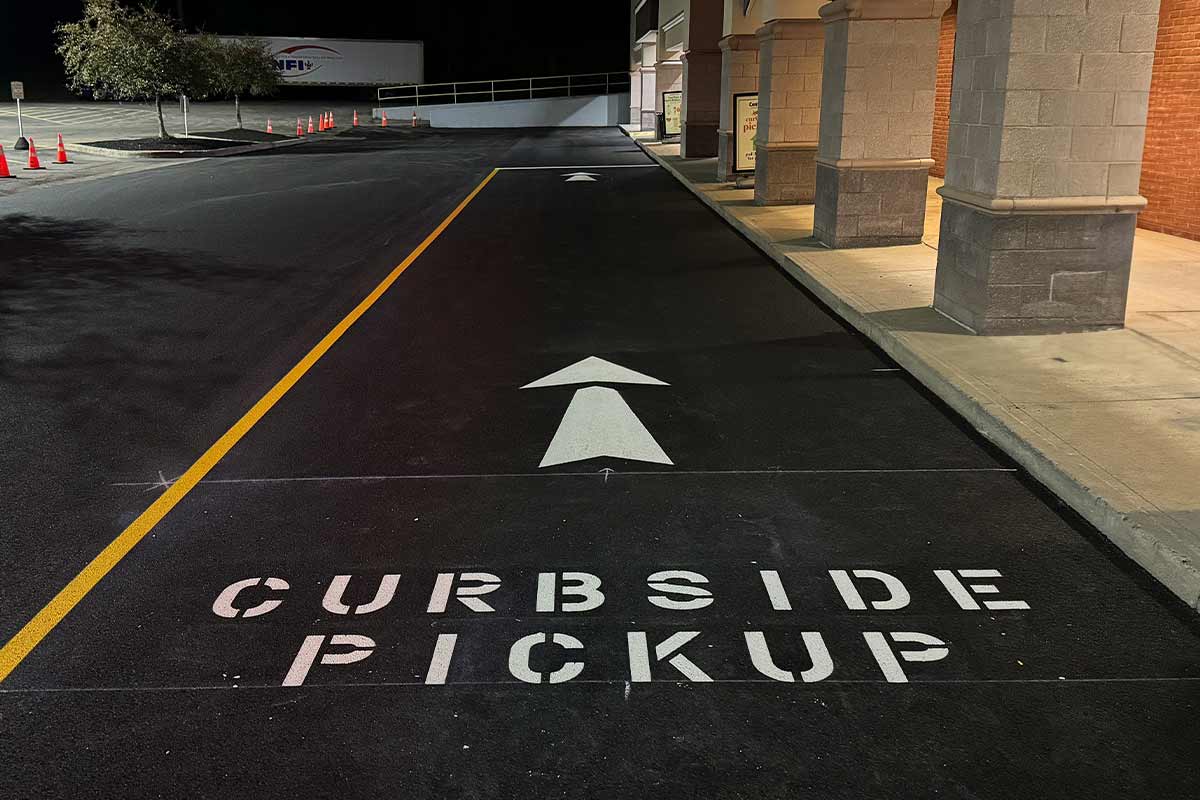
Parking Lot Layout Design Goals
A well-designed parking lot balances four interdependent objectives: maximizing vehicle capacity within the available footprint, maintaining ADA-compliant accessible routes and stall dimensions, optimizing traffic flow to reduce conflict points, and clearly marking every lane, stall, and restricted zone per applicable pavement marking standards. Commercial properties in Central Dallas face added pressure from high traffic volumes and mixed-use access patterns. Getting the layout right before the first stripe goes down prevents costly re-striping, reduces liability exposure, and keeps daily operations moving without congestion or confusion.
ADA §502 Compliance in Layout Design
The 2010 ADA Standards for Accessible Design, Chapter 5 (§502), sets the minimum requirements every parking lot layout must satisfy. Standard accessible stalls must measure at least 8 feet wide with a 5-foot access aisle; van-accessible stalls require either an 11-foot-wide stall or an 8-foot stall with an 8-foot adjacent access aisle. At least one van-accessible space is required per accessible cluster. Access aisles must connect directly to an accessible route leading to the facility entrance — they cannot terminate at a barrier or curb without a compliant curb ramp.
Required ratios scale with total lot capacity: one accessible space per 1–25 total spaces, two per 26–50, and so on up to six for lots of 151–200 spaces, with one van-accessible space required for every six accessible spaces provided. The U.S. Access Board publishes the full Chapter 5 technical specifications, including surface slope tolerances (no steeper than 1:48 in any direction within accessible stalls and aisles) and signage height requirements. Every layout 1-800-STRIPER designs for Central Dallas properties is reviewed against these specifications before any CAD work is finalized.
MUTCD Pavement Marking Standards
The Manual on Uniform Traffic Control Devices governs pavement marking colors, widths, and applications for parking facilities open to public use. Standard parking stall lines are white; fire lanes and no-parking zones use yellow. Lane lines in two-way drive aisles are yellow; one-way aisles use white directional markings. Longitudinal markings (stall lines) run 4 inches wide; stop bars and crosswalks are marked at 12–24 inches depending on application. Airless striping equipment holds consistent line width and edge definition across the full lot surface, keeping markings within MUTCD dimensional tolerances from the first pass.
Stall Configuration (90°, 60°, 45°, Parallel)
Stall angle is the single biggest lever in parking capacity planning. Each configuration involves trade-offs between density, drive aisle width, and ease of ingress and egress.
| Stall Angle | Relative Density | Ingress Difficulty | Typical Use |
|---|---|---|---|
| 90° | Highest | Moderate — requires precise turns | High-volume commercial, retail, warehouses |
| 60° | High | Lower — angled entry reduces turn radius | Mixed commercial, medical offices |
| 45° | Moderate | Lowest — easiest pull-in | Low-speed lots, older shopping centers |
| Parallel | Lowest | Highest — parallel parking maneuver required | Street-adjacent lots, narrow corridors |
Ninety-degree stalls maximize the number of stalls per linear foot of lot depth and work best in lots with sufficient two-way drive aisle width (24 feet minimum). Sixty-degree layouts pair well with one-way aisles and suit medical campuses and office parks where driver familiarity with the lot is lower. Forty-five-degree configurations show up in older Central Dallas surface lots where original geometry favored easier ingress over peak density. Parallel stalls are reserved for narrow or irregular parcels where angled stalls are geometrically impractical.
Drive Aisle Width Requirements
Drive aisle width must match stall angle and traffic direction. For 90-degree stalls with two-way traffic, the ITE and ULI standard is 24 feet of clear aisle width — enough for two opposing vehicles to pass without encroachment. One-way aisles serving 90-degree stalls need at least 20–22 feet. One-way aisles serving 60-degree or 45-degree stalls can drop to 14–18 feet, which is where angled layouts recover land area lost from lower stall density. Fire lanes add a fixed constraint: the Dallas Fire Code (IFC §503.2.1) requires a minimum 20-foot unobstructed clear width regardless of stall configuration. All aisle widths in 1-800-STRIPER layouts are dimensioned to satisfy both the geometric stall-angle minimum and any applicable fire access overlay.
Accessible Route Integration (ADA §402)
ADA §402 governs accessible routes connecting accessible parking stalls to building entrances. The minimum clear width for an accessible route is 36 inches, expanding to 60 inches at passing spaces where two wheelchair users may need to pass. Maximum running slope is 1:20 (5%); cross slope cannot exceed 1:48. Where an accessible route crosses a drive aisle, a marked crosswalk with detectable warning surfaces at curb transitions is required. Layout design accounts for accessible route corridors before stall rows are finalized — routes retrofitted after stall placement often require compromises that push the route out of compliance. Building §402 requirements in from the start protects against regulatory exposure and the cost of re-marking an already-striped lot.
Traffic Flow and Wayfinding
Clear traffic flow markings reduce vehicle conflicts and lower the incidence of low-speed collisions — a measurable liability factor for commercial property owners. Directional arrows go at aisle entries and at any decision point where a driver might proceed the wrong way. Stop bars are positioned at aisle-to-aisle intersections and wherever vehicles must yield to pedestrian crossings. One-way aisles get “DO NOT ENTER” or “ONE WAY” legends at entries. For larger Central Dallas commercial lots, entrance and exit lanes are differentiated with color and legend markings to block wrong-way entry from adjacent streets.
Loading Zones, Fire Lanes, and Service Access
Loading zones and fire lanes carry fixed dimensional and marking requirements that take priority in layout planning. Fire lanes carry a minimum 20-foot unobstructed clear width under the Dallas Fire Code (IFC §503.2.1), marked with curb paint and “FIRE LANE — NO PARKING” pavement legends where the fire marshal requires them. Loading zones are marked in yellow with the legend “LOADING ZONE” and sized to handle the largest delivery vehicle the property anticipates. Service access aprons for dumpster enclosures and utility access points are kept clear of stall overhangs. All three zone types are blocked out in the initial layout before stall rows are dimensioned — skip this step and geometry conflicts compress productive parking area later.
Our Design Process
- Site measurement — physical or plan-based dimensions of the lot footprint, including all fixed obstacles, curb lines, and utility covers.
- CAD layout — stall configuration, aisle widths, accessible stall count and placement, fire lane corridors, and loading zones drawn to scale.
- ADA compliance review — accessible stall ratios, aisle dimensions, route widths, and slopes verified against 2010 ADA Standards §502 and §402.
- Striping execution — Airless striping equipment applied per the approved CAD layout; markings meet MUTCD color, width, and legend specifications.
Service Area and Free Estimates
1-800-STRIPER of Central Dallas serves commercial properties throughout the DFW metroplex, including Central Dallas, Uptown, Deep Ellum, Oak Cliff, and surrounding areas. Call (214) 884-3669 for a free estimate on parking lot layout design — a 1-800-STRIPER crew will assess your site and provide a layout recommendation at no obligation.
For a full list of our pavement marking services, visit our parking lot striping in Central Dallas page.
Businesses We Serve




How it Works

GET A FREE ESTIMATE
Contact us today and we’ll have a quote to you in 24 hours

SCHEDULE AN INSTALLATION
We’ll have your installation scheduled in less than 7 days, without affecting your business hours

GET A PARKING LOT THAT POPS
For a budget-friendly price, you’ll get a parking lot that looks like new
We proudly work with:


We proudly work with:


Frequently Asked Questions About Parking Lot Layout Design in Central Dallas, TX
What does parking lot layout design include beyond the striping itself?
Parking lot layout design is the planning phase that precedes any striping work. It determines stall geometry, parking angles, drive-aisle widths, ADA space placement, fire-lane routing, crosswalk positions, directional arrow placement, and signage locations. 1-800-STRIPER of Central Dallas produces a complete layout plan — then the same crew executes the striping — so design intent and field execution stay aligned from start to finish.
How many ADA accessible spaces are required by law in a parking lot?
The ADA Standards for Accessible Design specify a minimum number of accessible stalls based on total lot capacity: one accessible space per 25 total stalls up to 100 stalls, scaling down proportionally for larger lots. At least one space in every accessible parking area must be van-accessible with an eight-foot access aisle. 1-800-STRIPER of Central Dallas designs layouts that meet or exceed these federal requirements.
What are the fire lane placement and width requirements for DFW lots?
The Dallas Fire Code (IFC §503) and local fire marshal guidelines generally require fire lanes to maintain a minimum unobstructed width of 20 feet, with turning radii sufficient for ladder trucks and pumpers. During the layout design phase, 1-800-STRIPER of Central Dallas identifies fire lane routes that satisfy code and integrate cleanly with stall geometry and pedestrian circulation paths.
What drive-aisle widths are used in a standard parking lot layout?
Drive-aisle width depends on parking angle. A 90-degree stall layout typically requires a 24-foot two-way aisle; 60-degree angled layouts can use a narrower one-way aisle of approximately 18 feet; 45-degree layouts are often paired with 13- to 16-foot one-way aisles. 1-800-STRIPER of Central Dallas selects aisle widths based on expected traffic flow, vehicle mix, and ADA and fire-access requirements specific to each property.
What format are layout design deliverables provided in?
The layout plan is delivered as a marked-up site diagram showing stall count, ADA space locations, fire lane routes, aisle flow direction, and key dimensions — giving property owners and contractors a clear reference document. For larger or phased projects in the DFW area, additional detail can be provided as needed. Contact 1-800-STRIPER of Central Dallas at (214) 884-3669 to discuss deliverable format for your specific project.
Can the layout be revised if site conditions change after the design phase?
Yes. If field conditions differ from the original site plan — utility conflicts, drainage modifications, revised building footprint — the layout can be adjusted prior to striping. 1-800-STRIPER of Central Dallas reviews conditions on-site before crews begin marking, and minor routing adjustments are accommodated within the same project scope. For significant redesigns, a revised plan is produced before any paint is applied.
How is pricing for parking lot layout design determined?
Layout design pricing reflects lot size, complexity, the number of ADA and fire lane elements required, and whether the project involves a new surface or reconfiguration of an existing lot. Because every commercial property in the DFW metroplex has different dimensions and code requirements, 1-800-STRIPER of Central Dallas provides free, on-site estimates tailored to your specific property. Call (214) 884-3669 to schedule.