
Bollard Installation
In Central Dallas, TX
Safety and Security Bollards
1-800-STRIPER provides professional bollard installation in Central Dallas, TX — anchoring concrete-filled steel, decorative, and removable bollards to protect storefronts, ADA access aisles, and fire department connections per ASTM F3016 impact specifications for commercial properties across the DFW metroplex.
1-800-STRIPER® of Central Dallas PROVIDes Bollard Installation Services NEAR YOU
Want to prevent accidents and protect your property?
Bollards provide physical protection for your customers and your property.
Safety and security:
Bollards create a physical barrier between vehicles and pedestrians, protecting people in walking areas from accidental or intentional vehicle intrusions.
Bollards act as a protective barrier around storefronts, gas stations, and other vulnerable areas, minimizing the risk of costly damage from vehicle impacts.
Strategic Placement Locations:
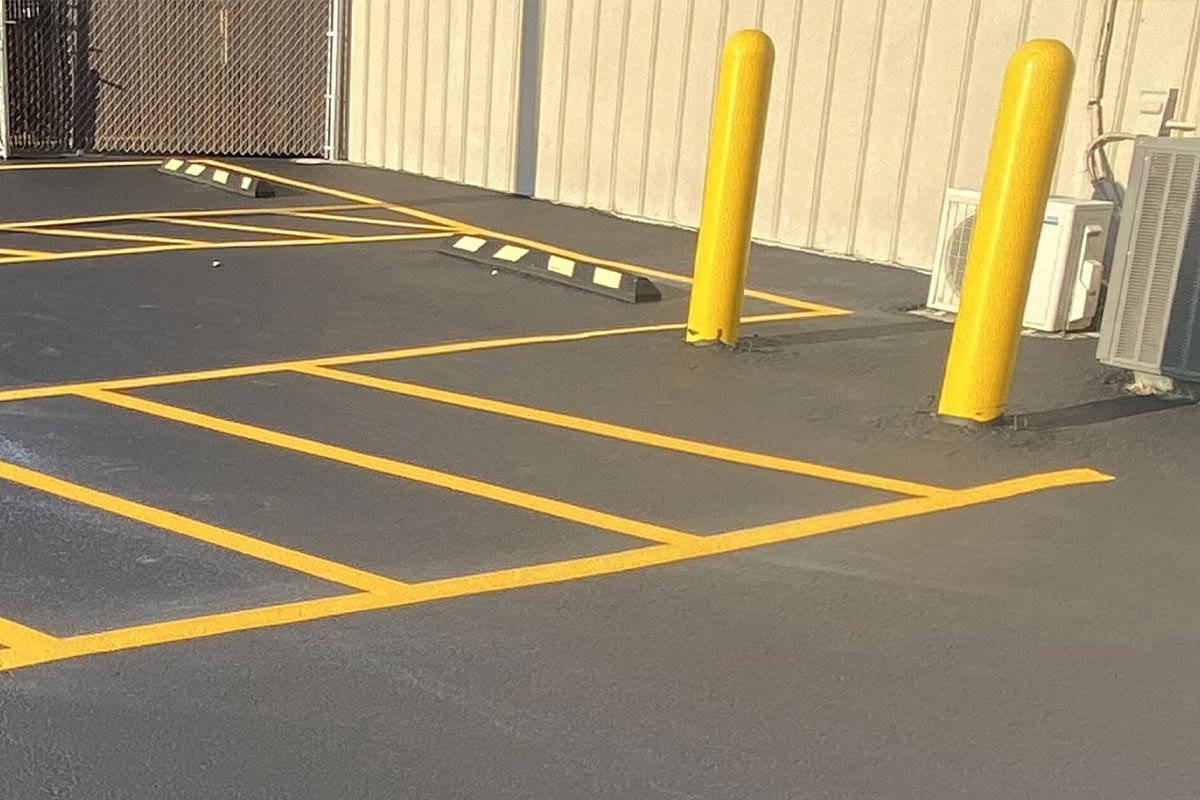
Bollard Types and Use Cases
Parking lots and commercial storefronts need physical barrier protection that fencing contractors rarely provide. 1-800-STRIPER installs three primary bollard categories suited to commercial property needs across Central Dallas.
Security bollards are concrete-filled Schedule 40 or Schedule 80 steel pipes. They’re the most common type at storefronts, fuel canopies, and building corners. Their mass and embedment depth absorb vehicle impact loads without structural failure.
Decorative bollards combine an architectural cover — available in cast iron, powder-coated steel, or polymer — over a steel core pipe. They deliver the same protection as plain security bollards while matching a building’s exterior aesthetic. Retail centers and mixed-use properties in the Uptown and Deep Ellum corridors regularly specify decorative covers.
Removable bollards use a lockable receiver sleeve set in concrete at grade. The post drops into the sleeve and locks in place; authorized personnel can lift it out to allow temporary vehicle access. Loading dock entrances and event spaces that need flexible access control are the most common applications.
| Bollard Type | Core Material | Typical Use | Removable |
|---|---|---|---|
| Security | Concrete-filled steel pipe | Storefronts, fuel islands, building corners | No |
| Decorative | Steel core + architectural cover | Retail, mixed-use facades | No |
| Removable | Steel post + in-ground receiver | Loading docks, event access lanes | Yes |
ASTM F3016 Impact Ratings
ASTM F3016 is the current standard for shallow-foundation vehicle impact protection. It classifies bollards by their resistance to a 4,000-pound vehicle at speeds from 10 mph to 50 mph, producing rated designations such as M30 P1, M40 P2, and M50 P3. Each tier indicates the test vehicle speed (M = mph) and penetration tolerance (P1 through P4, with P1 the most restrictive).
F3016 differs meaningfully from ASTM F2656, which governs anti-ram crash-rated barriers tested with a 15,000-pound vehicle. Most commercial parking-lot bollard installations fall under F3016 rather than F2656 because the exposure risk — errant passenger vehicles or low-speed smash-and-grab incidents — aligns with the lighter test vehicle. Specifying F2656 at a typical storefront is overdesign; specifying nothing leaves you with no documented performance baseline.
The Institute of Transportation Engineers — ite.org — publishes guidance on vehicle barrier selection and context-appropriate impact specifications that can inform site-specific bollard planning decisions.
Concrete-filled Schedule 40 steel pipe at typical commercial embedment depth generally meets F3016 M30 P1 (10 mph, minimal penetration) without additional engineering. Higher rated performance requires larger pipe diameters, heavier wall schedules, and deeper footings confirmed by a licensed engineer.
Where Bollards Are Required
Several code and regulatory frameworks create mandatory or strongly recommended bollard placement requirements for commercial properties in Texas.
ADA Section 307 — Protruding Objects. ADA Standards for Accessible Design, Section 307, prohibits objects that protrude into circulation paths in ways that cane users cannot detect. Bollards at the end of ADA access aisles, curb cuts, or accessible routes must comply with reach-range and detection requirements. Post-only bollards without a cane-detectable base create ADA exposure.
International Fire Code Section 912 — Fire Department Connections. IFC §912 requires that fire department connections (FDCs) remain accessible and unobstructed. Bollards are commonly installed around FDC standpipes at commercial buildings to prevent vehicle damage to the connection hardware while keeping the required clear working space available for fire apparatus.
Storefront protection — commercial best practice. Texas building code does not universally mandate storefront bollards, but commercial property insurers increasingly expect physical vehicle-intrusion mitigation at high-exposure facades. Storefronts with direct parking-stall-to-glass exposure, fuel canopies, and ATM locations are the most common voluntary installations across the DFW market.
Propane and utility cylinder storage. Commercial properties that store liquid propane cylinders or utility metering equipment outdoors are subject to NFPA 58 setback and protection requirements. Bollards anchored at the correct spacing provide compliant vehicle separation around cylinder cages and meter banks.
Bollard Materials
Material selection affects both long-term maintenance cost and installed appearance. The four materials most commonly specified for commercial bollard work in Central Dallas are:
Concrete-filled Schedule 40 steel pipe is the baseline for security bollards. The concrete fill prevents the pipe from crushing inward on impact and distributes load into the footing. Schedule 40 wall thickness handles standard commercial exposures; high-traffic fuel islands or drive-through queuing lanes often call for Schedule 80.
Schedule 80 steel pipe has a heavier wall than Schedule 40 at the same nominal diameter, providing greater resistance to shear loads from vehicle strikes. The material cost increase is modest relative to the performance gain at elevated-risk locations.
Stainless steel is selected where corrosion resistance or a polished architectural appearance is the priority. Stainless costs more but eliminates the repainting cycle. It’s common at upscale retail, medical campuses, and building entrances.
Decorative cast iron with steel core pairs a traditional aesthetic with structural performance. The outer cast-iron sleeve is not structural — the inner steel pipe carries the load. These are common at historic commercial districts and mixed-use developments where plain pipe would look out of place.
Foundation, Embedment, and Anchoring
Bollard performance under vehicle impact depends more on the foundation than on the pipe itself. A correctly embedded bollard transfers impact load to the surrounding concrete and soil; an undersized footing lets the pipe lever out.
Standard embedment depth for a security bollard is 36 inches below finished grade. The concrete footing is typically 24 inches in diameter and 36 inches deep, poured monolithically around the pipe. In existing asphalt or concrete, the installation sequence involves core drilling or jackhammering the surface, excavating to footing depth, setting the pipe plumb, and pouring footing concrete.
Surface-mount bollards attach to existing concrete slabs via an anchor cage or bolt pattern. They’re used where deep excavation isn’t practical — over parking structure decks or areas with subsurface utilities at shallow depth. Surface-mount bollards are more vulnerable to shear because there’s no embedment to distribute load, and their impact rating is typically lower than equivalent embedded installations.
Concrete cure time is a critical hold-point. Structural load transfer is achievable at seven days; full design strength at 28 days. Bollards in drive-through or active traffic lanes should be protected from vehicle contact until full cure to avoid shear failure at the base.
Our Bollard Installation Process in Central Dallas
- Site review — Walk the property to confirm bollard locations, spacing, and clearance against ADA access aisles and fire department connections.
- Permit check — Verify whether a permit is required for the scope and municipality within the DFW metroplex.
- Core drilling or excavation — Cut or excavate existing pavement to footing depth at each bollard location.
- Bollard installation — Set pipe plumb in footing, pour concrete, and brace during cure.
- Concrete cure hold — Allow minimum seven days before traffic exposure.
- Walkthrough — Verify alignment, install decorative covers where specified, and confirm no ADA or FDC clearance violations before sign-off.
For a full list of our pavement marking services, visit our parking lot striping in Central Dallas page.
Businesses We Serve




How it Works

GET A FREE ESTIMATE
Contact us today and we’ll have a quote to you in 24 hours

SCHEDULE AN INSTALLATION
We’ll have your installation scheduled in less than 7 days, without affecting your business hours

GET A PARKING LOT THAT POPS
For a budget-friendly price, you’ll get a parking lot that looks like new
We proudly work with:


We proudly work with:


Frequently Asked Questions About Bollard Installation in Central Dallas, TX
What are bollards and why do commercial properties in Central Dallas install them?
Bollards are sturdy steel or concrete posts installed to protect buildings, pedestrians, and equipment from vehicle impact — whether accidental or intentional. In the DFW metroplex, common applications include storefront crash protection, fuel pump and electrical equipment guarding, pedestrian zone separation, drive-thru lane delineation, and keeping fire egress paths clear. 1-800-STRIPER installs bollards across Dallas, Tarrant, Denton, and Rockwall counties.
What type of steel pipe is used for bollard installation?
Standard commercial bollards use Schedule 40 steel pipe, typically 4 to 6 inches in diameter for general-duty applications and up to 12 inches for high-security installations. Schedule 40 provides the wall thickness needed to resist vehicle impact without excessive material cost. The pipe is filled with concrete after embedment to add mass and impact resistance. 1-800-STRIPER sources heavy-duty steel pipe meeting industry specifications for every installation.
How deep are bollards embedded, and why does embedment depth matter?
Embedded bollards are typically set 36 to 48 inches below grade, with the surrounding excavation filled with concrete. Embedment depth is the primary factor in impact performance — a shallow installation can be sheared or uprooted under vehicle force, regardless of the pipe’s surface height or wall thickness. Proper depth also prevents heaving in expansive clay soils common in the DFW area.
What is the ASTM F2656 K-rating system, and which rating do I need?
ASTM F2656 is the full-scale crash-test standard for vehicle security barriers. K-ratings classify the speed at which a tested barrier stops a 15,000 lb vehicle: K4 (M30) = 30 mph impact; K8 (M40) = 40 mph impact; K12 (M50) = 50 mph impact. Most retail and office storefronts are well served by K4-rated bollards, which address accidental low-speed incidents. High-risk facilities — fuel stations, utility infrastructure, government or financial buildings — may specify K8 or K12. 1-800-STRIPER can help determine the appropriate rating for your site; call (214) 884-3669 for a free estimate.
What is the difference between embedded bollards and surface-mounted bollards?
Embedded bollards are core-drilled or excavated into the pavement and backfilled with concrete, creating a permanent installation with the highest impact resistance. Surface-mounted bollards attach to the existing slab with anchor bolts — installation is faster and less disruptive, but impact capacity is lower and load transfers to the slab anchors. For storefront crash protection or any high-impact-risk application, 1-800-STRIPER recommends embedded installation.
Are removable bollards available, and when are they used?
Yes. Removable bollards use a receiver sleeve permanently set in the ground; the bollard post locks into the sleeve and can be lifted out with a key or tool. They are used in areas that need occasional vehicle access — loading zones, event venue entrances, emergency-vehicle paths — while maintaining a physical barrier the rest of the time. 1-800-STRIPER installs both permanent and removable systems across the DFW metroplex.
What finish and color options are available for bollards?
Standard safety bollards are finished in high-visibility yellow paint or powder coat. Decorative options include custom powder-coat colors, plastic sleeve covers, stone veneer, and stainless or galvanized finishes for architectural settings. Reflective tape banding is also available to improve nighttime conspicuity — particularly useful near pedestrian crossings and drive-thru lanes. All finishes are selected to withstand the heat and UV exposure of the Central Texas climate.
Can 1-800-STRIPER repair a bollard that has been hit by a vehicle?
Yes. When a bollard is dented, bent, or knocked loose by vehicle contact, it loses structural integrity and should be addressed promptly. 1-800-STRIPER assesses whether the post can be reset and refinished or requires full replacement. If surrounding pavement was damaged in the impact, concrete repair is integrated into the same scope of work. Call (214) 884-3669 for a free assessment across Dallas, Tarrant, Denton, and Rockwall counties.