
ADA Parking Lot Striping
In Central Dallas, TX
ADA-Compliant Accessible Parking
1-800-STRIPER provides ADA-compliant parking lot striping in Central Dallas, TX — installing accessible spaces, van-accessible stalls, access aisles, ISA symbols, and required signage per the 2010 ADA Standards for Accessible Design and Texas Accessibility Standards (TAS) for commercial properties across the DFW metroplex.
1-800-STRIPER® of Central Dallas PROVIDes ADA Compliance Services NEAR YOU
Need to make your property more accessible?
Upgrade your facility to become fully ADA compliant by partnering with us to create clear, accessible parking for all your visitors.
Our ADA Compliant line striping services include:
What ADA Parking Lot Striping Requires
Federal law under the Americans with Disabilities Act mandates accessible parking for any facility open to the public or serving employees. The governing technical document — the 2010 ADA Standards for Accessible Design published on ADA.gov — specifies requirements under three primary sections: §208 (parking spaces), §502 (accessible parking space dimensions), and §216.5 (parking signs). Section §703.7 governs the International Symbol of Accessibility used to mark each accessible stall.
Together these sections define the number of spaces required, stall and access-aisle widths, vertical clearance for van-accessible spaces, symbol specifications, and sign mounting. A facility must satisfy all four sections to achieve compliance — partial striping that meets dimension requirements but omits required signage, or that installs the correct number of spaces but uses non-conforming aisle widths, still constitutes a deficiency under the Standards.
1-800-STRIPER measures, lays out, and stripes accessible parking to satisfy each of these ADA sections together, ensuring the completed installation reflects the full scope of what the Standards require.
Accessible Stall Count Requirements
The number of accessible parking spaces a facility must provide is determined by the total number of spaces in each parking facility — not by building type or square footage. ADA §208.2 sets minimum counts on a sliding scale:
| Total Parking Spaces | Minimum Accessible Spaces Required |
|---|---|
| 1–25 | 1 |
| 26–50 | 2 |
| 51–75 | 3 |
| 76–100 | 4 |
| 101–150 | 5 |
| 151–200 | 6 |
| 201–300 | 7 |
| 301–400 | 8 |
| 401–500 | 9 |
| 501–1,000 | 2% of total |
| 1,001 and over | 20, plus 1 for each 100 over 1,000 |
Each parking facility on a site is counted separately. A campus with three separate lots, each with 80 spaces, must provide four accessible spaces in each lot — not four total across the campus.
Of the required accessible spaces, at least one in every six (or fraction of six) must be van-accessible. For a facility with exactly four required accessible spaces, at least one must meet van-accessible dimensions. For six required accessible spaces, at least one must still meet van-accessible requirements; the fraction rounds up, so seven required spaces also trigger a second van-accessible stall.
1-800-STRIPER calculates the correct count and van-accessible breakdown for each lot as part of the pre-striping assessment.
Van-Accessible Stalls and Access Aisles
Van-accessible spaces impose stricter dimensional requirements than standard accessible stalls because they must accommodate vehicles with side-mounted lifts or ramps. ADA §502.3 and §502.4 define two compliant configurations:
Configuration A — Wider stall with standard aisle: The parking space is at least 11 feet wide and the adjacent access aisle is at least 5 feet wide, for a combined width of 16 feet. This is the most common configuration in lots with adequate space.
Configuration B — Standard stall with wider aisle: The parking space is at least 8 feet wide and the adjacent access aisle is at least 8 feet wide, also yielding a combined 16-foot envelope. This configuration lets the lot maintain standard-width stalls while providing the necessary maneuvering room through a wider aisle.
In both configurations, the access aisle must be at the same level as the stall it serves and must connect directly to an accessible route leading to the building entrance. The aisle may be shared between two accessible spaces where layout permits, but it cannot be shared with a drive aisle or pedestrian travel path that would force a wheelchair user to travel behind parked vehicles.
Van-accessible spaces require a minimum vertical clearance of 98 inches (approximately 8 feet 2 inches) along the entire vehicle route from the parking facility entrance to the van space, including at any overhead obstruction such as beams, pipes, or signage mounts. Surface slopes within both the stall and the access aisle must not exceed 1:48 in any direction.
ISA (International Symbol of Accessibility) Specifications
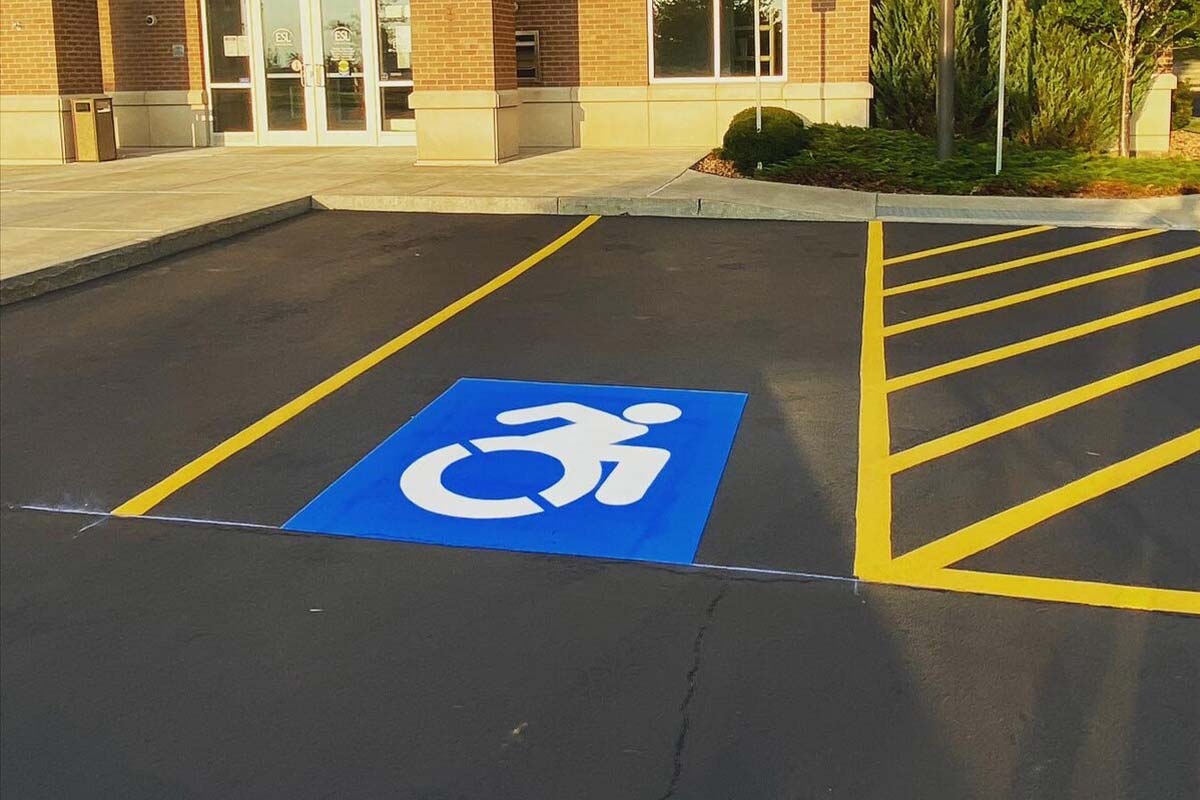
The International Symbol of Accessibility — the wheelchair-and-figure pictogram commonly painted on accessible parking stalls — is governed by ADA §502.6 and §703.7. Both the pavement marking and the sign mounted at the head of the space must display the ISA.
For the pavement marking, §703.7 requires the symbol to display with sufficient contrast against the background surface. The ISA is most commonly rendered in white paint on the blue stall background, or in blue paint when applied directly to light-colored pavement without a colored stall field. The symbol is centered within the stall and sized for clear visibility from the approach angle.
Symbol proportions follow the International Organization for Standardization (ISO) 7001 standard referenced in the ADA Standards. The pictogram shows a stylized figure in a wheelchair, facing right, with the wheel depicted below and forward of the seated figure. Non-conforming variations — older wheelchair-figure symbols with different proportions, or generic handicap icons that do not match the ISO shape — must be repainted to the current specification during a restriping that brings a facility into compliance.
1-800-STRIPER applies ISA symbols using stencils sized to the stall dimensions of each specific facility, ensuring the symbol is centered, correctly proportioned, and painted with adequate contrast.
Required Signage
ADA §216.5 requires each accessible parking space to have a sign displaying the ISA. Van-accessible spaces require an additional “Van Accessible” designation. Signs must be mounted so the bottom of the sign is at least 60 inches above the finish floor or ground surface, measured to the bottom edge of the sign, and positioned at the head of the space so they are not obscured by a vehicle parked in the stall.
Signs installed below 60 inches — a common deficiency in older lots where signs were placed for visual convenience rather than ADA compliance — represent a code violation because a parked vehicle can fully obstruct a low-mounted sign, making the reserved designation invisible from the approach.
Sign materials must use retroreflective sheeting meeting ASTM D4956 Type I or higher. Retroreflective sheeting ensures signs remain visible at night and in low-light conditions without requiring active illumination. The ISA on the sign must appear in white on a blue background, or blue on white, with sufficient contrast for the symbol to be clearly distinguishable.
Where a facility has spaces reserved for persons with disabilities who also use specific medical equipment, additional international symbols for accessibility may be required. The R7-8 sign series (International Symbol of Accessibility sign) is the standard mounting used in Texas and throughout the United States.
Post-mounted signs must be set back from the stall in a location where they will not be struck by opening vehicle doors and will remain upright. Pole placement, sign height verification, and hardware torque specifications are all part of the signage installation 1-800-STRIPER performs alongside the parking lot striping work.
Texas Accessibility Standards (TAS) Differences from ADA
Texas enforces its own accessibility standards — the Texas Accessibility Standards administered by the Texas Department of Licensing and Regulation (TDLR) — which apply to buildings and facilities regulated under the Texas Architectural Barriers Act. TAS is not a replacement for the federal ADA; it operates alongside it, and where TAS imposes a stricter requirement than federal ADA, the Texas standard governs for Texas facilities.
The following table summarizes the primary areas where TAS diverges from or exceeds the federal ADA Standards:
| Requirement | ADA (2010 Standards) | Texas Accessibility Standards (TAS) |
|---|---|---|
| Accessible stall width | 8 ft minimum (standard); 11 ft for van with 5 ft aisle | 8 ft minimum; van configuration follows ADA §502.3 dimensions |
| Signage mounting height | 60 in minimum to bottom of sign | 60 in minimum; TAS also specifies maximum mounting height considerations for facilities subject to Texas Architectural Barriers Act review |
| Access aisle ratio | 1:6 accessible spaces must be van-accessible | 1:6 van-accessible ratio; Texas-regulated facilities subject to TDLR plan review for new construction and alterations |
| Plan review requirement | Not a federal requirement for existing facilities | New construction and alterations to covered facilities must submit to TDLR for accessibility compliance review before construction |
| Inspection and certification | No federal field inspection mandate | TDLR-registered accessibility specialists (RAS) provide inspections; certificate of compliance may be required for covered projects |
For Central Dallas commercial facilities, both ADA and TAS compliance may apply simultaneously. Striping projects that involve new construction or substantial alteration of parking facilities typically require a TDLR plan review submission. 1-800-STRIPER stripes to the more stringent applicable standard in all cases.
Our ADA Striping Process in Central Dallas
1-800-STRIPER follows a defined sequence for ADA parking lot striping in Central Dallas to ensure the finished installation meets federal and Texas requirements without requiring rework:
- Site assessment — We measure the total stall count, evaluate the existing striping layout, document current accessible space locations and dimensions, and identify any existing signs. This establishes the baseline for calculating required accessible space counts under ADA §208.2.
- Compliance calculation — Using the stall count from the assessment, we determine the minimum number of accessible spaces, the number that must be van-accessible, and whether the existing layout can accommodate required dimensions or whether spaces need to be relocated.
- Layout and marking — Before applying paint, we chalk-line the stall boundaries, access aisle widths, and ISA symbol positions. Layout is reviewed against §502 dimension requirements prior to painting.
- Striping — Accessible stalls, access aisles, and ISA pavement symbols are applied in traffic-grade paint. Van-accessible spaces receive their own pavement callout where required by the layout.
- Signage installation — R7-8 accessible parking signs are mounted at the head of each accessible space at the required 60-inch minimum height. Van-accessible spaces receive the required “Van Accessible” placard. Sign posts are set plumb and secured.
- Verification — After installation, dimensions are re-measured against ADA §502 requirements and sign heights are confirmed. Any discrepancy found during verification is corrected before the crew leaves the site.
The result is an accessible parking installation that reflects the complete requirements of ADA §208, §502, §216.5, and §703.7 — not a partial striping that leaves compliance gaps for the property owner to resolve.
Service Area and Free Estimates
1-800-STRIPER serves commercial properties across the DFW metroplex, including Dallas County, Tarrant County, Denton County, and Rockwall County. Central Dallas facilities — office parks, retail centers, medical campuses, warehouses, and multi-family properties — are within our standard service area.
To schedule an on-site assessment and receive a free estimate for ADA parking lot striping, call 1-800-STRIPER at (214) 884-3669.
For a full list of our pavement marking services, visit our parking lot striping in Central Dallas page.
Businesses We Serve




How it Works

GET A FREE ESTIMATE
Contact us today and we’ll have a quote to you in 24 hours

SCHEDULE AN INSTALLATION
We’ll have your installation scheduled in less than 7 days, without affecting your business hours

GET A PARKING LOT THAT POPS
For a budget-friendly price, you’ll get a parking lot that looks like new!
We proudly work with:


We proudly work with:


Frequently Asked Questions About ADA Parking Lot Striping in Central Dallas, TX
What federal and state standards govern accessible parking in Texas?
Accessible parking in Texas must comply with the 2010 ADA Standards for Accessible Design at the federal level and the Texas Accessibility Standards (TAS) at the state level. TAS is administered by the Texas Department of Licensing and Regulation (TDLR) and applies to newly constructed or renovated facilities registered with TDLR on or after August 1, 2020. For practical purposes, TAS and the 2010 ADA Standards align closely — satisfying one generally satisfies the other — but properties in Texas are subject to both.
How many accessible parking spaces does my parking lot need?
The 2010 ADA Standards require 1 accessible space per 25 total spaces for the first 100 spaces in a lot. One of every six accessible spaces — or at least one total — must be van-accessible. Always round up: a lot with 51 spaces requires 3 accessible spaces, not 2. Medical and outpatient facilities have higher ratios. If your lot has not been audited recently, 1-800-STRIPER of Central Dallas can assess your current count against the required ratio. Call for a free estimate: (214) 884-3669.
What is the difference between a standard accessible space and a van-accessible space?
A standard accessible space must be at least 96 inches (8 feet) wide with an adjacent access aisle at least 60 inches wide. A van-accessible space requires the same 96-inch minimum stall width but with a wider 96-inch access aisle — or alternatively a 132-inch-wide stall paired with a 60-inch aisle. The wider access aisle accommodates side-loading wheelchair lifts. Van-accessible spaces must also carry additional vertical signage indicating “Van Accessible” below the International Symbol of Accessibility.
What is an access aisle and how must it be marked?
An access aisle is the striped zone adjacent to an accessible parking stall that gives wheelchair users space to deploy ramps or lifts and maneuver safely. Under the 2010 ADA Standards, access aisles must be at least 60 inches wide for standard stalls and at least 96 inches wide for van-accessible stalls. The aisle must be marked with diagonal hash lines across its full width to signal it is not a parking space. The surface must be firm, stable, and level — no slope greater than 1:48 in any direction.
What are the ISA symbol requirements for accessible stall markings?
Each accessible parking space must display the International Symbol of Accessibility (ISA) — the white wheelchair figure on a blue background — painted conspicuously on the pavement surface in a color that contrasts with the surrounding pavement. The 2010 ADA Standards and TAS do not mandate a specific color beyond high contrast, but blue and white is the universal convention in Texas. The symbol must be positioned within the stall and remain visible after routine restriping.
What signage is required at each accessible parking space?
Every accessible space must have a vertically mounted sign displaying the ISA symbol positioned so the bottom of the sign is at least 60 inches above the ground. Van-accessible spaces require a supplemental sign reading “Van Accessible” mounted directly below the ISA sign. Signs must be permanently installed, clearly visible from inside a vehicle, and not obstructed by parked cars. Ground-level ISA symbols painted on the stall surface do not substitute for the required vertical sign.
What accessible route requirements connect the parking stall to the building entrance?
The 2010 ADA Standards require a continuous accessible route from every accessible parking space to the building entrance it serves. The route must be at least 36 inches wide, have a firm and slip-resistant surface, and avoid steps or abrupt changes in level greater than half an inch unless a compliant ramp is provided. Cross-slope (perpendicular to travel direction) must not exceed 1:48. Where the accessible route crosses vehicle lanes, a marked crosswalk is required.
What are common ADA parking compliance failures found in Texas lots?
The most frequent violations found during accessibility audits in the Dallas, Tarrant, Denton, and Rockwall county area include: insufficient number of accessible spaces for the lot size; access aisles that are too narrow or share space with a drive aisle; faded or absent ISA symbols on the stall surface; missing or improperly mounted signage; and accessible routes with cross-slopes that exceed 1:48 due to pavement settling or original poor grading. Re-striping alone cannot fix grade issues, but it can correct stall count, aisle width, symbol clarity, and layout problems.
What are the consequences of non-compliant accessible parking?
Non-compliant accessible parking exposes property owners to ADA Title III complaints filed with the U.S. Department of Justice and civil lawsuits brought by individuals who experience barriers. Texas facilities registered with TDLR can also face state-level enforcement action. There is no fixed dollar amount we can cite, but ADA Title III enforcement can result in injunctive relief requiring corrections plus attorney fees and costs. Proactive compliance through accurate striping and signage is significantly less expensive than litigation or remediation under a consent order.