Warehouse Line Painting
In Long Island, NY
OSHA-Compliant Safety Markings
1-800-STRIPER® provides warehouse line painting in Long Island, NY — marking permanent aisles, passageways, pedestrian walkways, equipment zones, and staging areas per OSHA 29 CFR 1910.176(a) for distribution centers and industrial facilities across Suffolk County.
1-800-STRIPER® of Long Island PROVIDes Warehouse Floor Markings Services NEAR YOU
Want your indoor space to operate more efficiently?
Warehouse and interior markings ensure clear traffic lanes, organized storage zones, and designated spaces designed to help your business operate safely and efficiently.
Benefits:
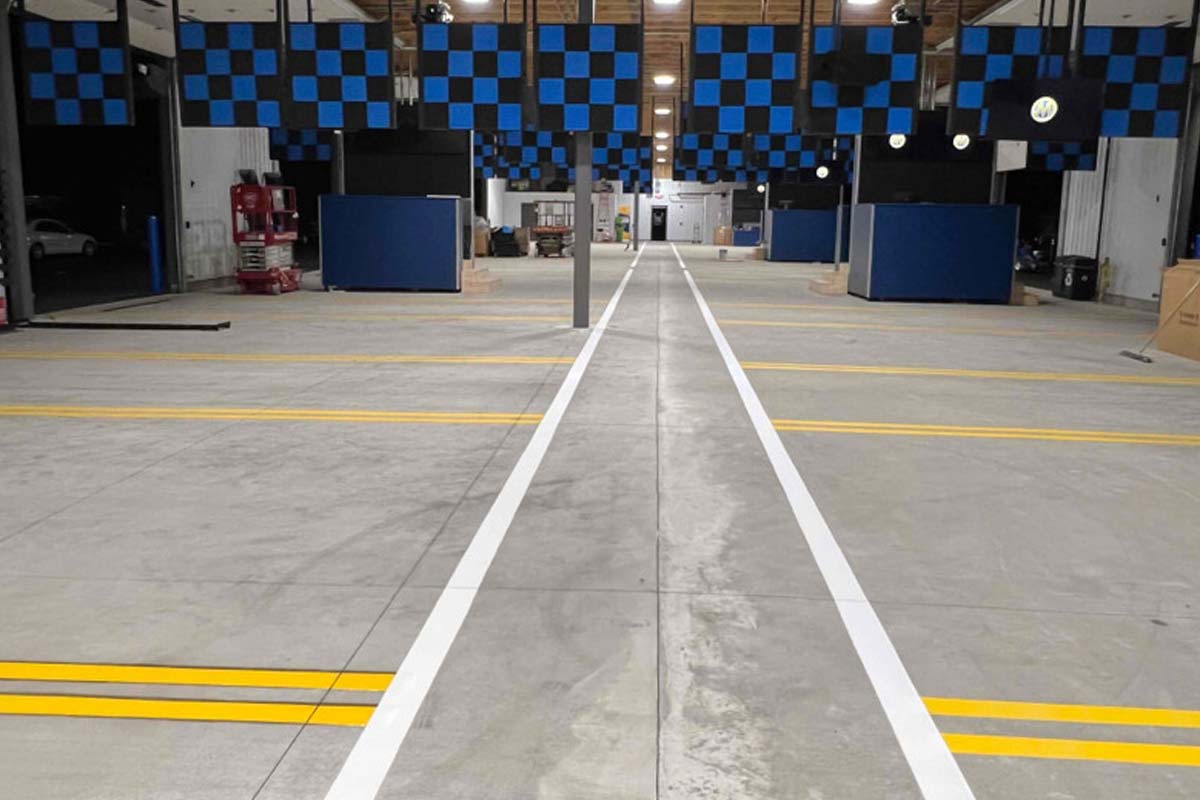
Warehouse Line Painting in Long Island, NY
Warehouse floor marking is a different discipline from parking lot striping. The surface is sealed concrete rather than asphalt, the traffic is forklifts and pedestrians sharing the same floor, the markings have to survive wheel loads that no parking lot ever sees, and the whole job usually has to happen around a shift rather than around store hours.
We mark permanent aisles, passageways, pedestrian walkways, equipment and battery charging zones, staging and racking areas, dock approaches, and floor-level safety boundaries for distribution centers, manufacturing plants, and industrial facilities across Suffolk County.
What OSHA 29 CFR 1910.176(a) Actually Requires
The operative federal rule is one sentence long, and most of what gets sold around it is not in it.
OSHA 29 CFR 1910.176(a) states that where mechanical handling equipment is used, sufficient safe clearances shall be allowed for aisles, at loading docks, through doorways and wherever turns or passage must be made; that aisles and passageways shall be kept clear and in good repair, with no obstruction across or in aisles that could create a hazard; and that permanent aisles and passageways shall be appropriately marked.
That is the whole marking duty. Note where it sits — 1910.176(a), in the materials handling and storage subpart. It is not in 1910.22, which is the walking-working surfaces rule and is frequently cited for this by people who have not read either.
Now the part worth paying for. The regulation specifies no aisle width. It says sufficient safe clearances, which is a performance requirement judged against the equipment you run, not a number. It specifies no line width. And it specifies no color.
The color point is the one that costs facilities money. OSHA 29 CFR 1910.144 is titled safety color code for marking physical hazards, and it assigns red to fire protection equipment, danger, and emergency stops, and yellow to caution and to physical hazards such as striking against, stumbling, falling, tripping, and caught in between. That is a hazard-marking standard. It is not an aisle-boundary standard, and it does not make yellow a required aisle color. Yellow aisle lines are an industry convention and a good one, because it keeps the color consistent with the hazard code — but a contractor telling you OSHA mandates yellow aisles at a specified width is quoting a regulation that does not exist.
What this means in practice is that your marking plan is a decision, not a transcription. We build it around your equipment, your traffic, and your insurer’s or customer’s own requirements, which are frequently stricter than the federal rule.
Markings We Paint on Warehouse Floors
Permanent aisles and passageways — the marking OSHA 29 CFR 1910.176(a) actually requires, laid out to clearances that suit your equipment.
Pedestrian walkways — separated routes through the floor, usually the highest-value marking in the building because they are what keeps people out of forklift paths.
Crosswalks and traffic-conflict points — where pedestrian routes and equipment aisles have to intersect.
Equipment and machine footprints — outlines that keep clearance around fixed plant.
Battery charging and hazardous material zones — bounded areas, marked to whatever color convention your safety program uses.
Staging, racking, and inventory zones — floor grids for put-down areas, pallet positions, and staging lanes.
Dock approaches and loading positions — the approach and stopping marks at each door.
Fire equipment and electrical panel clearances — the floor-level keep-clear zones that stop pallets ending up in front of an extinguisher or a panel.
Lettering, numbering, and directional arrows — aisle identifiers, bay numbers, and flow direction.
For a full list of our pavement marking services, visit our parking lot striping in Long Island page.
Businesses We Serve




How it Works

GET A FREE ESTIMATE
Contact us today and we’ll have a quote to you in 24 hours

SCHEDULE A STRIPING
We’ll have your space restriped in less than 7 days, without affecting your business hours

GET A PARKING LOT THAT POPS
For a budget-friendly price, you’ll get a parking lot that looks like new
We proudly work with:


We proudly work with:


Frequently Asked Questions About Warehouse Line Painting in Long Island, NY
Does OSHA require warehouse aisles to be marked?
Yes. OSHA 29 CFR 1910.176(a) states that permanent aisles and passageways shall be appropriately marked, and that where mechanical handling equipment is used, sufficient safe clearances shall be allowed for aisles, at loading docks, through doorways and wherever turns or passage must be made. The provision number matters: the marking duty sits in 1910.176(a), in the materials handling subpart, not in 1910.22, which is often cited for it by mistake.
What color do warehouse floor lines have to be?
OSHA specifies none. There is no required aisle marking color in 1910.176(a). The standard people reach for, OSHA 29 CFR 1910.144, is titled safety color code for marking physical hazards — it assigns red to fire protection equipment, danger, and emergency stops, and yellow to caution and physical hazards. That governs hazard marking, not aisle boundaries. Yellow aisles are a sound convention because they stay consistent with that code, but they are a convention, not a mandate.
How wide do warehouse aisle lines have to be?
No numeric OSHA aisle width exists, and neither does a required line width. The regulation says sufficient safe clearances shall be allowed, which is judged against the equipment you actually operate — the turning radius and load width of your forklifts, the traffic pattern, and whether pedestrians share the route. Anyone quoting you a mandatory OSHA aisle width in inches or feet is quoting something that is not in the regulation. We size the plan to your equipment.
What markings go in a warehouse besides aisles?
Pedestrian walkways and crosswalks, which are usually the highest-value markings in the building. Equipment and machine footprints. Battery charging and hazardous material zones. Staging, racking, and inventory grids for pallet positions and put-down areas. Dock approach and stopping marks. Keep-clear zones at fire equipment and electrical panels, which stop pallets ending up where they block access. Plus aisle lettering, bay numbering, and directional arrows.
Can you paint warehouse lines while the facility is operating?
Usually, yes, by working around your shift schedule rather than stopping it. The floor gets divided into zones and taken one at a time, with the active zone barricaded so equipment routes around it. Most of the facilities we work in schedule us for off-shift hours, weekends, or a planned shutdown window. Tell us how the building runs and which areas cannot be closed, and the sequence gets built around that at the quoting stage.
How long do warehouse floor markings last?
It comes down to traffic type and surface preparation far more than to the calendar. A walkway that only sees foot traffic holds up for years. An aisle line crossed constantly by loaded forklifts, especially where they turn, wears fastest, and turning points are always the first place a floor plan starts to fail. Preparation is the other half: markings applied to properly cleaned and prepared concrete last substantially longer than markings put down over dust and residue.