Parking Lot Restriping
In Long Island, NY
Restripe Existing Lines and Markings
1-800-STRIPER® provides parking lot restriping in Long Island, NY — restriping faded stalls, ADA spaces, fire lanes, directional arrows, and crosswalks over your existing layout, with surface prep and traffic phasing planned around an occupied lot.
1-800-STRIPER of Long Island PROVIDes Restriping Services NEAR YOU
Need to brighten up your faded parking lot?
Keep your parking lot safe and attractive by restriping annually to freshen up lines and symbols that have faded from the sun, weather, and traffic. Nothing beats a fresh coat of paint!
Benefits:
Parking Lot Restriping in Long Island, NY
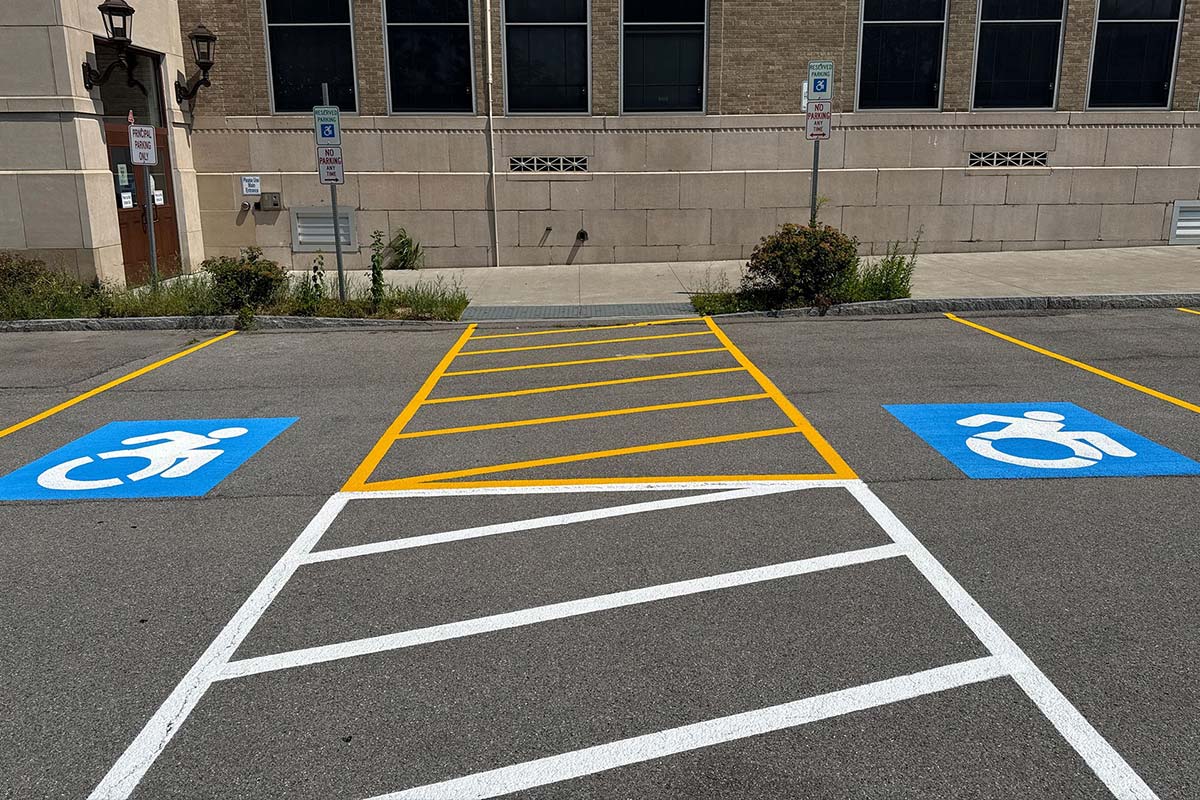
Restriping is what you do to a lot whose layout still works but whose paint no longer reads. The stalls are where they should be, the drive aisles are the right width, the accessible spaces are in the right place — the markings have worn to the point where drivers stop trusting them. Restriping puts the same layout back down on prepared pavement.
That makes it a different job from laying out a lot for the first time, and a much cheaper one, because none of the measuring and none of the design decisions have to be made again. Most of the commercial work we do across Suffolk County is restriping.
What we restripe on a typical commercial lot: standard stalls, accessible car and van stalls with their access aisles, fire lane markings, directional arrows, crosswalks and pedestrian paths, loading zones, and any no-parking hatching the site needs. All of it goes back in the same positions unless you ask us to change something.
When Your Parking Lot Needs Restriping
There is no code-mandated repainting interval for ordinary parking stall lines, and anyone quoting you one is quoting something that does not exist. The test is whether the markings still do their job.
The signs that a lot is due are consistent. Drivers park crooked or straddle two stalls, because the line they are aiming at is a ghost. The accessible stalls and their access aisles have faded to the point where the aisle is no longer obviously off-limits, which is both a safety problem and a compliance one. Directional arrows and stop bars have worn away at the exact points where traffic conflicts. Fire lane markings are patchy — and unlike stall lines, those carry an explicit maintenance duty in the New York fire code.
Winter is the accelerant here. Plow blades scrape paint off a Long Island lot far faster than sunlight and tires alone would, which is why lots on the East End often need attention on a shorter cycle than a sheltered office park inland.
If you are looking at the lot wondering whether it is bad enough yet, that hesitation is usually the answer.
Restripe Over the Existing Layout, or Redesign It?
Restriping repeats what is already on the ground. If the existing layout works, that is the fastest and least disruptive option, and the old lines act as their own guide.
There are three situations where repeating the existing layout is the wrong call. The first is when the lot is not compliant as laid out — too few accessible stalls for the space count, access aisles narrower than the code requires, or accessible stalls sited a long way from the entrance. Repainting a non-compliant layout just refreshes the problem. The second is when the property’s use has changed: a building that has gone from office to medical, or from single-tenant to multi-tenant, usually needs a different stall mix and different circulation. The third is when you are leaving stalls on the table, which happens most often on lots laid out for ninety-degree parking that would take more cars at an angle.
In any of those cases the job is parking lot layout design rather than restriping, and our layout design page covers what that involves. You will hear which one you are looking at when we come out — it is not in our interest to sell you a redesign a restripe would have covered.
A word on what standard governs the arrows, crosswalks, and legends either way. The Manual on Uniform Traffic Control Devices is the national standard for roads open to public travel, and the parking area itself is not one of them: under 23 CFR 655.603(a), parking areas and the driving aisles within parking areas are excluded from that definition. Read the same subsection carefully, though, because it cuts both ways — roads within shopping centers and similar privately owned facilities, where the public is allowed to travel without access restrictions, are expressly included. So a retail center’s ring road can sit inside that manual’s scope while the parking bays it feeds sit outside it. For the stall lines, arrows, and crosswalks inside the parking area, we follow its shapes and proportions as a convention because drivers already read them fluently, not because they are legally required there. What does bind the parking area is the accessibility code and the fire code.
How Parking Lot Restriping Works
- Site visit and measurement. We walk the lot, count what is there, note the pavement condition, and flag anything in the existing layout that would not meet current requirements if it were being installed today.
- Written scope. You get the layout, the marking schedule, and the phasing plan in writing before anything is scheduled.
- Surface preparation. Paint bonds to clean pavement and lifts off dirty pavement. Loose material, dust, oil, and old flaking paint come off first. On a lot that has not been cleaned in years this is the step that decides how long the new lines last, and it is often a full pressure washing job in its own right.
- Layout verification. Where we are repeating the existing plan we still verify the critical dimensions rather than tracing worn lines by eye — particularly the accessible stalls and their access aisles, which have specific width requirements.
- Marking. Lines, symbols, arrows, and lettering go down in sequence so that no section is walked or driven over before it has set.
- Walkthrough. We go over the finished lot with you before the crew leaves.
Surface Prep and Cure Time
Surface preparation is the part of a restripe that customers see least and that determines the result most. New paint over dirt, oil film, or loose old paint will look correct on the day and fail early. Pressure washing the lot before striping is the standard preparation step, and on lots with heavy oil staining or years of accumulated grime it is not optional if you want the lines to last. Our parking lot pressure washing page covers that side of the work.
On return-to-service time, we will give you a straight answer rather than a number pulled from nowhere: there is no code or federal standard that sets how long a freshly striped lot must stay closed. It depends on the product being applied and on the weather that day — temperature, humidity, and sun exposure all move it. The crew works to the product data sheet for the material being used and will tell you on site when each section can take traffic. Anyone giving you a fixed figure before knowing the product or the forecast is guessing.
What we can plan around is sequence. Because the lot is marked in sections, the reopening happens in sections too.
Restriping a Lot That Stays Open for Business
Most of the properties we restripe cannot close. A shopping center, a medical building, or a distribution facility has customers and staff arriving whether or not there is a crew on the lot, so the work is phased around them rather than the other way around.
In practice that means splitting the lot into sections and taking one at a time, coning and signing the active section so traffic routes around it, and scheduling the sections that matter most to you when they are least used — early mornings, evenings, or weekends depending on what the property is. Entrances, exits, and the accessible route from the accessible stalls to the door stay usable throughout; those are the parts of a lot that cannot be closed off even briefly without causing a real problem.
Tell us how the property runs and we will build the phasing around it. That conversation happens at the estimate, not on the morning the crew arrives.
For a full list of our pavement marking services, visit our parking lot striping in Long Island page.
Businesses We Serve




How it Works

GET A FREE ESTIMATE
Contact us today and we’ll have a quote to you in 24 hours

SCHEDULE AN INSTALLATION
We’ll have your installation scheduled in less than 7 days, without affecting your business hours

GET A PARKING LOT THAT POPS
For a budget-friendly price, you’ll get a parking lot that looks like new
We proudly work with:


We proudly work with:

Frequently Asked Questions About Parking Lot Restriping in Long Island, NY
What does restriping a parking lot mean?
Restriping means repainting the markings that are already on your lot — stalls, accessible spaces and their access aisles, fire lanes, arrows, crosswalks — in the same positions, on prepared pavement. The layout does not change. That is what separates it from layout design, where the stall positions and drive aisles are planned from scratch. Because none of the design work has to be redone, a restripe is the faster and less expensive of the two on a lot whose plan still works.
Do you need a permit to restripe a parking lot?
That is set locally, not by any statewide rule we can quote you, and it varies between Suffolk County towns. We do not assert that your property needs a permit or that it does not — the authority having jurisdiction for your site is the one that can answer it. One case is defined in the state fire code: construction documents showing the location of fire lanes go to the fire department for review and approval. For everything else, ask your town, and we will work to whatever they require.
How do I know when my parking lot needs restriping?
Look at how people are parking rather than at the calendar. If drivers are straddling stalls or parking crooked, the lines have stopped guiding them. Check the accessible stalls and access aisles specifically, because those fade into the surrounding pavement and stop being obviously off-limits well before the ordinary stall lines look bad. Faded directional arrows and stop bars at traffic conflict points are the other early signal. Fire lane markings carry an explicit maintenance duty and should never be allowed to go faint.
Can you restripe over the existing layout, or does it need a redesign?
If the existing layout works and complies, we restripe straight over it and the old lines guide the new ones. A redesign makes sense in three cases: the lot is not compliant as drawn, the building’s use has changed and the stall mix no longer fits, or the current plan is wasting space that a different angle would recover. Which situation you are in gets settled at the estimate, and our layout design page covers the redesign route.
How soon can the lot be driven on after restriping?
There is no code or federal standard that sets a return-to-service time, so we will not invent one. It depends on the product applied and on the weather — temperature, humidity, and sun exposure all change it. The crew works to the data sheet for the material going down on your lot and will tell you on the day when each section can take traffic. Because we mark in sections, the lot reopens in sections rather than all at once.
Can you restripe a lot that stays open for business?
Yes, and most of the lots we restripe never close. We split the property into sections and work one at a time, coning and signing the active section so traffic routes around it. Entrances, exits, and the accessible route from the accessible stalls to the building stay usable throughout. Sections that matter most to your operation get scheduled for your quietest hours. We plan the phasing with you at the estimate.