
Sports Court Striping
In Long Island, NY
Multi-Sport Court Line Marking
1-800-STRIPER® provides sports court striping in Long Island, NY — painting pickleball courts to USA Pickleball Official Rulebook dimensions, basketball courts, tennis courts, and playground game markings on asphalt and concrete surfaces across Suffolk County.
1-800-STRIPER® of Long Island PROVIDes Sport Court and Playground Markings Services NEAR YOU
Want to get people to come out to play?
Brighten up your faded sport courts or turn your playground into a safe, colorful, and engaging space that entices people to come out and play.
Sport Court Specialties:
Sports Court Striping in Long Island, NY
Court painting is measuring work with a paint brush attached. A pickleball court that is two inches narrow plays wrong, a basketball key painted off-center is visible from the stands forever, and a tennis court laid out from a tape measure held by one person will not be square. The paint is the easy part; the layout is the job.
We paint and line pickleball courts, basketball courts, tennis courts, and playground game markings on asphalt and concrete surfaces for schools, parks departments, homeowner associations, apartment communities, and private clubs across Suffolk County — from Riverhead and Southampton through Brookhaven, Islip, and Smithtown.
Most of what we do is one of three jobs: painting fresh lines onto a new or resurfaced slab, repainting faded lines on an existing court, or converting a court from one sport to another — overwhelmingly, these days, adding pickleball to something that used to be a tennis court.
Pickleball Court Painting and Line Marking
Pickleball is the reason most of the phone calls come in. The dimensions are published by USA Pickleball, the sport’s national governing body, and they are not negotiable if you want the court to play correctly.
A pickleball court measures 20 feet wide by 44 feet long for both singles and doubles. Each side of the net has a 7-foot non-volley zone — the kitchen — running the full width of the court. The net is 36 inches high at the sidelines and 34 inches at the center.
Those are the playing-surface dimensions, not the space you need. A court needs run-off room beyond the lines on every side, and how much depends on whether you are building for casual play or for sanctioned tournament use. We will lay out what fits in the space you have and tell you honestly if the footprint is too tight for the number of courts you were hoping for.
Converting an existing tennis court is the most common request we get, and it works well. A standard tennis court has room for multiple pickleball courts, and the conversion can either be a dedicated repaint or a set of blended lines in a contrasting color that leaves the tennis court playable. Blended lines are cheaper and keep both sports available; a dedicated conversion gives a much cleaner playing surface with no visual confusion. Which one is right depends on whether anyone is still playing tennis there.
Basketball Court Painting
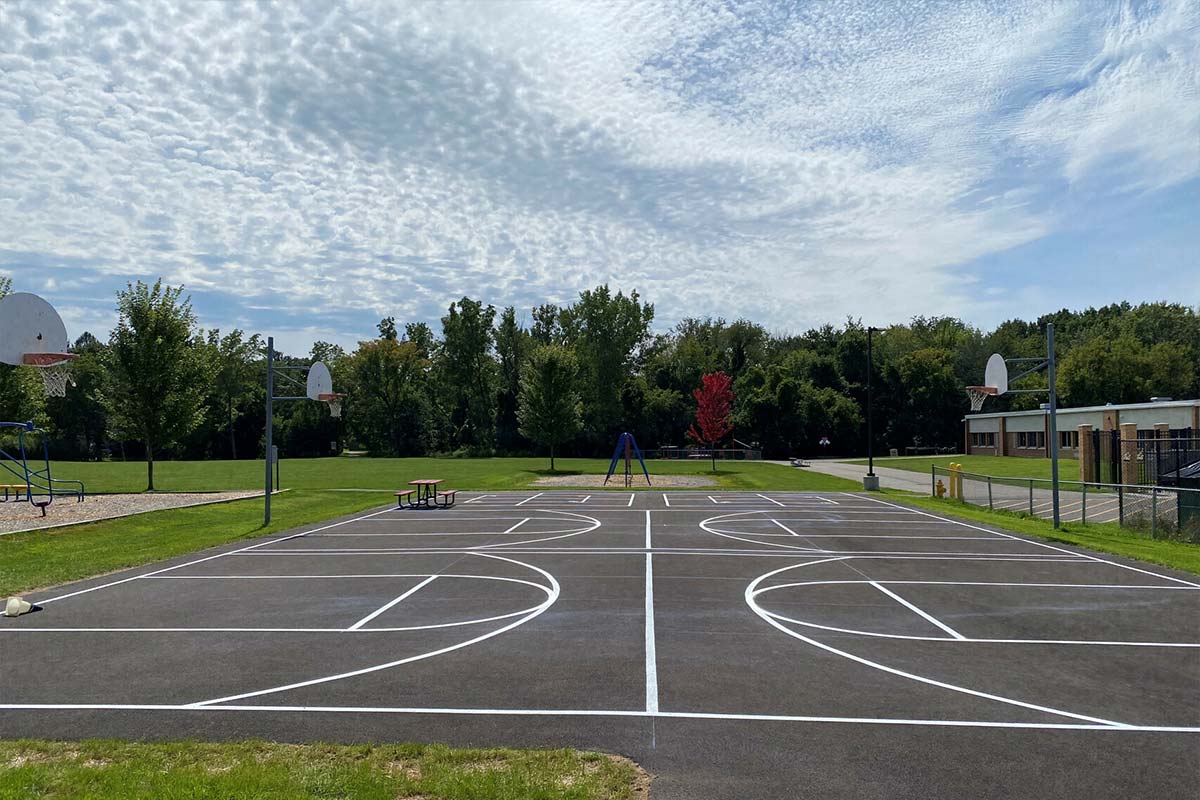
Basketball is the other high-volume court we paint, and unlike pickleball there is no single dimension set — a regulation high school court, a college court, and a half-court pad at an apartment complex are all different, and most outdoor community courts are laid out to whatever the slab allows rather than to a rulebook.
So the first question on a basketball job is always what the court is for. A school playing scheduled games needs its lines to match the governing body its teams compete under, and we will paint to whatever specification you supply. A park or apartment court needs a layout that is proportionate and plays well on the pad that exists.
What we paint: the boundary and baselines, the center circle and division line, the key and free throw lane with its lane spaces, the free throw circle, the three-point arc, and the restricted area under the basket where the court calls for one. Full court, half court, or a shared surface with other sports.
Tennis Court Line Marking
Tennis lines are unforgiving because the court is large and every line is straight, which means any error in squaring the layout is visible along its whole length.
We repaint faded lines on existing courts, line newly resurfaced courts, and mark out shared-use courts where tennis coexists with pickleball. On a repaint, the existing lines give a reference but we still verify the layout rather than tracing what is there — courts get repainted over their own drift, and three cycles of tracing a slightly-off line produces a court that is measurably wrong.
Where a court is being shared, we will talk through line color and contrast with you before painting. Getting that wrong is the most common complaint about blended courts: too little contrast and players cannot pick out their sport’s lines, too much and the primary sport’s court looks cluttered.
Playground Game Markings
Playground and blacktop games are the most flexible work we do, and for schools they are often the highest-impact square footage on the property.
The standards are hopscotch, four square, kickball diamonds, tetherball circles, running tracks and sprint lanes, and number and alphabet grids. Beyond those, the layouts are as varied as the schools asking for them: compass roses, map outlines, sensory paths and follow-the-line trails, snakes and ladders, and custom games a teacher has sketched out.
Bring us a drawing and dimensions and we will lay it out. For sensory paths and similar routed markings, tell us the age group — the spacing that works for kindergarten does not work for fifth grade.
Court Surfaces We Paint
Asphalt is the most common outdoor court surface on Long Island and takes court paint well once it is clean and fully cured. New asphalt needs to cure before it is painted; painting too early traps oils and the lines fail early.
Concrete takes paint well and lasts longest, but surface preparation matters more than on asphalt because a smooth troweled slab gives paint less to grip.
Existing acrylic and cushioned court coatings are painted over routinely — this is most repaints and most conversions. The existing coating has to be sound. Where it is delaminating or blistering, painting lines over it just puts fresh paint on a surface that is coming off, and the coating needs attention first.
What decides the result on any of the three is cleaning. Courts collect algae, moss, and organic growth, particularly shaded courts and courts near tree lines, which is a great many of them here. That growth comes off before any line goes down.
How Court Striping Works
- Site visit. We measure the existing slab, check the surface condition and drainage, and confirm what will genuinely fit — including the run-off room around the playing lines, which is where most optimistic court plans fall apart.
- Layout plan. You get the court configuration, the dimensions we are painting to, and the color scheme in writing. For blended or shared courts this is where the line color decisions get made, not on the day.
- Surface preparation. Cleaning, and where needed pressure washing to remove algae, moss, dirt, and chalky residue. Any failing coating is identified now.
- Layout and measurement. The court is measured, squared, and chalked before any paint is opened. On a repaint we verify against the specification rather than tracing the old lines.
- Painting. Lines and any painted areas go down in sequence, allowing each stage to set before the next is masked over it.
- Walkthrough. We check the finished court dimensions with you before leaving.
For a full list of our pavement marking services, visit our parking lot striping in Long Island page.
Businesses We Serve




How it Works

GET A FREE ESTIMATE
Contact us today and we’ll have a quote to you in 24 hours

SCHEDULE AN INSTALLATION
We’ll have your play space restriped in less than 7 days, without affecting your playtime

GET A PARKING LOT THAT POPS
For a budget-friendly price, you’ll get a parking lot that looks like new
We proudly work with:


We proudly work with:


Frequently Asked Questions About Sports Court Striping in Long Island, NY
Can you paint a pickleball court on an existing tennis court?
Yes, and it is the most common court job we do. A standard tennis court has room for multiple pickleball courts. You have two routes: blended lines in a contrasting color, which keeps the tennis court fully playable and is the lighter touch, or a dedicated conversion that repaints the surface for pickleball alone and gives a much cleaner court with no visual confusion. Which is right depends on whether anyone is still playing tennis there. We will lay out how many courts your slab takes.
What are the dimensions of a pickleball court?
A pickleball court measures 20 feet wide by 44 feet long, and that is the same for singles and doubles. Each side of the net has a 7-foot non-volley zone, the kitchen, running the full court width. The net is 36 inches high at the sidelines and 34 inches at the center. Those figures come from USA Pickleball, the sport’s national governing body. Note they are playing-surface dimensions — the total space you need is larger, because the court requires run-off room on every side.
Can you paint a basketball court on asphalt?
Yes. Asphalt is the most common outdoor basketball surface here and takes court paint well once it is clean and fully cured. If the asphalt is newly laid it needs to cure first, because painting too early traps oils in the surface and the lines fail early. On an older lot the deciding factor is cleaning — algae and moss are common on shaded Long Island courts and have to come off before any line is painted.
Do you paint playground game markings?
Yes, and for schools it is often the highest-impact work on the property. The standards are hopscotch, four square, kickball diamonds, tetherball circles, sprint lanes and running tracks, and number and alphabet grids. We also paint sensory paths, follow-the-line trails, compass roses, map outlines, and custom games teachers have sketched out. Send us a drawing with dimensions and tell us the age group, because the spacing that works for kindergarten does not suit fifth grade.
How long does court paint last?
It depends far more on use, shade, and preparation than on the calendar. A school court in constant use wears its lines faster than a private court used on weekends, and courts under tree cover pick up algae and organic growth that degrades the surface underneath the paint. Preparation is the biggest single factor: lines painted onto a properly cleaned surface last substantially longer than lines painted over dirt or a chalky, failing coating. Keeping the court clean extends it further.
What surfaces can courts be painted on?
Asphalt, concrete, and existing acrylic or cushioned court coatings. Asphalt is the most common outdoors and needs to be fully cured before painting. Concrete lasts longest but needs more surface preparation, because a smooth troweled slab gives paint less to grip. Painting over an existing coating is routine for repaints and conversions, with one condition: the coating must be sound. If it is blistering or delaminating, fresh lines on top of it will come away with it.