
Bollard Installation
In East Kansas City, MO
Steel and Decorative Bollards
1-800-STRIPER provides professional bollard installation in East Kansas City, MO — setting concrete-filled steel guard posts and decorative bollards that protect storefronts, walkways, utilities, and fire department connections from vehicle impact for commercial properties across the Missouri and Kansas sides of the Kansas City metro.
1-800-STRIPER® of East Kansas City PROVIDes Bollard Installation Services NEAR YOU
Want to prevent accidents and protect your property?
Bollards provide physical protection for your customers and your property.
Safety and security:
Bollards create a physical barrier between vehicles and pedestrians, protecting people in walking areas from accidental or intentional vehicle intrusions.
Bollards act as a protective barrier around storefronts, gas stations, and other vulnerable areas, minimizing the risk of costly damage from vehicle impacts.
Strategic Placement Locations:
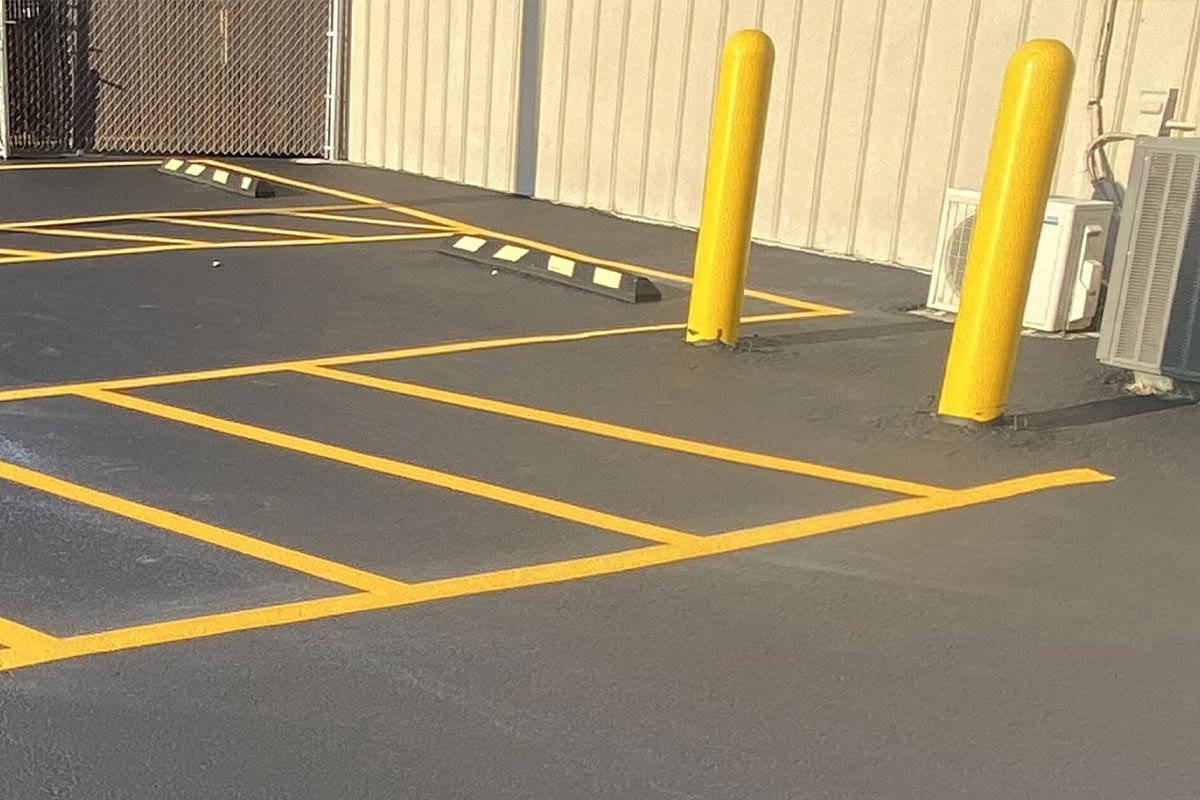
Bollard Installation in East Kansas City, MO
A bollard is a short, sturdy post that stands between a moving vehicle and something you do not want hit. On a commercial property that usually means the front of the building, a walkway full of pedestrians, a gas meter or electrical transformer, a fire department connection, or a drive-up door. Some bollards are also there to direct traffic — to close a lane, protect a corner, or keep cars out of a fire lane.
We install bollards on both sides of the Kansas City metro for retail, office, industrial, medical, and multifamily properties. That covers everything from a single post protecting a storefront corner to a full run guarding a loading area or a bank of utility equipment.
What Kansas City’s Fire Code Requires
Kansas City has adopted the 2018 International Fire Code, and where that code calls for vehicle impact protection, Section 312 says exactly how a guard post has to be built. It is worth reading before anyone quotes you a job, because a decorative post dropped into a shallow hole does not meet it.
Section 312.2 requires a guard post to be steel at least 4 inches in diameter and concrete-filled, spaced no more than 4 feet apart on center, set at least 3 feet deep in a concrete footing at least 15 inches across, standing at least 3 feet above the ground, and placed at least 3 feet from whatever it is protecting. The code also allows other barriers, under Section 312.3, when they are designed to resist or deflect an impact and the local authority approves them.
Not every bollard on your property is code-driven — plenty go in purely to protect a storefront or guide traffic, and those are yours to spec. But where the fire code does require protection, that is the standard, and it is the standard we build to.
Steel, Decorative, and Removable Bollards
Bollards come in a few forms, and the right one depends on what the post is for.
- Concrete-filled steel pipe is the workhorse — the type the fire code describes and the type you want anywhere real impact protection matters.
- Decorative bollards, or decorative sleeves over a steel core, give you the same protection with a finished look that suits a storefront or a plaza.
- Removable and retractable bollards let you close a lane or a fire access point when you need to and open it when you do not, which is useful at gated drives and event entrances.
We will steer you toward protection where protection is the point and toward appearance where the job is really about traffic and looks — and we will say when a painted line would do the same work for less.
Our Bollard Installation Process
- Locate what is underground first. Before any core or excavation we have the utilities marked — a bollard footing goes deep enough to hit a line that nobody flagged.
- Set out the run. We mark each post so spacing, setback from the protected object, and alignment are right before anything is cut.
- Excavate or core the footing. Depth and footing size follow the job — where the fire code applies, that means the Section 312.2 dimensions.
- Set, fill, and finish. Steel posts are set plumb in concrete and filled; decorative or removable units are installed to the manufacturer’s spec. Caps or sleeves go on last.
- Walk it with you. You see the finished line and confirm it does what you needed it to.
For a full list of our pavement marking services, visit our parking lot striping in East Kansas City page.
Businesses We Serve




How it Works

GET A FREE ESTIMATE
Contact us today and we’ll have a quote to you in 24 hours

SCHEDULE AN INSTALLATION
We’ll have your installation scheduled in less than 7 days, without affecting your business hours

GET A PARKING LOT THAT POPS
For a budget-friendly price, you’ll get a parking lot that looks like new
We proudly work with:


We proudly work with:


Frequently Asked Questions About Bollard Installation in East Kansas City, MO
Does Kansas City require bollards?
Not everywhere, but the fire code does require vehicle impact protection in certain situations, and where it does, it sets the spec. Kansas City has adopted the 2018 International Fire Code, and Section 312 says a guard post has to be steel at least 4 inches across and concrete-filled, spaced no more than 4 feet on center, set at least 3 feet deep, and standing at least 3 feet above grade. Plenty of other bollards go in purely to protect a storefront or guide traffic — those are yours to spec.
What is a bollard actually for?
Two jobs. The first is impact protection — standing between a vehicle and something you do not want hit, like a storefront, a walkway, a gas meter, an electrical transformer, or a fire department connection. The second is traffic control — closing a lane, protecting a corner, or keeping cars out of a fire access point. Some bollards do both.
Should I use steel or decorative bollards?
Where real impact protection is the point, concrete-filled steel pipe is the answer — it is what the fire code describes. Where the job is mostly about appearance and light traffic control, a decorative bollard, or a decorative sleeve over a steel core, gives you a finished look. Removable and retractable bollards suit gated drives and fire lanes you need to open and close.
How deep do bollards have to be set?
Where the fire code applies, the guard-post standard is at least 3 feet deep in a concrete footing at least 15 inches across, with the post at least 3 feet above grade and at least 3 feet from the object it protects. A decorative or purely cosmetic bollard can be set to the manufacturer’s spec, but a post that is meant to stop a vehicle has to be footed to do it.
Can bollards be removable?
Yes. Removable and retractable bollards let you close a lane, a fire access point, or an event entrance when you need the barrier and open it when you do not. They install into a fixed sleeve in the pavement so the post is solid when it is up and flush or gone when it is down.
Will bollards block my accessible route?
They should not, and placement is how you keep that true. A bollard set along a walkway has to leave the accessible route its required clear width — bollards are meant to protect that route, not pinch it. We lay out spacing and setback so the posts guard what they need to without narrowing the path below what the ADA standards require.