ADA Parking Lot Striping
In East Kansas City, MO
ADA-Compliant Accessible Parking
1-800-STRIPER provides ADA-compliant parking lot striping in East Kansas City, MO — installing accessible spaces, van-accessible stalls, access aisles, ISA symbols, and required signage per the 2010 ADA Standards for Accessible Design, Missouri RSMo 301.143, and Kansas KSA 8-1,128.
1-800-STRIPER® of East Kansas City PROVIDes ADA Compliance Services NEAR YOU
Need to make your property more accessible?
Upgrade your facility to become fully ADA compliant by partnering with us to create clear, accessible parking for all your visitors.
Our ADA Compliant line striping services include:
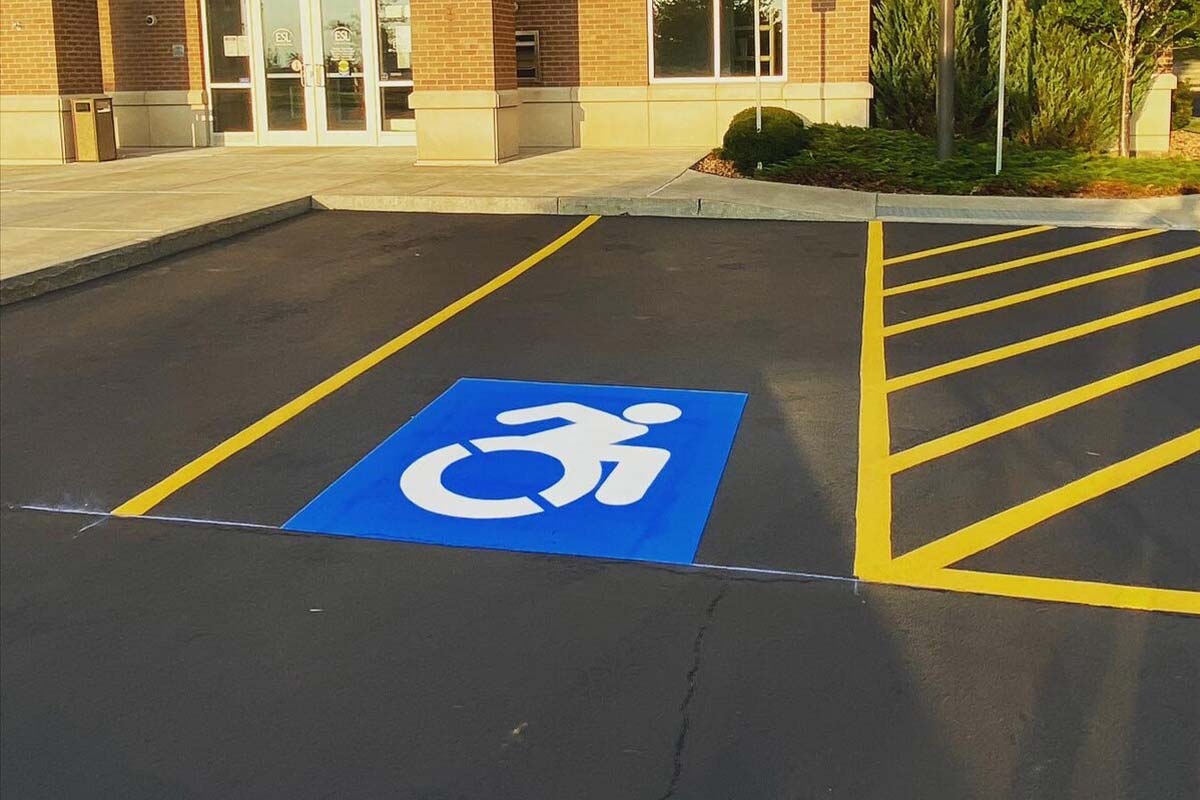
ADA Parking Lot Striping in East Kansas City, MO
Accessible parking is the part of a lot most likely to be non-compliant, and the part most likely to generate a complaint. It is also the part owners think they have handled because there is a blue stall by the door.
We install and correct accessible parking across the metro: space counts, dimensions, access aisles, symbols, signage, and the ramp and slope conditions that make the whole thing usable. On the Missouri side and the Kansas side.
What the ADA Actually Specifies — and What It Leaves to Local Law
Start with what surprises people.
The 2010 ADA Standards, at section 502.3.3, require that access aisles be marked so as to discourage parking in them. Then the official Advisory to that section adds this:
> “The method and color of marking are not specified by these requirements but may be addressed by State or local laws or regulations.”
The federal standard does not mandate a color. Not blue, not white, not for the aisle and not for the stall. The market writes as though “ADA-compliant striping” means a specific color scheme handed down from Washington. It does not. The federal standard deliberately leaves method and color to state and local law.
That is not a technicality — it is the whole argument for hiring someone local. If federal law is silent on color and method, then what fills the gap is your city’s code and your state’s statute. In Kansas City, the fire code is what supplies a color requirement, and it does so for fire lanes rather than accessible stalls. Someone working from a national template will not know that, because the national template does not have a Kansas City in it.
What the federal standard does specify, and specify tightly: how many accessible spaces you need (section 208), how wide they and their access aisles must be (section 502), and that one in every six must be van-accessible. The U.S. Access Board‘s Chapter 5: Parking guide is the clearest plain-English walkthrough of it.
When the Standards Attach, and How Many Spaces You Owe
The table below is not an ambient duty that lands on a lot merely because the lot exists. Under section 201.1, the 2010 Standards attach to new construction and to altered portions of an existing facility. For a lot nobody is touching, the obligation is a different and narrower one: remove barriers where that is readily achievable.
Here is why that still lands on this page. The Department of Justice’s own guidance is that restriping a parking lot is precisely the moment the Standards attach — and, because restriping is inexpensive, that barrier removal is “readily achievable in most cases.” So the practical rule is simple: when you repaint, you paint to this table.
| Total spaces in the parking facility | Minimum accessible spaces |
|---|---|
| 1 to 25 | 1 |
| 26 to 50 | 2 |
| 51 to 75 | 3 |
| 76 to 100 | 4 |
| 101 to 150 | 5 |
| 151 to 200 | 6 |
| 201 to 300 | 7 |
| 301 to 400 | 8 |
| 401 to 500 | 9 |
| 501 to 1,000 | 2 percent of total |
| 1,001 and over | 20, plus 1 for each 100 over 1,000 |
For every six of those accessible spaces, or fraction of six, at least one must be van-accessible — so a lot with a single accessible space needs that one space to be a van space. Kansas City codifies the same schedule in section 88-420-14, which means the city and the Department of Justice ask you for the same numbers.
Two things the table does not tell you, and most contractors will not either.
Section 208.2 applies “except as required by 208.2.1, 208.2.2 and 208.2.3.” Those exceptions are real and they run upward: hospital outpatient facilities owe ten percent of their patient and visitor spaces, and rehabilitation facilities specializing in conditions that affect mobility, and outpatient physical therapy facilities, owe twenty percent. On a medical property, the table above is the wrong answer — and it is wrong in the direction that leaves you short.
And the count is calculated separately for each parking facility on your site, not pooled across all of them. A campus with three lots does three calculations, not one.
Missouri and Kansas: One Spec, Both Sides of the State Line
Property managers with lots in both states ask us whether they need two different approaches. For accessible parking, the answer is a genuinely useful no.
Missouri — RSMo 301.143. Reserved accessible spaces must be designated by a sign immediately adjacent to and visible from each space, bearing the International Symbol of Accessibility, and the spaces must meet the requirements of the federal Americans with Disabilities Act.
Kansas — KSA 8-1,128. Each accessible space must be clearly marked by vertically mounted signs bearing the international symbol of access, and accessible parking must conform to Title II or Title III of the Americans with Disabilities Act.
Both states point straight back at the federal standard. One spec satisfies Missouri, Kansas, and the ADA. And both states independently require the same thing owners most often skip: a sign at every accessible space — in Missouri, posted immediately adjacent to and visible from the space; in Kansas, vertically mounted. Paint on the ground is not enough in either state. A stall with a beautiful symbol on the pavement and no sign is not a compliant stall on either side of State Line Road.
One limit worth knowing, and it runs in your favor rather than ours. Missouri grandfathers old work: under the same statute, signs or spaces that were already in use before August 28, 2011 and no longer conform are not in violation for the remainder of their useful life. So if your lot was signed to the old standard and the signs are still doing their job, Missouri is not asking you to tear them out today. We would rather tell you that than sell you posts you do not owe.
There is a wrinkle here worth knowing, because it is the one place the two states are stricter than Washington. The federal standard, at section 216.5, actually excuses you from identifying accessible spaces at all where a site has four or fewer parking spaces in total. Missouri and Kansas grant no such relief: the Missouri statute puts the duty on the owner of private property used for public parking, and the Kansas statute says each designated accessible space shall be marked by vertically mounted signs. So on a four-space lot behind a small office in Mission or Independence, the ADA would let the sign go and your state statute would not. Sign it.
Kansas City adds a third layer that happens to line up. Section 88-420-14 of its Zoning and Development Code writes the accessible parking schedule into the city’s own law, and the count table matches the federal 2010 ADA table exactly — one space up to 25 total, two up to 50, three up to 75, four up to 100, and so on, with one van-accessible space per six required. It also codifies the dimensions: an 8-foot car space, an 11-foot van space, a 5-foot access aisle, a sign mounted at least 60 inches above the ground measured to the bottom of the sign, a maximum 1:48 slope, and curb ramps at least 36 inches wide.
So a Kansas City owner answers to the city and to the Department of Justice for the same numbers. There is one right answer. Most lots still get the sign height or the van ratio wrong.
For a full list of our pavement marking services, visit our parking lot striping in East Kansas City page.
Businesses We Serve




How it Works

GET A FREE ESTIMATE
Contact us today and we’ll have a quote to you in 24 hours

SCHEDULE AN INSTALLATION
We’ll have your installation scheduled in less than 7 days, without affecting your business hours

GET A PARKING LOT THAT POPS
For a budget-friendly price, you’ll get a parking lot that looks like new!
We proudly work with:


We proudly work with:


Frequently Asked Questions About ADA Parking Lot Striping in East Kansas City, MO
What color does the ADA require for accessible parking striping?
It doesn’t require one. Advisory 502.3.3 of the 2010 ADA Standards says the method and color of marking are not specified by the requirements, and may be addressed by state or local law instead. Blue is a very strong convention and we use it, but a contractor citing a federal color mandate is citing something that does not exist.
Do Missouri and Kansas have different accessible-parking requirements?
Not in any way that changes the striping. Missouri’s RSMo 301.143 and Kansas’s KSA 8-1,128 both route accessible parking back to the federal ADA, and both require a sign at each space — Missouri’s posted immediately adjacent to and visible from it, Kansas’s vertically mounted. One spec works for a portfolio spanning both states.
Is paint enough, or do I need signs too?
You need signs, and this is the most common miss we find. Missouri requires a sign immediately adjacent to and visible from each space. Kansas requires each space to be clearly marked by vertically mounted signs. A painted symbol with no sign is not compliant in either state.
How many accessible spaces does my lot need?
Section 208 of the 2010 ADA Standards sets the schedule, and Kansas City’s zoning code mirrors it exactly: one accessible space for a lot up to 25 spaces, two up to 50, three up to 75, four up to 100, five up to 150, six up to 200, and upward from there. One in every six accessible spaces must be van-accessible, with a minimum of one. Two caveats most people miss. The schedule attaches when a lot is newly built or altered — and restriping counts as an alteration, which is why repainting is the moment to get this right. And if you run a hospital outpatient facility the figure is ten percent of patient and visitor spaces, or twenty percent for a rehabilitation or outpatient physical therapy facility, both well above the table.
How wide does a van-accessible access aisle have to be?
Under the 2010 ADA Standards at section 502, an access aisle is a minimum of 5 feet wide and runs the full length of the space it serves. The van space itself is 11 feet wide, or 8 feet where the adjacent access aisle is widened to 8 feet. Kansas City codifies the same figures in section 88-420-14. Two spaces may share one access aisle.
Do I have to re-stripe to current standards when I resurface?
Resurfacing wipes the markings, so what goes back down is effectively new marking — and that is exactly the situation the Department of Justice addresses in its Restriping Parking Spaces brief on ADA.gov. If we are laying out a resurfaced lot, we lay it out to the current standard.
Does the ADA symbol have to be painted on the space?
The federal requirement is the sign: under the 2010 ADA Standards, each accessible space is identified by a sign bearing the International Symbol of Accessibility, mounted high enough not to be obscured by a parked vehicle. A painted symbol on the pavement is conventional, useful for enforcement and expected by most tenants, and we paint it. But it is the sign that the standard requires. (Missouri does have a painted-symbol rule — it applies to on-street spaces designated by cities in residential areas, not to private commercial lots, and we will not tell you otherwise.)
What happens if my lot isn’t compliant?
Accessible parking is one of the most frequently litigated parts of a commercial property, and the exposure is real: a complaint to the Department of Justice, a private lawsuit, or a demand letter, along with the cost of doing the work you would rather have done in the first place. The more useful framing is that the fix is usually small. Adding a sign, widening an aisle, correcting a slope, restriping a stall to the right dimension — none of that is a major project. Getting a letter about it is.