Wheel Stop Installation
In NE Boston, MA
Concrete and Rubber Parking Stops
1-800-STRIPER provides wheel stop installation in NE Boston, MA — anchoring concrete wheel stops, parking bumpers, and curb stops at stall heads to protect sidewalks, storefronts, and the accessible routes the 2010 ADA Standards require to stay clear at commercial properties.
1-800-STRIPER® of NE Boston PROVIDes Wheel Stop Installation Services NEAR YOU
Need to protect vehicles or walls from accidental damage?
Wheel stops (also called parking blocks) protect your property, enhance safety, and improve parking lot organization.
Benefits:
Wheel stops prevent vehicles from parking too far into a space or overextending into other spots, pedestrian walkways, and other areas, while also helping with vehicle alignment. They can prevent damage to buildings, curbs, or landscaping. Wheel stops also serve as clear visual cues for proper parking and are sometimes used on slopes to prevent cars from rolling.
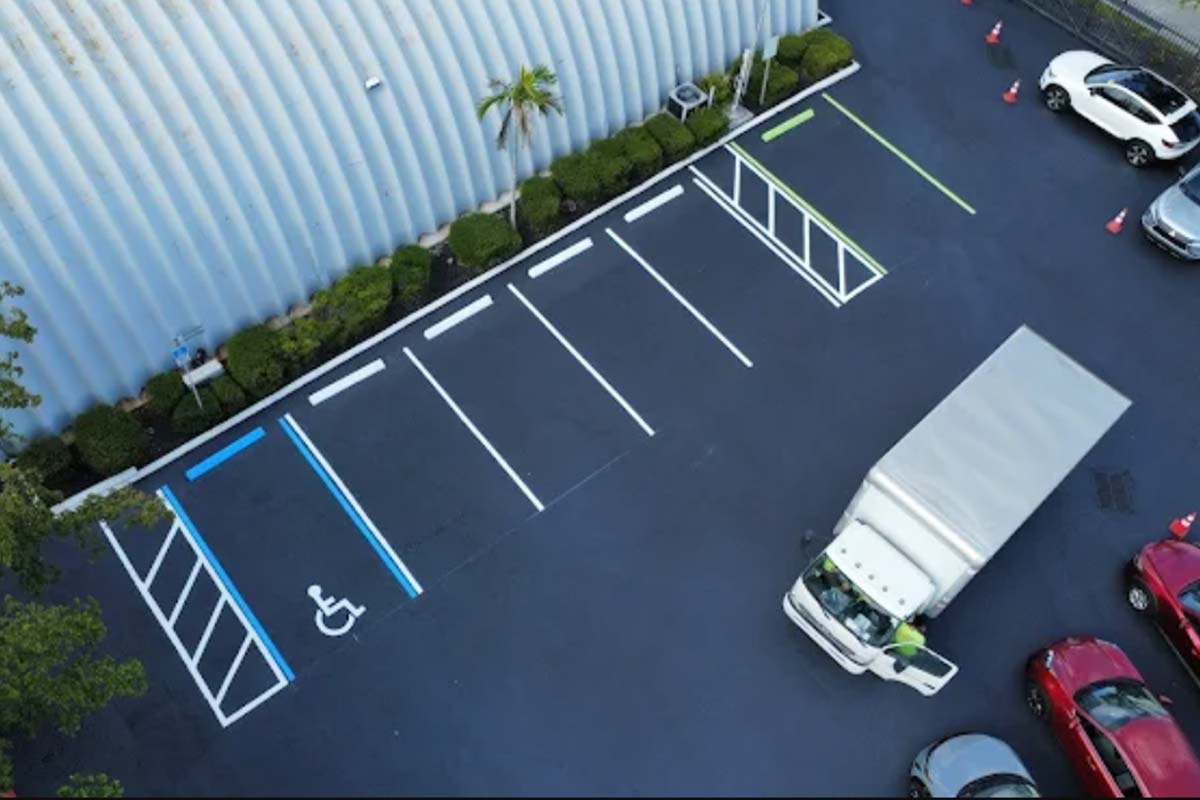
Wheel Stop Installation in NE Boston, MA
A wheel stop is a low barrier at the head of a parking stall. It stops a car before its bumper reaches whatever is behind it — a sidewalk, a storefront window, a light pole base, a fence, or a neighboring vehicle. We install them across commercial properties in Woburn, Burlington, Wakefield, Lynn, Salem, and Peabody, either as part of a striping job or as their own visit.
They matter most where overrun is expensive. A car that rolls eighteen inches too far into a walkway has hit a pedestrian route. The same eighteen inches at the front of a retail unit has hit glass. Wheel stops are the cheapest fixed answer to both.
Concrete Wheel Stops, Parking Bumpers and Curb Stops
The same object goes by several names. Wheel stops, parking bumpers, curb stops, and parking blocks all describe the barrier at the head of a stall, and the choice that actually matters is what it is made of.
| Material | Holds up to | Notes |
|---|---|---|
| Precast concrete | Heavy vehicle contact, plow contact if set back | The northeast Massachusetts default. Heavy, stable, and repairable by replacement. Can chip and spall after repeated winter contact. |
| Recycled rubber | Repeated light contact, temperature swings | Lighter, will not spall, more forgiving to a vehicle. Needs positive anchoring because the mass alone will not hold it. |
| Recycled plastic composite | Repeated light contact, salt exposure | Does not absorb water, so it resists the freeze cycle that damages concrete. Color is through the material rather than painted on. |
Concrete remains the most common choice on commercial lots here. It stays where it is put. The trade-off is winter: a concrete stop set where a plow blade catches it will chip, and a chipped stop is a trip hazard as well as a worn-out one.
We also paint them. A stop marked in a contrasting color is visible in a wet lot at night, which is when it needs to be, and accessible stalls in particular benefit from the contrast.
Protecting Accessible Routes and Storefronts
The strongest reason to fit wheel stops is that the space behind the stall usually has a job.
Where that job is an accessible route, the point is not aesthetic. The 2010 ADA Standards for Accessible Design require an accessible route connecting accessible parking spaces to the accessible entrance, and that route has to remain usable. A vehicle overhanging a walkway by a foot reduces the clear width, and on a narrow path it can remove it entirely. A wheel stop is a physical guarantee that the parked car stays out of the route, which is a more reliable control than a painted line.
The same logic covers storefront glass, entry doors, bollards and light standards, fence lines, dumpster enclosures, and stalls that face each other across a shared strip. Sloped lots add a fourth reason. A stop gives a driver a positive stop point on a grade where a painted line alone gives none.
Anchoring and Placement
Placement first. A wheel stop sits set back from the head of the stall by the distance a vehicle’s front overhang travels past its front wheels, so the stop catches the tire rather than the bumper. Set too far forward and cars strike the stop with their bodywork; set too far back and the vehicle reaches the obstacle before the wheel reaches the stop.
Set-back also matters for snow. On a lot that gets plowed, stops placed hard against a curb line collect a snow bank and get struck by the blade. Where the lot layout allows it, we set stops where the plow route does not cross them.
Anchoring depends on surface and material. On asphalt, steel spikes driven through the stop into the base give a fixing that survives contact. On concrete, expansion anchors or adhesive anchors into drilled holes hold better than spikes, which do not bite in a slab. Rubber and composite stops need anchoring in every case, because their mass will not resist a nudge from a delivery van.
We drill, anchor, and set on the same visit, and where an existing stop has broken up we remove the fragments and the old anchors rather than setting a new stop over them.
For a full list of our pavement marking services, visit our parking lot striping in NE Boston page.
Businesses We Serve




How it Works

GET A FREE ESTIMATE
Contact us today and we’ll have a quote to you in 24 hours

SCHEDULE AN INSTALLATION
We’ll have your installation scheduled restriped in less than 7 days, without affecting your business hours

GET A PARKING LOT THAT POPS
For a budget-friendly price, you’ll get a parking lot that looks like new
We proudly work with:


We proudly work with:


Frequently Asked Questions About Wheel Stop Installation in NE Boston, MA
What is the difference between a wheel stop, a parking bumper and a curb stop?
Nothing — they are different names for the same thing, and parking blocks and concrete parking bumpers describe it too. The distinction that actually affects your lot is material, not vocabulary. Precast concrete is the northeast Massachusetts default because it stays put; recycled rubber and plastic composite are lighter, will not spall in winter, and need positive anchoring because their mass alone will not hold them in place.
Do wheel stops help with ADA compliance?
Indirectly, and usefully. The 2010 ADA Standards require an accessible route from accessible parking spaces to the accessible entrance, and that route has to stay usable. A vehicle overhanging a walkway reduces the clear width and on a narrow path can remove it. A wheel stop physically prevents that overhang, which is a more reliable control than a painted boundary. It is not a substitute for correct stall and access aisle dimensions.
How are concrete parking bumpers anchored?
On asphalt, with steel spikes driven through the pre-cast holes into the base beneath. On concrete, with expansion or adhesive anchors set into drilled holes, because spikes do not bite in a slab and a spiked stop on concrete will walk out of position. Where we are replacing a broken stop we take out the old fragments and the old anchors first rather than setting a new unit over a failed fixing.
Will concrete wheel stops survive a Massachusetts winter?
They survive the cold; what damages them is contact. Plow blades chip and spall concrete stops, and a chipped stop is both a trip hazard and a shorter-lived one. Two things help: setting stops back from the curb line where snow banks and blades collect, and choosing recycled rubber or plastic composite on lots where the plow route genuinely cannot avoid them, since neither material spalls.
Where exactly should a wheel stop be placed in the stall?
Set back from the head of the stall by roughly the distance a vehicle’s front overhang travels beyond its front wheels, so the stop meets the tire rather than the bodywork. Too far forward and cars strike it with the bumper; too far back and the vehicle reaches the sidewalk or the wall before the wheel reaches the stop. The right set-back depends on the vehicle mix using the lot, which is worth a conversation on a fleet or truck-heavy property.
Can you install wheel stops at the same time as restriping?
Yes, and it is the better sequence. Stops are set after the layout is chalked and before or alongside the paint, so the stop position matches the finished stall rather than an approximate guess. Doing both in one visit also means one mobilization, and it is the point at which any stall that needs a stop but does not have one is easiest to spot.