
ADA Parking Lot Striping
In NE Boston, MA
ADA-Compliant Accessible Parking
1-800-STRIPER provides ADA parking lot striping in NE Boston, MA — laying out accessible car and van stalls, access aisles, and ISA symbols to the 2010 ADA Standards for Accessible Design and marking access aisles with the diagonal stripes Massachusetts requires under 521 CMR 23.4.6.
1-800-STRIPER® of NE Boston PROVIDes ADA Parking Lot Striping Services NEAR YOU
Need to make your property more accessible?
Upgrade your facility to become fully ADA compliant by partnering with us to create clear, accessible parking for all your visitors.
Our ADA Compliant line striping services include:
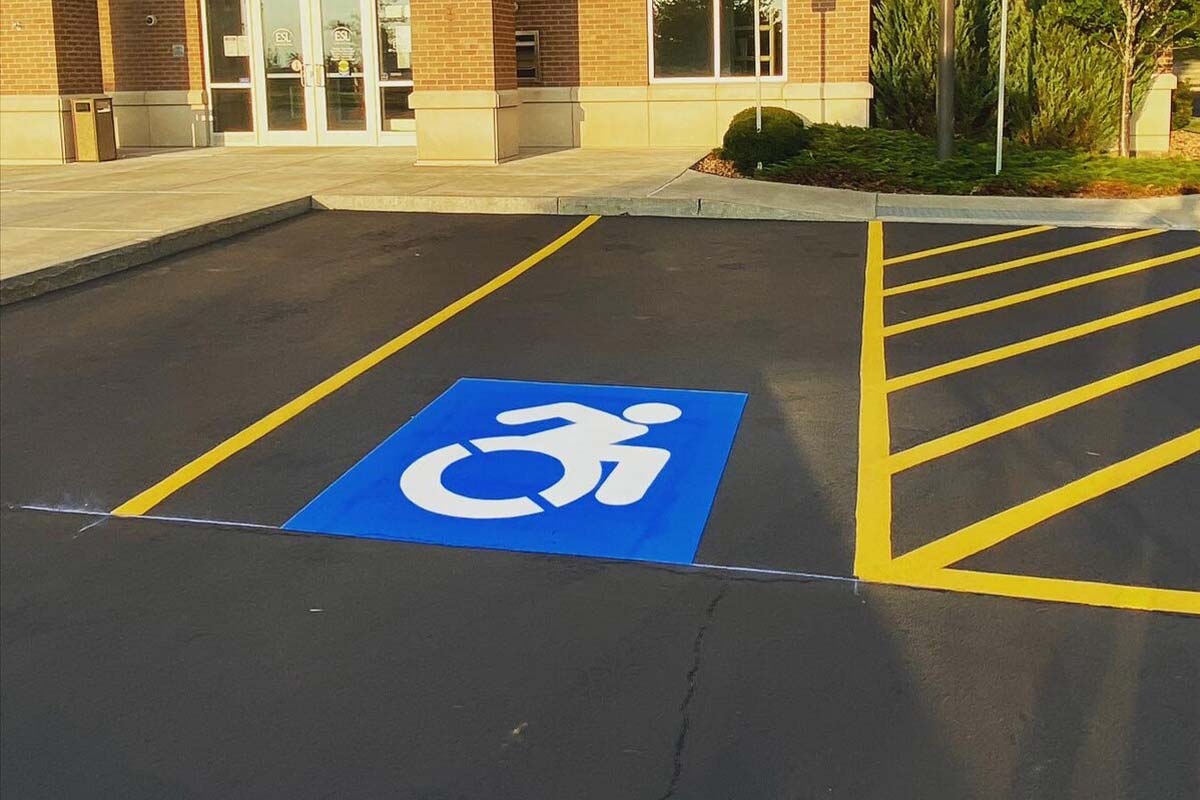
ADA Parking Lot Striping in NE Boston, MA
ADA parking lot striping is laying out and marking accessible stalls, access aisles, and the accessible route to the entrance so the lot meets the 2010 ADA Standards for Accessible Design. We do this across commercial properties in Woburn, Burlington, Wakefield, Lynn, Salem, and Peabody.
Two things catch Massachusetts property managers out. The first is timing. Restriping is the trigger: the Department of Justice states that a business restriping parking spaces must provide accessible parking spaces as required by the 2010 ADA Standards, counted separately for each parking facility. Its brief is guidance rather than binding law, and frames the duty as barrier removal where that is readily achievable — which, being inexpensive, it says restriping usually is.
Second, Massachusetts layers its own requirements on top, and on marking the state code is the more specific of the two.
Massachusetts Access Aisle and Stall Rules
Federal law sets the floor and, on one point, hands the detail to the states. The 2010 ADA Standards say access aisles must be marked so as to discourage parking in them, and the advisory to that section says the method and color of marking are not specified federally but may be addressed by state or local law.
Massachusetts addresses it. Under Massachusetts Architectural Access Board 521 CMR 23.00, access aisles must be clearly marked by means of diagonal stripes. A compliant Massachusetts access aisle is hatched, not merely bounded.
| Requirement | Figure |
|---|---|
| Car access aisle width | 5 feet minimum |
| Van access aisle width | 8 feet minimum |
| Van space width | 8 feet, or all accessible spaces at 11 feet with a 5-foot aisle |
| Access aisle marking | diagonal stripes (Massachusetts) |
| Accessible space delineation | high contrast painted lines or other high contrast delineation (Massachusetts) |
| Placement | closest to accessible entrances, and in no case more than three spaces from the accessible entrance (Massachusetts) |
| Van provision ratio | 1 in every 6 accessible spaces (federal — stricter than the state figure, and the one to build to) |
Two of those rows have no federal twin. High contrast delineation goes beyond the federal instruction to mark the width, and the three-spaces rule constrains design rather than marking — if the stalls sit in the wrong part of the lot, no paint fixes it.
We check count, placement, aisle widths, van provision, and route continuity against both layers before quoting.
For a full list of our pavement marking services, visit our parking lot striping in NE Boston page.
Businesses We Serve




How it Works

GET A FREE ESTIMATE
Contact us today and we’ll have a quote to you in 24 hours

SCHEDULE AN INSTALLATION
We’ll have your installation scheduled in less than 7 days, without affecting your business hours

GET A PARKING LOT THAT POPS
For a budget-friendly price, you’ll get a parking lot that looks like new!
We proudly work with:


We proudly work with:


Frequently Asked Questions About ADA Parking Lot Striping in NE Boston, MA
Does Massachusetts require diagonal stripes in an access aisle?
Yes, and this is the clearest case of state law being more specific than federal law on a striping question. The 2010 ADA Standards require the access aisle to be marked so as to discourage parking in it, and the federal advisory says the method and color are not specified federally and may be addressed by state law. Massachusetts does address it: the state access code requires access aisles to be clearly marked by means of diagonal stripes.
How wide does a van access aisle have to be in Massachusetts?
Eight feet minimum for a van access aisle, against five feet for a car access aisle. Massachusetts also allows an alternative configuration: van spaces need not be separately provided if every accessible space is 11 feet wide with a 5-foot aisle. Either is acceptable, but the choice belongs at layout stage rather than when the crew is measuring.
How close to the entrance do accessible spaces have to be?
The Massachusetts access code requires accessible spaces to be dispersed and located closest to the accessible entrances, and in no case more than three spaces from the accessible entrance. There is an exception: where spaces cannot be located within 200 feet of an accessible entrance, an accessible passenger drop-off within 100 feet is required instead. This is a placement rule, so meeting it usually means changing the layout rather than the marking.
How many van accessible spaces do we need?
One in every six accessible spaces must be van accessible under the 2010 ADA Standards. The Massachusetts figure is less demanding, and where federal and state rules differ the stricter one governs, so build to the federal ratio. Fractions round up — a lot with seven accessible spaces needs two van accessible ones, not one.
Does restriping our lot trigger ADA requirements?
Yes. The Department of Justice compliance brief on restriping states that a business restriping parking spaces must provide accessible parking spaces as required by the 2010 ADA Standards. The count is calculated separately for each parking facility rather than across a whole site, which usually produces more accessible spaces than a single site-wide total would.
Is a painted symbol enough, or do we need a sign as well?
Both, in practice. The painted symbol identifies the space on the ground; signage identifies it when a vehicle is parked over the paint, which is exactly when someone needs to know. Massachusetts also requires accessible spaces to be delineated with high contrast painted lines or other high contrast delineation, going further than the federal instruction simply to mark the width.