Warehouse Line Painting
In NE Boston, MA
OSHA-Compliant Safety Markings
1-800-STRIPER provides warehouse line painting in NE Boston, MA — laying down aisle lines, pedestrian walkways, and safety zone markings that satisfy the OSHA duty in 29 CFR 1910.176(a) to appropriately mark permanent aisles and passageways in distribution and manufacturing facilities.
1-800-STRIPER® of NE Boston PROVIDes Warehouse Line Painting Services NEAR YOU
Want your indoor space to operate more efficiently?
Warehouse and interior markings ensure clear traffic lanes, organized storage zones, and designated spaces designed to help your business operate safely and efficiently.
Benefits:
Warehouse Line Painting in NE Boston, MA
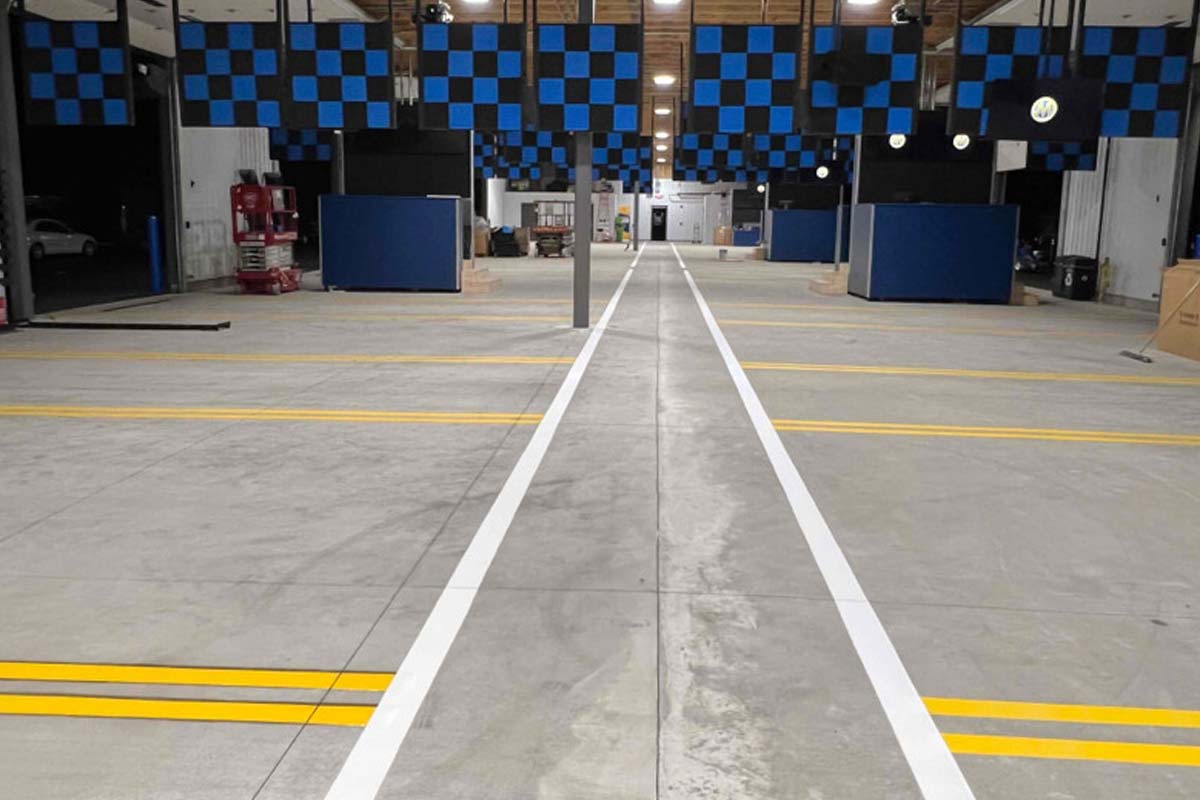
Warehouse line painting is the interior equivalent of parking lot striping: aisle lines, pedestrian walkways, equipment zones, and hazard markings applied to a concrete floor instead of asphalt. We mark distribution centers, manufacturing plants, and storage facilities across Woburn, Wilmington, Burlington, Lynn, and Peabody.
The surfaces are different, the traffic is different, and the rulebook is different. What stays the same is that the markings only earn their keep if people can still read them under a loaded pallet jack two years from now.
Warehouse Floor Marking and Aisle Lines
Warehouse floor marking starts with the aisles. Everything else references them. We lay continuous boundary lines along each permanent aisle and passageway, then work outward to the zones that sit between them.
Aisle lines do two jobs at once. They tell forklift operators where the travel path is, and they tell everyone else where it is not. On a floor without them, the aisle is wherever the last pallet was not set down, which is exactly the condition the marking requirement exists to prevent.
What OSHA Actually Requires
Less than most people assume, and more precisely than most people quote.
The operative provision is Occupational Safety and Health Administration 29 CFR 1910.176(a), and its marking duty is one sentence long.
| Provision | What it requires | What it does not say |
|---|---|---|
| 29 CFR 1910.176(a) | Permanent aisles and passageways shall be appropriately marked | No line width |
| 29 CFR 1910.176(a) | Sufficient safe clearances allowed for aisles, at loading docks, through doorways, and wherever turns or passage must be made | No clearance figure |
| 29 CFR 1910.144 | Red for fire equipment, danger and stop; yellow for caution and physical hazards | The word “aisle” appears zero times |
That is the whole marking duty. The word doing the work is “permanent” — a temporary staging lane is not covered, a permanent travel aisle is. And “appropriately” is deliberately open, which is why the second half of this page exists.
Why There Is No Mandated Line Color
OSHA does not prescribe a color for aisle lines. This surprises people, and the absence is checkable rather than an opinion.
29 CFR 1910.144 Safety Color Code for Marking Physical Hazards is the regulation that assigns colors: red for fire protection equipment, danger, and stop; yellow for caution and for marking physical hazards. The word “aisle” does not appear in it once.
So the common belief that OSHA requires yellow aisle lines is not in the regulation. Yellow is a convention — a good one, and the one most facilities use — but the legal requirement is that permanent aisles be appropriately marked, not that they be marked in a particular color. What that means for you is that the color scheme is a decision you get to make consistently across a site, rather than a compliance box. We will recommend a scheme; we will not tell you a regulation demands it when it does not.
Pedestrian Walkways
Pedestrian routes get their own marked corridors, separated from forklift travel wherever the floor plan allows it. In a facility with mixed traffic this is the marking that does the most safety work per foot of paint.
We run walkways along the shortest realistic path between the entrance, the offices, the break area, and the dock — realistic being the operative word, because a walkway that adds forty seconds to a route is a walkway nobody uses. Crossings where a walkway meets an aisle get marked on both surfaces so the forklift operator and the person on foot see the same conflict point.
Safety and Equipment Zones
Fixed equipment needs a marked footprint and a marked clearance around it. Electrical panels need their access space kept clear, and hatching the floor in front of a panel is the most reliable way to stop a pallet being parked there.
The same treatment applies to fire extinguishers and fire equipment, eyewash stations, emergency exits and their approach paths, and any machine with a swing radius or a hot zone. Hatched exclusion zones read as “not storage” in a way an empty patch of floor never does.
Racking, Staging and Dock Areas
Racking gets marked at the uprights so a struck rack is visible as a struck rack rather than as a scuff. Staging and inbound and outbound zones get bounded footprints, sized to the pallet counts they actually hold rather than to the space available.
Dock areas take the heaviest wear on any warehouse floor and need the most explicit marking: the approach lane, the load and unload footprints, the restraint or chock position, and the clearance a driver needs to walk behind a trailer safely.
Coatings for Forklift Traffic
Concrete floors under forklift traffic destroy ordinary paint. We use coatings specified for industrial floor traffic, applied to a properly prepared surface. Adhesion on concrete is decided by the preparation, not the product.
Preparation means clean, dry, and profiled: removal of existing coating where it has failed, degreasing where lift traffic has laid down oil, and abrasion so the coating keys into the slab. A line painted onto a sealed or contaminated slab will lift at the edges within a season regardless of what it cost.
Scheduling Around Operations
Most facilities cannot stop, so we work around the operation rather than through it. That usually means zone-by-zone scheduling, second-shift or weekend work, or a phased plan that keeps the dock live while the far aisles are marked.
Cure time is the constraint that drives the schedule. A marked zone has to stay off traffic long enough for the coating to harden, and the honest way to plan a facility is to sequence the zones so that the cure window always falls somewhere the operation is not.
Facility Types We Mark
Distribution and fulfillment centers along the Route 128 and I-93 corridors. Manufacturing plants and assembly floors. Cold storage and food handling facilities, where the coating specification matters more than usual. Third-party logistics warehouses with mixed tenant zones. Auto and equipment service bays. Municipal and institutional storage buildings across Middlesex and Essex counties.
For a full list of our pavement marking services, visit our parking lot striping in NE Boston page.
Businesses We Serve




How it Works

GET A FREE ESTIMATE
Contact us today and we’ll have a quote to you in 24 hours

SCHEDULE A STRIPING
We’ll have your space restriped in less than 7 days, without affecting your business hours

GET A PARKING LOT THAT POPS
For a budget-friendly price, you’ll get a parking lot that looks like new
We proudly work with:


We proudly work with:


Frequently Asked Questions About Warehouse Line Painting in NE Boston, MA
What line color does OSHA require for warehouse aisles?
None. This is the answer people least expect and it is checkable. The OSHA safety color code regulation assigns red to fire equipment, danger, and stop, and yellow to caution and physical hazards, but the word “aisle” does not appear in that regulation at all. Yellow aisle lines are an industry convention rather than a legal requirement, so the scheme is genuinely your decision to make consistently across a site.
How wide does a warehouse aisle have to be?
No regulation gives a number. The OSHA provision that governs aisles requires that sufficient safe clearances be allowed at loading docks, through doorways, and wherever turns must be made, and it stops there. In practice the width is set by your equipment — the turning radius of the largest lift truck that uses the aisle, plus clearance for a loaded pallet — not by a code figure someone can quote at you.
What does OSHA actually require for warehouse floor line marking?
One sentence: permanent aisles and passageways shall be appropriately marked. That is 29 CFR 1910.176(a), and it is the whole duty. Two words carry the weight. “Permanent” means a travel aisle that is part of the layout, not a temporary staging lane. “Appropriately” is deliberately open, which is why the color and the exact pattern are engineering decisions rather than compliance items.
How long do warehouse floor markings last under forklift traffic?
Two to five years for a properly specified and properly prepared coating, and the range is almost entirely about preparation rather than product. Lines fail early for one of three reasons: the slab was sealed and the coating never keyed into it, oil contamination was painted over instead of removed, or the zone went back into traffic before the coating had cured. Fix those three and the marking outlasts the racking layout.
Can you mark our floor without shutting the warehouse down?
Almost always. We work zone by zone, and on most sites we schedule second shift or weekends so the dock and the live aisles stay in service. The real constraint is cure time rather than paint time — a marked zone has to stay off traffic while the coating hardens — so the plan sequences zones such that the cure window always lands where the operation is not working that day.
Do you mark the parking lot and the warehouse floor in the same visit?
Yes, and on industrial properties it is usually the efficient way to do it. The exterior stall lines, fire apparatus access markings, and the interior aisle and walkway markings are different materials on different surfaces, but they are one mobilization and one schedule. It also means the whole site gets looked at once, which is how the mismatch between an approved fire route and what is painted outside tends to surface.