Parking Lot Restriping
In NE Boston, MA
Restripe Existing Lines and Markings
1-800-STRIPER provides parking lot restriping in NE Boston, MA — refreshing faded stalls, ADA spaces, fire lanes, and directional arrows, and bringing accessible parking up to the 2010 ADA Standards that the Department of Justice says restriping triggers for commercial properties.
1-800-STRIPER of NE Boston PROVIDes Parking Lot Restriping Services NEAR YOU
Need to brighten up your faded parking lot?
Keep your parking lot safe and attractive by restriping annually to freshen up lines and symbols that have faded from the sun, weather, and traffic. Nothing beats a fresh coat of paint!
Benefits:
Parking Lot Restriping in NE Boston, MA
Restriping is repainting an existing layout. It is not designing a new one. The stall pattern, the drive aisles, and the accessible spaces stay where they are; the lines, symbols, and arrows go back on at full opacity. For most commercial properties in Woburn, Lynn, Salem, and Peabody, that is the work they actually need. The lot functions fine. It has simply stopped being legible.
We restripe over the existing pattern using layout traffic paint, working from the lines that are still visible plus the ghost marks left in the asphalt where paint has worn through. On lots where the old pattern is genuinely gone, we lay the grid out fresh from measurements rather than guessing at where stalls used to be.
When Restriping Is Due
The trigger is legibility at night in the rain, not a date on a maintenance calendar. If a driver pulling in at seven on a February evening cannot tell where one stall ends and the next begins, the lot is due, whether that took eighteen months or four years.
Three signs show up first, and they show up in a predictable order. Stall lines go from white to gray while the accessible symbols are still readable, because the blue paint in accessible markings is laid heavier. Then the arrows and crosswalk bars fade, since they take direct tire contact. Then the accessible markings themselves start to break up, and at that point the lot has a compliance problem rather than a cosmetic one.
The other trigger is a complaint. Drivers parking across two stalls, cars nosing into the fire apparatus access road, delivery vehicles blocking the door because the loading zone is invisible — those are all symptoms of paint, not of drivers.
Why Restriping Triggers ADA Obligations
This is the single most expensive thing property managers get wrong, and it is worth stating plainly: restriping is a compliance event.
The Department of Justice says so directly. Its ADA Compliance Brief: Restriping Parking Spaces states that when a business restripes parking spaces in a parking lot or parking structure, it must provide accessible parking spaces as required by the 2010 ADA Standards for Accessible Design. The same brief frames this as a continuing obligation to remove barriers where doing so is readily achievable — and says that because restriping is relatively inexpensive, it is readily achievable in most cases. The brief is Justice Department guidance rather than binding law, but it is the clearest published statement of how the department reads the duty, and it is what an inspector or a plaintiff’s lawyer will point at.
Two details in that brief catch people out. First, the required number of accessible spaces is calculated separately for each parking facility, not by dividing a total across a whole campus or shopping center site. A property with three lots does the arithmetic three times. Second, the obligation applies to the restriping itself, which means the cheapest moment to fix an accessible-parking deficiency is the moment you were already paying to repaint.
We check the accessible count, the aisle widths, and the van provision against the standards before the first line goes down, and we tell you what we find before we start rather than after.
Faded Stalls and Traffic Flow
A faded lot does not just look neglected. It loses capacity. Drivers park defensively when they cannot see the lines, leaving gaps that swallow a stall every six or seven cars. On a hundred-space lot that is a dozen spaces you pay property tax on and do not use.
Circulation degrades the same way. Worn directional arrows mean drivers pick their own path through the aisles, which produces the head-on encounters and reverse-out conflicts that generate low-speed collision claims. Fresh arrows and clear aisle boundaries put the traffic back on the pattern the lot was designed around.
Restriping vs. New Layout
Restriping keeps the existing geometry. A new layout changes it. The decision is usually made for you by three questions.
Has the building’s use changed? A retail bay converted to medical office needs a different accessible-space ratio and a different mix of short-stay and staff parking. Is the current pattern actually working? If drivers consistently misuse a corner or a row, repainting the same lines reproduces the problem at full opacity. And is the lot compliant as drawn? If the accessible spaces are in the wrong place or the aisles are undersized, restriping over them locks in the defect.
If all three answers are clean, restripe. If any one of them is not, the layout design work pays for itself, and we handle that on the layout design page rather than pretending a repaint solves it.
ADA Stalls and Access Aisles
Accessible stalls are the part of a restripe with the least room for improvisation, because the dimensions are set by the 2010 ADA Standards and, in Massachusetts, layered with a state code that is more specific in places.
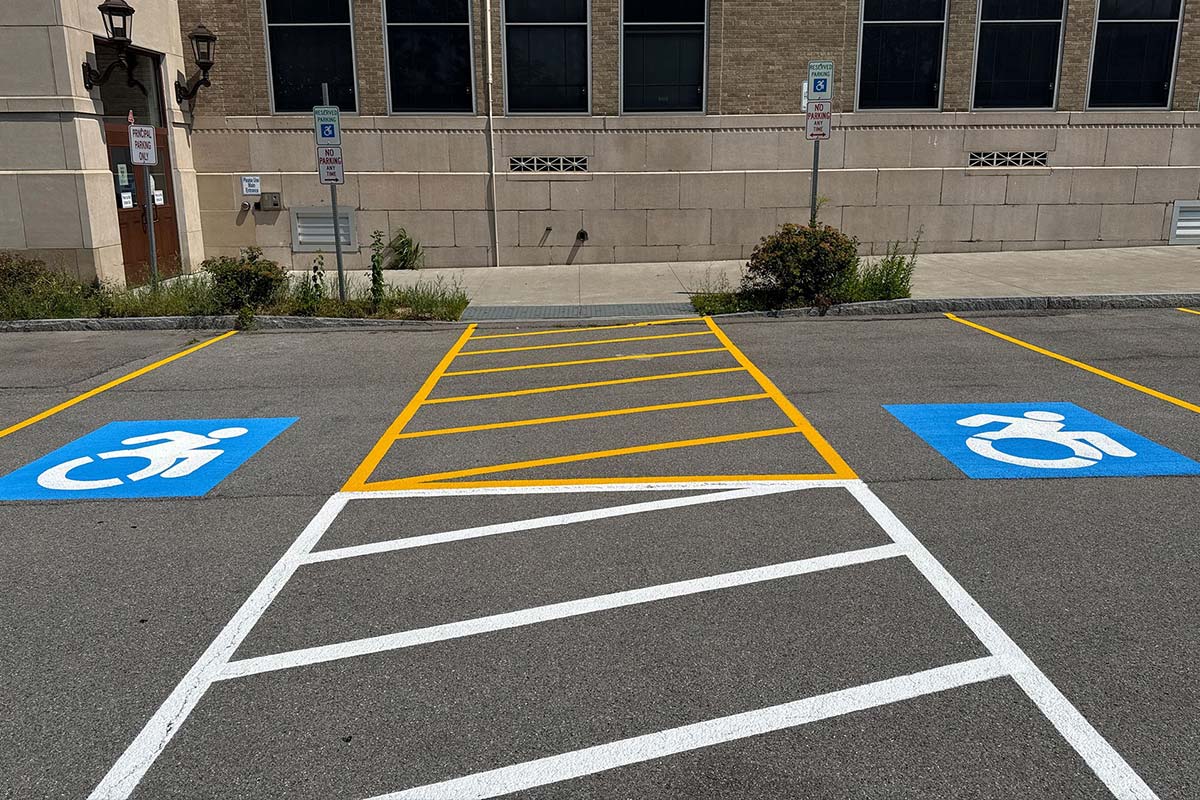
Access aisles are the clearest example. Federal law says the aisle must be marked to discourage parking in it and deliberately leaves the method open. Massachusetts fills that gap: 521 CMR 23.4.6(e) requires access aisles to be clearly marked by means of diagonal stripes. So a Massachusetts access aisle is not a pair of boundary lines with empty asphalt between them. It is hatched.
Van provision is where state and federal rules diverge and federal wins. The 2010 ADA Standards require one in every six accessible spaces to be van accessible. The Massachusetts figure is less demanding, so we build to the federal ratio, which is the operative rule.
We also mark the aisles on both counts of geometry: a car access aisle at five feet minimum, a van access aisle at eight feet minimum, connecting to an accessible route that stays clear.
Fire Lanes and No-Parking Zones
Fire access markings usually get repainted in the same visit, because they wear on the same schedule and they are the markings a fire inspector actually looks at.
Massachusetts is worth a note here. The state fire code does not use the phrase “fire lane” at all — it legislates fire apparatus access roads throughout. In practice that means the marking, the signage, and the width all get judged against the access road standard rather than against a generic painted-curb convention. The state sets that unobstructed width at twenty feet, and the local fire department is the authority that approves the specifics.
We restripe the access road boundaries, the no-parking hatching, and the curb painting to the plan the fire department already approved for your property. Where no approved plan exists, we say so rather than inventing one, and the fire lane striping page covers what happens next.
Directional Arrows and Crosswalks
Arrows and crosswalks take the worst wear on any lot because they sit directly under tire contact, and they are the first markings a plow blade catches on a raised or patched surface.
We repaint one-way arrows at aisle entries and decision points, stop bars at the exits onto public roads, and pedestrian crosswalks on the paths people actually use — typically the run from the far row to the main entrance, and the connection between the accessible spaces and the accessible entrance. That last one is not decoration. Under the accessibility standards the route from an accessible space to the entrance has to stay usable, and a crosswalk is how you tell drivers where it is.
Surface Prep Before Restriping
Paint bonds to clean, dry pavement and nothing else. Prep is the difference between markings that last three seasons and markings that lift in the first spring.
On a typical northeast Massachusetts lot the prep is a pressure wash to remove winter salt residue, oil staining at the head of the stalls, and the fine grit that settles into asphalt over a season. Where a previous layout has to disappear rather than be painted over, we remove the old markings instead of covering them, because a ghost line under fresh paint reads as a second stall boundary in low light.
Cracks and potholes are a separate trade and a separate decision. We will tell you if the surface needs repair before paint, and we will not paint over a failure that is going to take the lines with it.
New England Winters and Line Wear
Massachusetts lots wear differently from lots in most of the country, and the cause is mechanical rather than climatic. Plow blades ride the surface, and every raised joint, patch, or manhole collar is a place where the blade takes paint off in a single pass. Sand and salt then act as a grinding compound under tires for the rest of the season.
The practical consequences are two. Lots that are plowed need restriping more often than lots that are not, regardless of traffic volume. And the striping season runs from spring through late fall, because traffic paint needs pavement that is warm enough and dry enough to cure. We schedule northeast Boston work around that window rather than around the calendar year.
The Restriping Process
- Site walk and measure. We walk the lot, count the existing stalls, measure the accessible spaces and aisles, and note where the pattern has failed rather than faded.
- Compliance check. Accessible count, van provision, aisle widths, and access route are checked against the 2010 ADA Standards and the Massachusetts access code before anything is quoted.
- Written scope. You get the stall count, the specialty markings, and any prep or repair we think the surface needs, in writing, before scheduling.
- Prep. Pressure washing, debris clearing, and removal of any markings that must not show through.
- Layout. The existing pattern is chalked or the grid is re-measured where the old lines are gone.
- Paint. Stalls first, then accessible markings, then fire access and directional markings.
- Cure and reopen. The lot reopens in sections as the paint cures, so the property is never fully closed.
Property Types We Restripe
Retail plazas and strip centers, where stall turnover is high and the accessible spaces sit closest to the busiest doors. Office parks in Burlington, Woburn, and Wakefield, where the pattern is stable and the wear is seasonal. Medical and dental offices, which carry a higher accessible-space ratio because of who parks there. Restaurants and their overflow lots. Apartment and condominium properties, where numbered resident stalls need the numerals repainted along with the lines. Places of worship, schools, and municipal lots across Lynn, Salem, Peabody, and Melrose. Industrial and distribution properties, where the lot markings and the interior warehouse floor markings are usually best done in the same visit.
For a full list of our pavement marking services, visit our parking lot striping in NE Boston page.
Businesses We Serve




How it Works

GET A FREE ESTIMATE
Contact us today and we’ll have a quote to you in 24 hours

SCHEDULE AN INSTALLATION
We’ll have your installation scheduled in less than 7 days, without affecting your business hours

GET A PARKING LOT THAT POPS
For a budget-friendly price, you’ll get a parking lot that looks like new
We proudly work with:


We proudly work with:


Frequently Asked Questions About Parking Lot Restriping in NE Boston, MA
How often does a parking lot need restriping in Massachusetts?
Most commercial lots in the northeast Boston area run eighteen to thirty-six months between restripes, and the plow schedule is what decides where in that range a given lot falls. A lot that gets plowed hard every winter loses paint faster than a lot with the same traffic in a milder climate. The reliable test is legibility after dark in wet weather rather than elapsed time.
Does restriping trigger ADA requirements?
Yes, and this is the part people are most often surprised by. The Department of Justice compliance brief on restriping states that a business restriping parking spaces must provide accessible parking spaces as required by the 2010 ADA Standards, and treats that as a continuing obligation to remove barriers where doing so is readily achievable — which, the brief says, restriping usually is, because it is relatively inexpensive. The brief is guidance rather than binding law. Practically, it means the accessible count and geometry should be checked before the crew arrives, not after the invoice.
Is the accessible space count based on the whole site or each lot?
Each parking facility separately. The Department of Justice brief is explicit that the number of accessible spaces must be calculated separately for each parking facility, rather than being based on the total number of spaces provided on a site. A property with three separate lots runs the calculation three times, which usually produces more accessible spaces than a single site-wide total would.
Can you restripe over the existing lines, or do the old ones have to come off?
Usually over. If the existing pattern is correct and simply faded, painting over it is faster, cheaper, and produces a cleaner result because the old line acts as a guide. Old markings have to be removed when the layout is changing, because a ghost line under fresh paint reads as a real stall boundary in low light and puts drivers in the wrong place.
How long does the lot have to stay closed?
Rarely all of it, and rarely for long. We work in sections so part of the lot stays open throughout, and freshly painted lines take roughly thirty to sixty minutes to become walkable and a few hours to take traffic, depending on temperature and humidity. On retail and restaurant properties we usually schedule around opening hours so the lot is fully back in service before the first customers arrive.
Do I need a permit to restripe my parking lot?
Not normally for a like-for-like repaint on private commercial property, because nothing is being constructed and the layout is not changing. Two things change that answer. Altering the layout can trigger local site-plan review. And plans for a new or modified fire apparatus access road must be submitted to the fire department for approval before construction, sealed by a registered professional engineer, under the Massachusetts fire code.
What time of year should parking lot restriping be scheduled?
Spring through late fall in Massachusetts. Traffic paint needs pavement warm enough and dry enough to cure properly, and a New England winter does not supply either for long. The best-scheduled properties book in winter for an early-spring slot, which gets the lot legible before the season’s traffic arrives and avoids the summer queue.
Do you restripe fire lanes and accessible spaces at the same time?
Yes, and it is almost always the right call. The specialty markings wear on the same schedule as the stall lines, they are the markings inspectors look at first, and doing them in one visit means one mobilization instead of two. On a Massachusetts property that also means the fire apparatus access road markings get checked against the approved fire department plan while the crew is already on site.