Wheel Stop Installation
In SW Chicago, IL
Concrete and Rubber Parking Stops
1-800-STRIPER provides professional wheel stop installation in SW Chicago, IL — anchoring concrete, recycled-rubber, and plastic-composite wheel stops at stall heads to protect sidewalks, storefronts, and accessible routes per the 2010 ADA Standards for commercial properties across Cook, DuPage, and Will counties.
1-800-STRIPER® of SW Chicago PROVIDes Wheel Stops Services NEAR YOU
Need to protect vehicles or walls from accidental damage?
Wheel stops (also called parking blocks) protect your property, enhance safety, and improve parking lot organization.
Benefits:
Wheel stops prevent vehicles from parking too far into a space or overextending into other spots, pedestrian walkways, and other areas, while also helping with vehicle alignment. They can prevent damage to buildings, curbs, or landscaping. Wheel stops also serve as clear visual cues for proper parking and are sometimes used on slopes to prevent cars from rolling.
What Wheel Stop Installation Includes
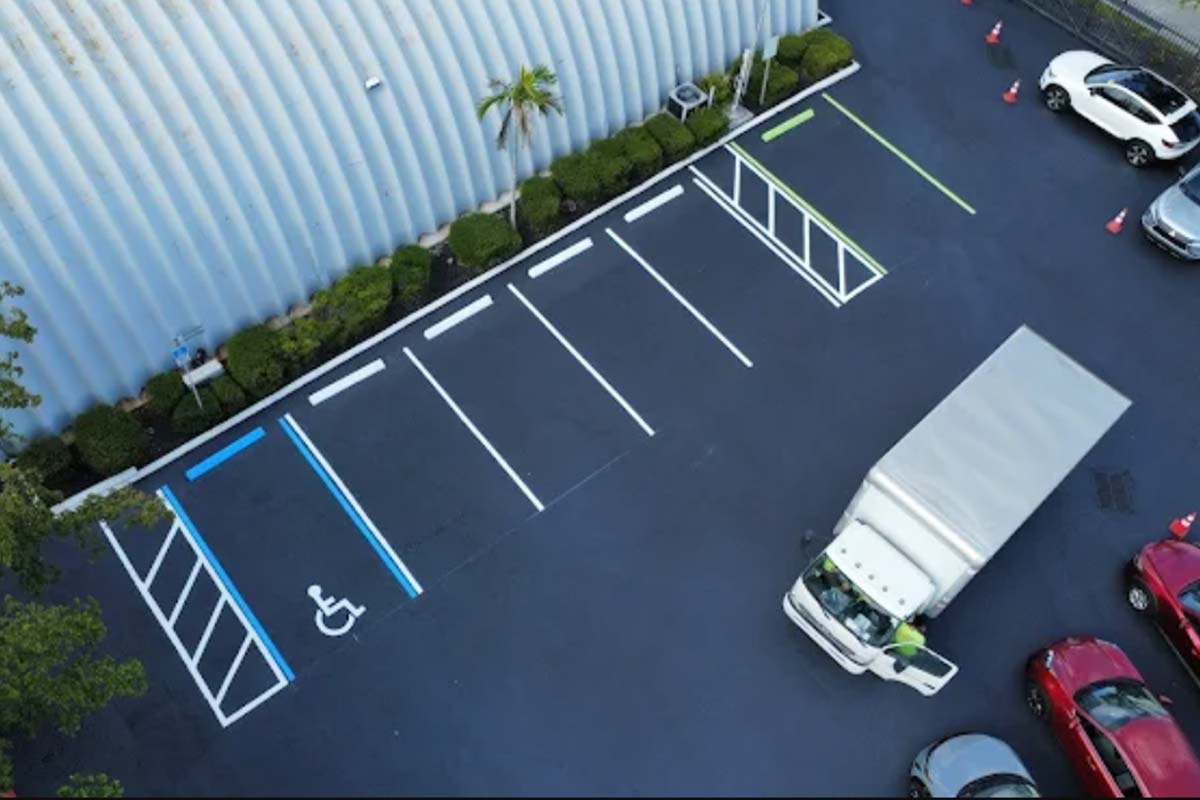
Wheel stops — also called parking bumpers, car stops, curb stops, or bumper blocks — sit at the head of a parking stall and give a driver a physical stopping point before the vehicle rolls too far forward. Without them, cars creep onto sidewalks, chip storefront facades, crush landscaping, and crowd the accessible route that runs along a building’s front. A wheel stop set at the correct distance from the stall front keeps bumpers clear of walkways and building edges while still letting a vehicle park square in its space.
For property and facility managers across the southwest suburbs, wheel stops are a straightforward way to cut down vehicle-into-building incidents and keep pedestrian routes clear of vehicle overhang. They also help define stall boundaries for drivers on lots where painted lines have worn thin between restriping cycles — a common problem after a Chicago winter of salt and plowing. 1-800-STRIPER of SW Chicago installs wheel stops as a standalone project or alongside new striping and layout work, matching stop placement to your existing or newly painted stall lines so the lot reads clearly from the drive aisle. Whether it’s a single row in front of a storefront or a full lot of stall-head stops for a new build in Cook, DuPage, or Will County, placement is set against the stripes so every stop lands where it belongs.
Materials — Concrete, Recycled-Rubber, and Plastic-Composite
Wheel stops come in three common materials, and the right choice depends on traffic volume, the vehicles the lot serves, and how hard the Chicago freeze-thaw cycle works on the pavement.
| Material | Characteristics |
|---|---|
| Concrete | Heaviest and most rigid; handles heavy truck and trailer traffic; can chip, crack, or spall under repeated freeze-thaw |
| Recycled rubber | Lighter and flexible; resists cracking, won’t rust or spall; high-visibility color options |
| Plastic composite | Lightweight; corrosion- and rot-proof; easy to reposition when a layout changes |
The southwest suburbs put every material through repeated freeze-thaw cycling: water works into a hairline crack, freezes, expands, and widens the crack a little more each winter, and road salt accelerates the surface damage. Concrete stops are the traditional choice and hold up well under heavy truck and trailer loads, but they’re also the material most prone to cracking and spalling over multiple Chicago winters. Recycled rubber and plastic composite stops flex instead of cracking and shrug off salt, which is why they’re often the better call for lots that see hard freeze-thaw exposure or need stops repositioned as the layout changes. Rubber and composite also come in high-visibility colors that stay legible against gray winter pavement. We walk through the trade-offs for your lot and traffic mix before recommending a material — there’s no single right answer for every property.
How Wheel Stop Installation Works
Every install follows the same sequence — lay out, position, then anchor to the surface.
- Mark stall-head positions. We lay out and mark each wheel stop location against your existing or newly striped stall lines, keeping the set-back consistent across the lot so every stop lines up with the stripes.
- Position each stop. Each stop is set at the correct distance back from the stall front — commonly two to three feet, depending on the vehicles the space serves — so a parked car’s overhang stays inside the stall and off the sidewalk or accessible route.
- Anchor and pin to the surface. In asphalt, we drive steel spikes or rebar pins through pre-drilled holes in the stop and into the base below. In concrete, driven pins don’t hold the same way, so we set embedded anchors — epoxy or mechanical bolt anchors — that grip a surface that won’t accept a driven spike.
- Verify clearance and alignment. We check that each stop sits at the right set-back, keeps the accessible route clear per ADA requirements, and lines up straight with the stall striping so the finished row reads clean from the drive aisle.
Matching the anchor to the surface is what keeps a stop from shifting, walking, or rocking loose under daily traffic — a spike driven into concrete, or an anchor that never bit into asphalt base, works free within a season.
ADA Route Clearance (§403 & §502.7)
Wheel stops can’t go wherever it’s convenient — placement has to respect the accessible route and access aisles running through the lot. Under the 2010 ADA Standards for Accessible Design, §502.7, parking spaces and access aisles have to be designed so a parked car or van can’t obstruct the required clear width of the adjacent accessible route. The standard’s own advisory names wheel stops as an effective way to keep vehicle overhang from reducing that clear width — which is exactly the job a correctly placed stop does.
The route those stops protect has a hard number behind it. ADA §403 requires an accessible route to hold at least 36 inches of clear width, and a wheel stop set too close to the stall front pushes a parked vehicle’s bumper or mirror into that clearance zone. Set the stop back correctly and the overhang stays inside the stall; set it too far forward and it never catches the bumper before it reaches the curb, sidewalk, or wall.
In Illinois, the federal 2010 ADA Standards are the baseline, and the Illinois Accessibility Code (71 Ill. Adm. Code 400) layers state accessibility requirements on top of them. We measure existing stall depth and accessible-route width during the site visit and set placement to hold clearance on both counts, adjusting stop position where a stall backs directly onto a building entrance, a sidewalk, or an accessible parking aisle so the route stays open and compliant.
For a full list of our pavement marking services, visit our parking lot striping in SW Chicago page.
Businesses We Serve




How it Works

GET A FREE ESTIMATE
Contact us today and we’ll have a quote to you in 24 hours

SCHEDULE AN INSTALLATION
We’ll have your installation scheduled restriped in less than 7 days, without affecting your business hours

GET A PARKING LOT THAT POPS
For a budget-friendly price, you’ll get a parking lot that looks like new
We proudly work with:


We proudly work with:


Frequently Asked Questions About Wheel Stop Installation in SW Chicago, IL
Concrete or rubber wheel stops — which lasts longer in Chicago winters?
It depends on the wear. Concrete stops are heavy and rigid, which holds up well against truck and trailer traffic, but repeated freeze-thaw cycles and road salt can chip, crack, or spall concrete over several southwest-suburban winters. Recycled rubber and plastic composite stops flex instead of cracking and won’t rust or spall, which often makes them the better long-term pick for lots exposed to hard freeze-thaw. We factor in your traffic mix and exposure before recommending a material.
How are wheel stops anchored in asphalt versus concrete?
Differently, because the surfaces hold differently. In asphalt, we drive steel spikes or rebar pins through pre-drilled holes in the stop and into the base beneath — the pin bites the softer material and the base below it. In concrete, driven pins don’t hold, so we set embedded anchors instead, either epoxy or mechanical bolt anchors sized to the stop. Matching the anchor to the surface keeps the stop seated so it doesn’t shift or walk loose under regular parking traffic.
Do wheel stops affect ADA accessible routes?
Yes, if they’re placed wrong. The 2010 ADA Standards §502.7 require parking spaces and access aisles to be laid out so a parked vehicle can’t obstruct the adjacent accessible route, and §403 sets that route’s minimum clear width at 36 inches. A stop set too close to the stall front pushes a bumper or overhang into that zone. We set stops back the correct distance — commonly two to three feet — to keep the route clear while still stopping vehicles short of sidewalks and building fronts.
What’s the difference between a wheel stop, a car stop, and a bumper block?
Nothing — they’re different names for the same thing. “Wheel stop,” “car stop,” “parking stop,” “curb stop,” and “bumper block” all refer to the low barrier anchored at the head of a stall that keeps a vehicle from pulling too far forward. You’ll hear property managers and suppliers use the terms interchangeably. Whatever you call it, we install it in concrete, recycled rubber, or plastic composite and anchor it to the surface at the correct set-back from the stall front.
Can you replace broken or loose stops?
Yes. We remove the damaged or loose stop, then either re-anchor a replacement in the same spot or switch materials if the original isn’t holding up to your lot’s traffic or Chicago’s freeze-thaw exposure. A concrete stop that’s spalling apart is often a good candidate to swap for recycled rubber or composite. Call 1-800-STRIPER of SW Chicago for a free estimate and we’ll assess which stops need full replacement versus a re-anchor.
Do you offer free estimates for wheel stop installation?
Yes. Call 1-800-STRIPER of SW Chicago for a free estimate on wheel stop installation, replacement, or a combined project with new striping and layout work anywhere across Cook, DuPage, and Will counties. We’ll look at your stall depth, traffic mix, accessible-route clearances, and surface — asphalt or concrete — then recommend the right material and anchoring method and lay out placement before any work is scheduled.