ADA Parking Lot Striping
In SW Chicago, IL
ADA-Compliant Accessible Parking
1-800-STRIPER provides ADA-compliant parking lot striping in SW Chicago, IL — installing accessible spaces, van-accessible stalls, access aisles, ISA symbols, and required signage per the ADA Standards for Accessible Design and the Illinois Accessibility Code.
1-800-STRIPER® of SW Chicago PROVIDes ADA Compliance Services NEAR YOU
Need to make your property more accessible?
Upgrade your facility to become fully ADA compliant by partnering with us to create clear, accessible parking for all your visitors.
Our ADA Compliant line striping services include:
What ADA Striping Includes — Stalls, Access Aisles, ISA & Signage
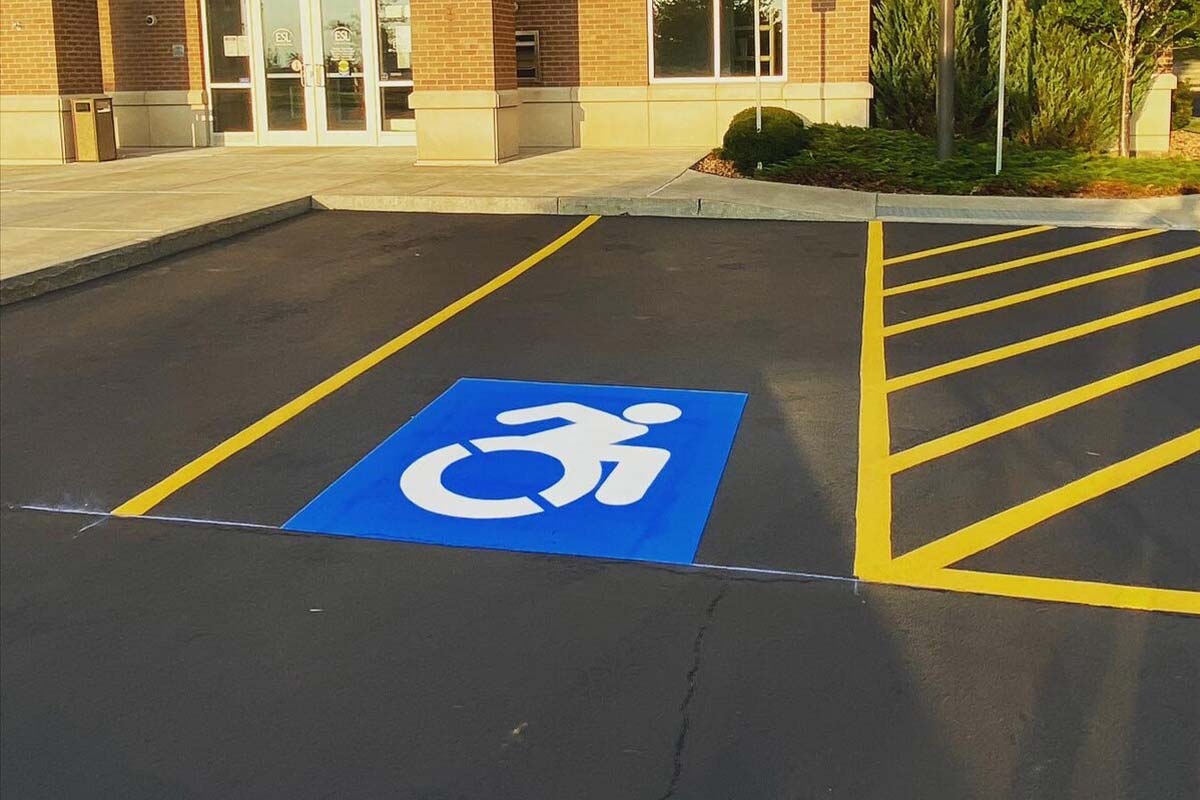
ADA-compliant striping means every accessible parking space, access aisle, symbol, and sign on your lot meets the 2010 ADA Standards for Accessible Design and the Illinois Accessibility Code. Compliance covers four things at once: the count of accessible spaces required for your lot size, the dimensions of each space and its adjoining access aisle, the International Symbol of Accessibility painted on the pavement, and the post-mounted signage that marks each space as reserved and identifies which stalls are van-accessible.
1-800-STRIPER of SW Chicago handles all four for commercial properties across the southwest suburbs — single-tenant retail lots to multi-building campuses. We stripe each accessible space to full width, paint the adjoining access aisle with the diagonal hatching that keeps it clear, apply the International Symbol of Accessibility per 2010 ADA §703.7.2.1 in the correct position for each space, and install the post-mounted signs — including the “van accessible” designation where required — at the mounting height the standard sets. Non-compliant striping is both an accessibility barrier and a liability exposure: faded, missing, or undersized markings make it harder for a person using a wheelchair to park and reach the building, and ADA parking complaints are a common enforcement path. Getting the layout done right once — sized correctly, positioned on the shortest accessible route to the entrance — is the most direct way to remove that risk.
Compliance isn’t tied only to new construction. Under the 2010 ADA Standards, an existing lot that gets resurfaced or restriped is treated as an alteration and has to be brought up to current accessible-parking requirements to the maximum extent feasible — which makes a restriping project the natural moment to correct an outdated layout, not just repaint the lines already there. In the southwest suburbs, freeze-thaw winters and road salt fade paint and heave pavement faster than in milder climates, so accessible striping and access-aisle hatching are often among the first markings to become unreadable, well before the rest of the lot needs attention.
ADA & Illinois Accessibility Code Requirements
Accessible parking in Illinois answers to two layers of rule. The federal layer is the 2010 ADA Standards for Accessible Design, which set the nationwide minimums for accessible-space counts, stall and aisle dimensions, symbols, and signage. The state layer is the Illinois Accessibility Code (71 Ill. Adm. Code 400), administered by the Illinois Capital Development Board, which adopts and in places exceeds the federal standards. A compliant lot has to satisfy both — where the two differ, the more stringent requirement governs.
Under the federal standard, the core dimensional rules are well established. Every accessible space, standard or van, must be at least 96 inches wide. A standard accessible space needs an adjoining access aisle at least 60 inches wide; a van-accessible space needs a 96-inch aisle (2010 ADA §502). Access aisles must be marked so they read as no-parking zones — typically with diagonal hatching — and must connect directly to an accessible route to the building entrance, without routing behind parked cars. Signage carries the International Symbol of Accessibility and, at van spaces, a “van accessible” designation; the sign sits at least 60 inches above the ground, measured to the bottom of the sign (2010 ADA §502.6). The Illinois Accessibility Code layers its own scoping and technical requirements on top of these, which is why we verify a Chicago-area lot against both the federal standard and the state code before laying out a single stripe.
Accessible-Stall Counts & Van Spaces
The number of accessible spaces a lot must provide is set by the total number of parking spaces on the lot, per 2010 ADA §208.2:
| Total parking spaces in lot | Minimum required accessible spaces |
|---|---|
| 1 to 25 | 1 |
| 26 to 50 | 2 |
| 51 to 75 | 3 |
| 76 to 100 | 4 |
| 101 to 150 | 5 |
| 151 to 200 | 6 |
| 201 to 300 | 7 |
| 301 to 400 | 8 |
| 401 to 500 | 9 |
| 501 to 1,000 | 2% of total |
| 1,001 and over | 20, plus 1 per 100 over 1,000 |
At least 1 in every 6 accessible spaces — with a minimum of one — must be van-accessible, no matter how small the total accessible count is. The count scales in whole increments: a lot that requires 4 accessible spaces still needs only 1 van space (4 ÷ 6 rounds up to 1), while a lot requiring 7 to 12 accessible spaces needs 2 van spaces. A van-accessible space pairs with the wider 96-inch access aisle instead of the 60-inch standard aisle, and two accessible spaces are permitted to share a single access aisle between them.
Placement matters as much as count. Accessible spaces have to sit on the shortest accessible route to an accessible entrance — usually near the front of the lot, not scattered wherever pavement happens to be open. Where a property serves more than one building or entrance, the spaces get distributed so each entrance has its own compliant count nearby rather than one distant cluster. We run the §208.2 math against your lot’s actual space count, then confirm the van ratio and placement before marking, because the Illinois Accessibility Code can require its own scoping on top of the federal minimum for certain uses.
How ADA Striping Works
- Audit the lot against current standards. We measure total space count, the existing accessible-space count and dimensions, aisle widths, and signage — comparing what’s on the ground to what the 2010 ADA Standards and the Illinois Accessibility Code require.
- Calculate required counts and locations. Using the §208.2 table, we confirm exactly how many accessible and van-accessible spaces the lot needs, then place them on the shortest accessible route to the main entrance rather than wherever space allows.
- Mark stalls, aisles, and ISA symbols. We stripe each accessible space to full width, paint the adjoining access aisle with diagonal hatching, and apply the International Symbol of Accessibility to the pavement per §703.7.2.1 in the correct position for each space.
- Install and verify signage. Post-mounted signs — including the “van accessible” designation where required — are set so the bottom of the sign sits at least 60 inches above the surface (§502.6), keeping it visible above a parked vehicle.
- Compliance walkthrough. Before we leave, we walk the finished layout against the same checklist from step one, confirming stripe placement, aisle width, symbol position, and signage height all match the standard — so the lot is inspection-ready and, more to the point, actually usable.
For a full list of our pavement marking services, visit our parking lot striping in SW Chicago page.
Businesses We Serve




How it Works

GET A FREE ESTIMATE
Contact us today and we’ll have a quote to you in 24 hours

SCHEDULE AN INSTALLATION
We’ll have your installation scheduled in less than 7 days, without affecting your business hours

GET A PARKING LOT THAT POPS
For a budget-friendly price, you’ll get a parking lot that looks like new!
We proudly work with:


We proudly work with:


Frequently Asked Questions About ADA Parking Lot Striping in SW Chicago, IL
How many accessible spaces does my lot need?
It depends on your lot’s total parking count, per the 2010 ADA §208.2 table: 1 accessible space for a lot of 1–25 spaces, 2 for 26–50, and up from there, reaching 2 percent of total spaces for lots over 500, or a flat 20 plus 1 per 100 over 1,000 for very large lots. We measure your total count first, then confirm the required number — and check it against the Illinois Accessibility Code — before laying out any stalls.
What makes a space van-accessible instead of standard?
Both are the same 96-inch minimum width, but a van-accessible space pairs with a wider 96-inch access aisle instead of the standard 60-inch aisle, and its post-mounted sign carries a “van accessible” designation. At least 1 in every 6 accessible spaces on your lot — a minimum of one — must be van-accessible, no matter how small the total accessible count is.
What are the access-aisle rules?
Every accessible space needs an adjoining access aisle: at least 60 inches wide for a standard accessible space, or 96 inches for a van-accessible space. The aisle has to be marked — typically with diagonal hatching — so it reads as a no-parking zone, and it must connect directly to an accessible route to the building entrance without routing behind parked vehicles. Two accessible spaces are allowed to share a single aisle between them.
How high do the accessible-parking signs go?
Each accessible space needs a post-mounted sign displaying the International Symbol of Accessibility, set so the bottom of the sign is at least 60 inches above the ground surface, measured to the bottom edge (2010 ADA §502.6). That height keeps the sign visible above the roof of a parked vehicle in a full lot. Van spaces get an added “van accessible” designation on the same sign.
Does Illinois add requirements beyond the federal ADA?
Yes. On top of the 2010 ADA Standards, Illinois enforces the Illinois Accessibility Code (71 Ill. Adm. Code 400), administered by the Capital Development Board, which adopts and in places exceeds the federal scoping and technical requirements. A compliant lot has to satisfy both, and where they differ, the more stringent requirement governs. We verify a Chicago-area lot against the federal standard and the state code together before we mark anything.
How much does ADA parking lot striping cost?
Cost depends on how many accessible and van spaces the lot requires, whether signage and access aisles already exist, and the condition of the current layout. Because every lot’s space count and starting point are different, we don’t quote flat rates online. Call 1-800-STRIPER of SW Chicago for a free estimate — we’ll audit your space count and current layout against the ADA and Illinois requirements and scope the work before anything is scheduled.