Sports Court Striping
In SW Chicago, IL
Multi-Sport Court Line Marking
1-800-STRIPER provides professional sports court striping in SW Chicago, IL — marking pickleball courts to USA Pickleball specifications, basketball courts, tennis courts, and playground game markings using durable acrylic traffic paint for schools, parks, and commercial properties.
1-800-STRIPER® of SW Chicago PROVIDes Sport Court and Playground Markings Services NEAR YOU
Want to get people to come out to play?
Brighten up your faded sport courts or turn your playground into a safe, colorful, and engaging space that entices people to come out and play.
Sport Court Specialties:
What Sports Court Striping Covers
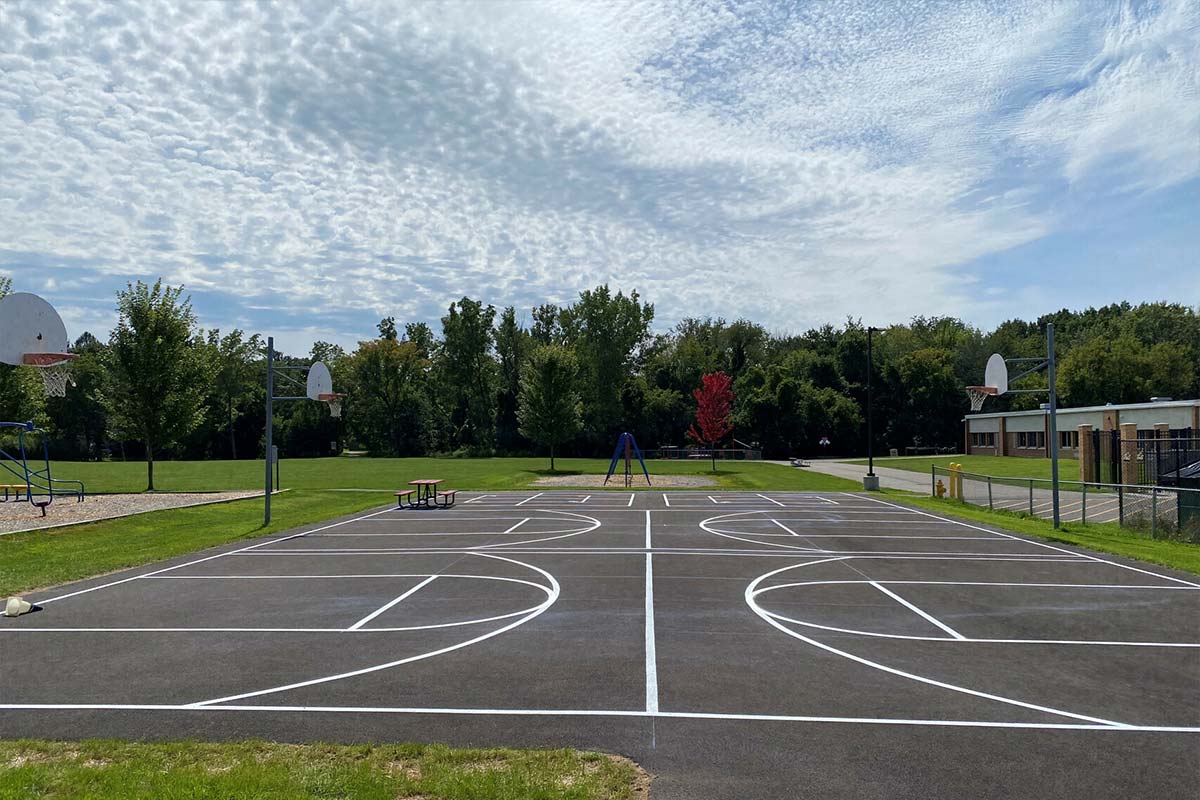
1-800-STRIPER of SW Chicago marks the lines on sports courts across the southwest suburbs — we stripe courts, we don’t build or resurface them. That covers pickleball, basketball, tennis, and playground game markings on existing asphalt or concrete at schools, park districts, HOAs, apartment communities, and commercial properties from Oak Park and La Grange out through Downers Grove and Bolingbrook.
Most jobs fall into one of two types: a new court that needs its first layout, or an existing court that needs a repaint or a sport conversion. Pickleball conversions are now the most common request we get. Either way the work is the same at its core — we measure to the governing spec, chalk the layout, mask the lines, and apply durable acrylic paint in the colors and widths the sport requires. Sports court striping is exacting work: a line an inch off spec can put a serve in or out, so the measurement step matters as much as the paint. We handle single courts and full multi-court complexes, and we can lay out one sport cleanly or stack several sports on a shared surface for a park district or HOA trying to get the most out of one slab.
Court Types — Pickleball, Basketball & Tennis
Each sport has a governing dimension we stripe to. Pickleball courts follow the USA Pickleball Official Rulebook: a 20-foot by 44-foot court with a 7-foot non-volley zone (the “kitchen”) on each side of the net, 2-inch lines, and a net set 36 inches high at the sidelines and 34 inches at center. Because a pickleball court is smaller than a tennis court, a single tennis court can typically hold two to four pickleball courts, or carry a second color of pickleball lines overlaid on the existing tennis markings so both sports share one surface.
Tennis courts get striped to USTA regulation dimensions — a 78-foot by 27-foot singles court, or 78 by 36 feet for doubles play. Basketball layouts vary by level of play: simplified rec-league and school markings, or full FIBA and NBA key and three-point geometry for competition facilities. Tell us the level of play and we’ll match it. When a court hosts more than one sport, contrasting acrylic colors keep each sport’s lines readable even where they overlap on the same surface.
Playground game markings. Beyond regulation sports, we stripe playground game markings for schools and park districts — hopscotch grids, four-square courts, number lines, activity maps, and other blacktop games. These go down in bright, durable colors that stand up to daily foot traffic, and they’re a common add-on when we’re already on-site striping a basketball court or a school blacktop. It’s the same acrylic paint and the same crew, so bundling the games with a court job keeps it to a single visit.
How Sports Court Striping Works
- Confirm the sport(s) and surface. We check which sport or sports the court needs to serve and confirm the existing asphalt or concrete is sound enough to hold new lines.
- Measure and chalk. We measure to the governing spec — USA Pickleball, USTA, or the applicable basketball standard — and chalk the full layout before any paint goes down.
- Mask the lines. Each line is taped to the required width for crisp, clean edges.
- Apply acrylic paint. We apply durable acrylic traffic paint in the colors the sport or sports call for.
- Cure and inspect. The paint cures, then we walk the court to confirm every line matches spec.
Paint Systems & Resurfacing
Court lines go down in 100% acrylic paint built for outdoor asphalt and concrete — the surface most SW Chicago school, park, and HOA courts have. Acrylic handles sun, temperature swings, and the freeze-thaw winters the southwest suburbs get, where road salt and repeated freezing work on any coating over time and pull the contrast out of court lines season after season. For a full color coat, an acrylic color-surfacing system can be applied over sound pavement to give the court a uniform, cushioned-looking playing surface before the lines go on top.
We stripe over existing pavement; we don’t resurface or repave courts. If your asphalt is cracked, heaving, or too far gone to hold paint, that’s a resurfacing job that has to come first — and we’ll tell you straight if the surface needs work before striping makes sense. On a sound court, fresh acrylic lines restore contrast and playability without the cost of a rebuild, and a re-stripe on a regular cadence keeps a well-used court reading clearly year after year.
For a full list of our pavement marking services, visit our parking lot striping in SW Chicago page.
Businesses We Serve




How it Works

GET A FREE ESTIMATE
Contact us today and we’ll have a quote to you in 24 hours

SCHEDULE AN INSTALLATION
We’ll have your play space restriped in less than 7 days, without affecting your playtime

GET A PARKING LOT THAT POPS
For a budget-friendly price, you’ll get a parking lot that looks like new
We proudly work with:


We proudly work with:

Frequently Asked Questions About Sports Court Striping in SW Chicago, IL
What are the official pickleball court dimensions?
USA Pickleball’s Official Rulebook sets the court at 20 feet by 44 feet for the lines, with a 7-foot non-volley zone — the “kitchen” — extending from the net on each side. Lines are 2 inches wide, and the net stands 36 inches high at the sidelines and 34 inches at center. We stripe to these exact measurements on every pickleball job, whether it’s a dedicated court or an overlay added to an existing tennis court.
Can you convert a tennis court to pickleball?
Yes. Because a pickleball court is smaller than a tennis court, we can overlay pickleball lines onto an existing tennis court in a contrasting color, letting the same surface serve both sports. Depending on the court’s size, two to four pickleball layouts often fit within one tennis court. We measure your court first to confirm how many will fit cleanly and lay the pickleball lines in a color that stays readable against the existing tennis markings.
Do you stripe playground games too, or only sports courts?
Both. Alongside pickleball, basketball, and tennis, we stripe playground game markings for schools and park districts — hopscotch, four-square, number grids, and activity maps — in bright, durable acrylic colors that hold up to daily foot traffic. Playground games are a common add-on when we’re already on-site striping a court or a blacktop, since it’s the same paint and the same crew in a single visit.
Can you stripe a court for more than one sport?
Yes. Multi-sport shared courts are common at parks, schools, and HOAs, and we handle them by color-coding each sport’s lines — basketball boundaries in one color, pickleball in a second, tennis in a third if the court needs it. Contrasting acrylic colors keep the layout readable even when several sets of lines overlap on one surface, so players can pick out their sport’s markings at a glance.
How long do court lines last in the Chicago-area climate?
Durability depends on paint quality, court traffic, and weather exposure. The southwest suburbs’ freeze-thaw winters, road salt, and summer sun all wear on outdoor acrylic over time, so a high-traffic court generally needs a re-stripe sooner than a lightly used one. There’s no fixed lifespan that fits every court — we can walk yours, look at how the lines are holding up, and tell you what to expect before any work starts.
Do you offer free estimates for court striping?
Yes. Call 1-800-STRIPER of SW Chicago and we’ll walk through your court, the sport or sports it needs to serve, and its current surface condition together. From there we provide a free, no-obligation estimate — typically back to you within 24 hours — before any work is scheduled. There’s no cost to find out what a court striping project involves for your school, park, or property.