Thermoplastic Striping
In Central Dallas, TX
Long-Lasting Pavement Markings
1-800-STRIPER provides professional thermoplastic striping in Central Dallas, TX — long-service-life pavement markings for stop bars, crosswalks, directional arrows, and fire lanes applied at roughly 400°F per AASHTO M249 specifications for high-traffic commercial lots across the DFW metroplex.
1-800-STRIPER® of Central Dallas PROVIDes Thermoplastics Services NEAR YOU
Want to reduce the maintenance requirements for your parking lot?
Thermoplastic pavement markings are a durable, weather and vehicle-resistant striping option for your parking lot or facility.
You can utilize them for stop bars, ADA stalls, no-parking zones, directional arrows, crosswalks, or your entire parking lot.
Benefits:
What Thermoplastic Striping Is
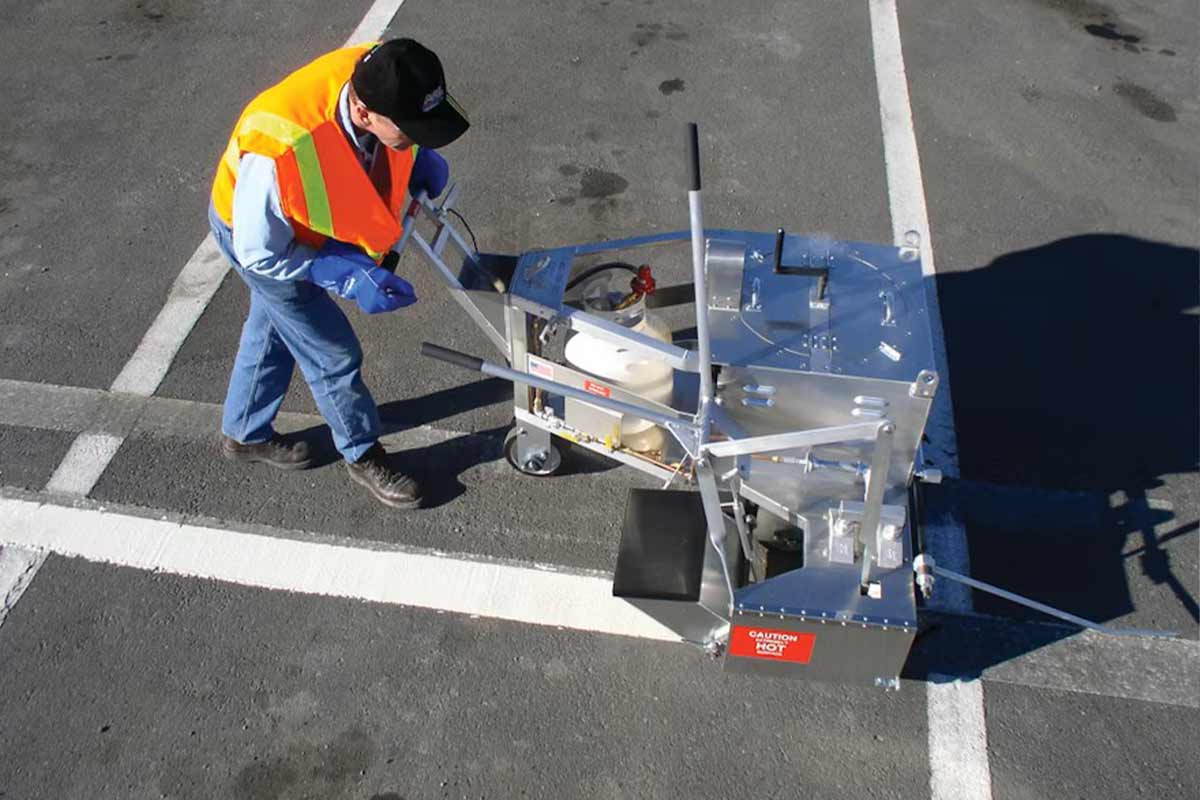
Thermoplastic is a solid, polymer-based pavement marking material that requires heating before application — it is not paint. The compound arrives on-site as a preformed shape or as granules loaded into a melting kettle, where it reaches approximately 400°F until liquid enough to apply.
Two delivery formats exist. Preformed thermoplastic is pre-cut into arrows, symbols, or stencil shapes and melted directly onto the pavement with a torch, making it efficient for standardized markings like handicap symbols or turn arrows. Sprayable thermoplastic is pumped through a screed box or spray wand for long continuous lines — stop bars, edge lines, fire-lane striping.
In both cases, the material bonds to the pavement as it cools, integrating into the surface rather than sitting as a film on top. Glass beads are pre-blended into the compound or dropped on immediately after application to produce retroreflectivity.
The result is a marking with a typical service life of eight to ten years in high-traffic commercial environments — substantially longer than traffic paint, which needs reapplication every 18 to 24 months under the same conditions.
AASHTO M249 Pavement Marking Specifications
The governing standard for thermoplastic pavement markings in the United States is AASHTO M249, published by the American Association of State Highway and Transportation Officials. The specification defines material composition, performance thresholds, and application requirements for thermoplastic markings on roadways and high-use commercial surfaces.
Under AASHTO M249, thermoplastic compound must meet minimum retroreflectivity values after glass-bead embedment. The spec distinguishes Type I beads blended into the compound and Type II drop-on beads applied immediately after placement. Most applications use both: pre-blended beads sustain long-term retroreflectivity as wear exposes fresh bead faces; drop-on beads deliver the high-visibility response required from the first night of service.
The standard also sets requirements for daylight luminance factor (whiteness and yellowness), skid resistance of the cured surface, and temperature ranges for application. 1-800-STRIPER uses AASHTO M249-compliant materials on all thermoplastic projects in Central Dallas, ensuring markings meet or exceed the reflectivity and durability thresholds the specification requires.
Thermoplastic vs Traffic Paint
The right marking material depends on traffic volume, pavement lifespan, and maintenance tolerance. The comparison below uses relative cost tiers because pricing varies by job size, surface condition, and regional supply.
| Attribute | Thermoplastic | Traffic Paint | Epoxy |
|---|---|---|---|
| Typical lifespan | 8–10 years | 1–3 years | 3–7 years |
| Upfront material cost | High | Low | Mid |
| Application method | Hot-applied, requires melting kettle | Spray or roll, ambient temperature | Two-part spray or roll, ambient temperature |
| Best use | High-traffic lots, stop bars, crosswalks, fire lanes, long-term installs | Low-to-medium traffic, interim markings, budget-constrained projects | Medium-traffic lots, indoor parking structures, areas requiring chemical resistance |
Over a full maintenance cycle, thermoplastic frequently costs less per linear foot than repeated paint applications. A property repainting traffic paint every two years will apply it four or five times across a nine-year window — each mobilization carrying labor, traffic control, and material costs — while thermoplastic goes down once. The aggregate paint spend typically matches or exceeds a single thermoplastic installation, without delivering the same reflectivity consistency or resistance to snowplow damage.
Epoxy occupies the middle ground: better adhesion and chemical resistance, suitable for enclosed parking structures where torch application creates ventilation challenges. For open-air, high-traffic surfaces in DFW — where summer heat and heavy trucks accelerate wear — thermoplastic is the higher-durability choice.
Best Applications for Thermoplastic
Thermoplastic delivers the strongest return where pavement markings face the most punishment. Property managers and facility operators in Central Dallas see the clearest durability advantage in these applications.
Stop bars at lot entrances, internal drive-aisle intersections, and pedestrian crossings are among the highest-wear markings on any commercial property. Vehicles decelerate and stop directly on top of them thousands of times per year. Traffic paint stop bars in active lots frequently wear to near-invisibility within 12 months. Thermoplastic stop bars hold their legibility for years under the same conditions.
Crosswalks at building entrances and pedestrian routes across drive aisles take concentrated foot and tire traffic. Thermoplastic crosswalk lines hold their edge definition and retroreflectivity far longer than painted equivalents, cutting restripe frequency and pedestrian-safety liability.
Directional arrows in large lots, garages, and logistics yards suffer wear from turning and braking forces. Faded arrows create ambiguous lane direction and liability exposure. Thermoplastic arrows stay legible under the same conditions that reduce traffic paint to a ghost within a year.
Fire-lane warning markings — including “FIRE LANE — NO PARKING” stencils and associated curb markings — must stay legible to satisfy local fire-marshal inspection requirements across DFW municipalities. The cost of a violation notice or emergency-access failure makes thermoplastic’s durability especially valuable here, where fading is not just an aesthetic problem.
Our Thermoplastic Application Process
1-800-STRIPER follows a consistent five-step process on every thermoplastic striping project in Central Dallas.
- Surface preparation — The application zone is cleaned of loose debris, oil contamination, and existing marking residue that could interfere with bond strength. Compromised pavement is flagged for the property manager before work begins.
- Surface pre-heat — The pavement is pre-heated with a torch to drive out surface moisture and open the pore structure of the asphalt or concrete, improving thermoplastic adhesion and reducing the risk of edge delamination.
- Material melt — Thermoplastic compound is loaded into the application kettle and brought to approximately 400°F, reaching the working viscosity specified by the material manufacturer and AASHTO M249.
- Application — Melted compound is applied to the layout lines using a screed box for solid lines or preformed shapes torched directly onto the surface for symbols and arrows.
- Glass-bead drop and cure — Type II drop-on glass beads are distributed across the hot surface immediately after application, embedding as the thermoplastic cools. Full cure takes minutes, after which the marking is traffic-ready and delivering its designed retroreflectivity from the first night of service.
For a full list of our pavement marking services, visit our parking lot striping in Central Dallas page.
Businesses We Serve




How it Works

GET A FREE ESTIMATE
Contact us today and we’ll have a quote to you in 24 hours

SCHEDULE AN INSTALLATION
We’ll have your installation scheduled restriped in less than 7 days, without affecting your business hours

GET A PARKING LOT THAT POPS
For a budget-friendly price, you’ll get a parking lot that looks like new
We proudly work with:


We proudly work with:

Frequently Asked Questions About Thermoplastic Striping in Central Dallas, TX
What is thermoplastic pavement marking and how does it differ from standard paint?
Thermoplastic is a hot-applied pavement marking material composed of binder, pigment, glass beads, and mineral filler. Unlike water-based latex traffic paint, thermoplastic is heated to approximately 400°F, applied in a molten state, and bonds to the pavement surface as it cools — typically within minutes. The result is a marking that is significantly thicker, harder, and more resistant to traffic wear than conventional paint, with glass beads embedded throughout the material (not just on the surface) to maintain retroreflectivity throughout the product’s life.
What standard governs thermoplastic pavement marking materials?
Hot-applied thermoplastic pavement markings are specified under AASHTO M249, the American Association of State Highway and Transportation Officials standard for thermoplastic road marking paint. AASHTO M249 sets minimum requirements for binder content, pigmentation, glass bead distribution, and application characteristics. TxDOT’s pavement marking handbook references alkyd thermoplastics applied under state specification DMS-8220 for public roadway work. Commercial and private lot applications generally follow AASHTO M249 as the accepted quality benchmark.
How long does thermoplastic striping last compared to water-based paint?
Thermoplastic markings installed at a standard 90-mil thickness typically last seven to ten years on well-prepared, high-traffic asphalt surfaces. Water-based latex traffic paint, by contrast, generally requires reapplication every two to three years under similar conditions. The longer service life of thermoplastic offsets its higher upfront material and equipment cost over a multi-year planning horizon, making it the preferred choice for high-traffic stalls, crosswalks, stop bars, and bicycle lanes in the DFW metroplex where ongoing repainting would be logistically disruptive.
What is the significance of the 90-mil thickness specification?
“Mil” refers to thousandths of an inch — 90 mils equals approximately 2.3 millimeters of applied material. This thickness is the standard commercial specification for durability; thicker markings resist wear longer and maintain their edge definition under repeated tire contact. Traffic paint is typically applied at 15–20 mils. The additional thickness also means more glass beads are distributed through the full depth of the marking, so retroreflectivity persists even as the surface wears down rather than being lost when a thin surface coat scuffs away.
How does retroreflectivity work in thermoplastic markings?
Glass beads are mixed throughout the thermoplastic material before application and also top-dressed into the surface immediately after application. When vehicle headlights strike the surface at night or in rain, the beads act as micro-retroreflectors, returning light toward the driver’s eyes rather than scattering it. Because the beads are distributed through the full 90-mil thickness rather than applied only to the surface, the marking continues to reflect effectively as the surface wears down over years of traffic. This embedded-bead design is a key safety advantage over painted markings.
What applications are best suited to thermoplastic striping?
Thermoplastic is the preferred material for crosswalks, stop bars, school zone markings, bicycle lane delineators, high-traffic directional arrows, and handicap symbols in heavy-use parking areas. Any marking that sees frequent tire contact, requires maximum nighttime visibility, or must remain legible for multiple years without repainting is a strong candidate for thermoplastic. Commercial and institutional property managers in the Dallas, Tarrant, Denton, and Rockwall county area frequently specify thermoplastic for drive-through lanes, fire lane stencils in high-traffic retail environments, and accessible parking symbols.
Are there surfaces where thermoplastic should not be used?
Thermoplastic has adhesion limitations on certain surfaces. Freshly poured or cured concrete that has not been properly primed can resist bonding — a compatible primer is required before applying thermoplastic to concrete, and some concrete formulations still present adhesion challenges even with primer. Sealed or coated asphalt surfaces similarly require surface preparation or may not hold thermoplastic reliably. Thermoplastic also cannot be applied over existing markings without removal, and it requires a pavement temperature of at least 50°F and an air temperature of at least 55°F at the time of application.
What surface preparation is required before thermoplastic application?
The pavement surface must be clean, dry, and free of oil, grease, loose aggregate, and existing markings. Any pre-existing paint or thermoplastic in the layout area must be removed by grinding, sandblasting, or approved chemical stripping before the new application — thermoplastic applied over old markings will not bond correctly and will delaminate prematurely. On concrete or older asphalt, a primer coat promotes adhesion and is generally required by material manufacturers. 1-800-STRIPER assesses surface condition before scheduling any thermoplastic application.
How is thermoplastic applied and how quickly can the lot be reopened?
The thermoplastic compound is loaded into a specialized heated kettle and maintained at approximately 400°F during application. The material can be applied by extrusion (direct contact with the pavement), ribbon gun (raised slightly above the surface), or spray (atomized air delivery). Each method produces a different edge profile suited to different marking types. Because thermoplastic cools and solidifies within minutes rather than the hours required for paint to cure, traffic can typically return to the marked area much faster — a significant advantage in active parking facilities. Call 1-800-STRIPER of Central Dallas for a free estimate: (214) 884-3669.