Parking Lot Sign Installation
In Central Dallas, TX
ADA, Fire Lane, and Directional Signage
1-800-STRIPER provides professional parking lot sign installation in Central Dallas, TX — installing ADA R7-8 accessible-space signs, fire lane “No Parking” signs, directional signage, and tow-away warning signs per the 2010 ADA Standards for Accessible Design, Texas Fire Code, and the Dallas Development Code Chapter 51A Article VII for commercial properties throughout the DFW metroplex.
1-800-STRIPER® of Central Dallas PROVIDes Signage Installations Services NEAR YOU
Are you communicating clearly?
We install new signs in adherence with local regulatory standards and can repair or replace damaged signs so you can clearly communicate your parking requirements.
ADA R7-8 Accessible Parking Signage
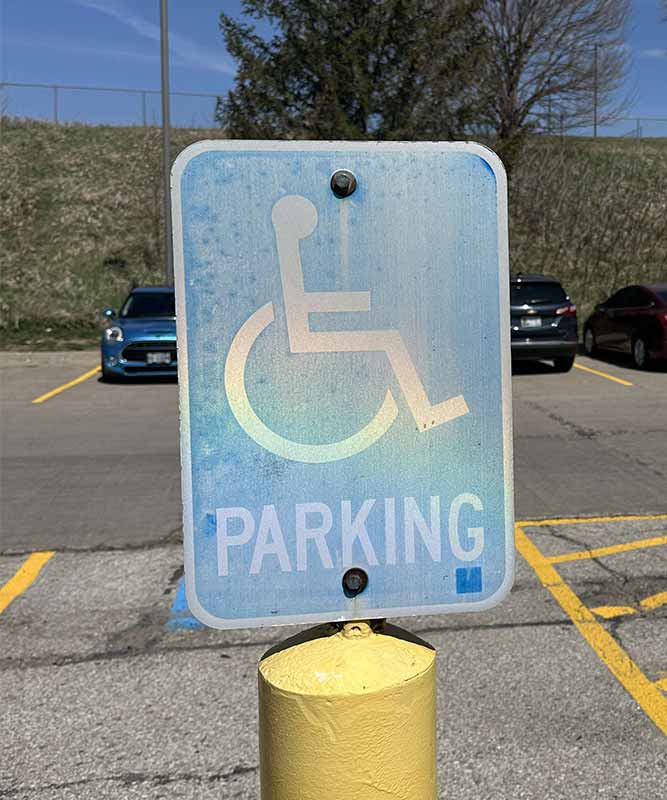
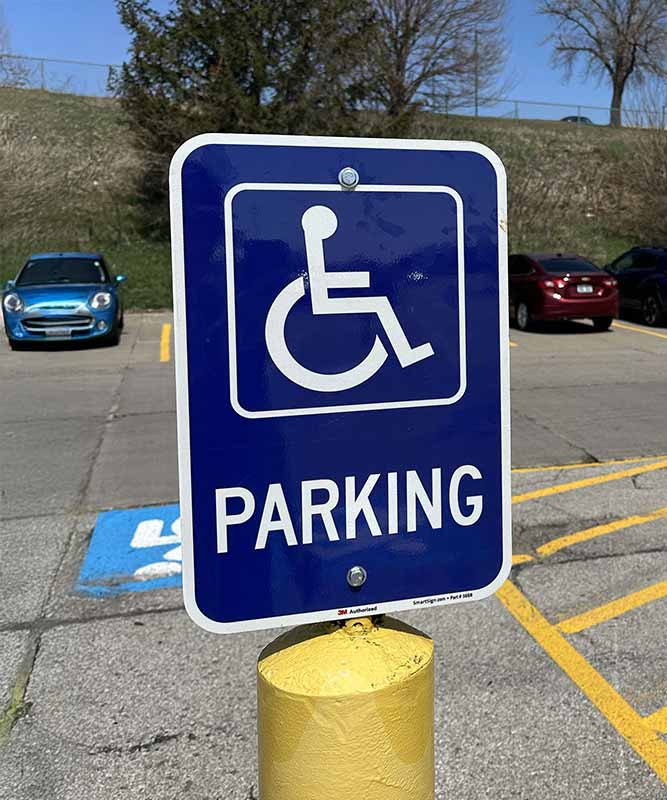
Every accessible parking space in Texas must display the R7-8 sign as specified by the MUTCD and the 2010 ADA Standards for Accessible Design — and Central Dallas properties that fall short risk federal civil-rights complaints, state enforcement actions, and private lawsuits. The R7-8 sign carries the International Symbol of Accessibility (ISA) along with the words “RESERVED PARKING” and, beneath that, either a fine-amount notice or a blank fine panel depending on local jurisdiction. The sign face is 12 inches wide by 18 inches tall per MUTCD specifications.
Mounting height is not optional. ADA.gov Section 216.5 and Section 502.6 of the 2010 ADA Standards for Accessible Design require the bottom of the sign to be mounted at least 60 inches above the finished parking stall surface. That elevation keeps the sign legible from inside the vehicle and prevents it from being obscured by the car hood. Our crews measure from the finished concrete or asphalt surface to the bottom edge of the sign face on every installation — not from grade, not from the base of the post.
Van-accessible spaces require an additional plaque: the R7-8a “Van Accessible” supplemental sign, mounted directly below the R7-8 face. The R7-8a panel is 12 inches wide by 6 inches tall and uses the same retroreflective sheeting as the primary sign. Properties with one accessible space must make that space van-accessible; properties with two or more accessible spaces must designate one van-accessible space per every six (or fraction thereof) accessible spaces. We verify the van-accessible count against your stall layout before ordering hardware, so no space is mislabeled.
Retroreflective sheeting is both a material specification and a visibility issue. Minimum compliance under MUTCD is ASTM D4956 Type I enclosed-lens sheeting; many municipalities and newer ADA guidance documents favor Type III or Type IV high-intensity prismatic sheeting for long-life performance in high-traffic settings. 1-800-STRIPER uses Type I as a minimum and upgrades to Type III sheeting on high-UV-exposure sites in the DFW metroplex, where summer temperatures and direct southern sun exposure accelerate retroreflective degradation. A sign that looks bright during the day but reads poorly at night is a compliance risk — MUTCD retroreflectivity requirements apply around the clock.
The ISA (blue square with white wheelchair figure) must also appear on the pavement of every accessible stall under Texas Accessibility Standards, but the pavement marking and the sign work together as a system. We coordinate the sign installation schedule with the striping crew to complete both elements in a single mobilization when possible, cutting closure time for your tenants or customers. Properties with compliant pavement markings but non-compliant signage — wrong height, missing R7-8a, faded sheeting — are still exposed under both ADA and Texas Accessibility Standards. The sign installation component cannot be treated as secondary.
The Manual on Uniform Traffic Control Devices (MUTCD) governs the design standards for all R7-series regulatory signs. 1-800-STRIPER installs to current MUTCD standards on every accessible-space project in Dallas County, Tarrant County, Denton County, and Rockwall County.
Fire Lane Signage
Fire lane signs on Texas commercial properties must comply with the Texas Fire Code, which adopts the International Fire Code (IFC) with local amendments, and must be installed so emergency vehicles can identify the lane boundary without ambiguity. Improperly marked or unmaintained fire lane signage is one of the most common code deficiencies cited by Dallas Fire-Rescue during commercial inspections — and one of the easiest to remediate with a proper installation.
The standard fire lane sign in Texas uses red lettering on a white retroreflective background with the text “NO PARKING — FIRE LANE — TOW AWAY ZONE.” The IFC and Texas adopting amendments require signs at the beginning and end of every fire lane and at intervals not exceeding 50 feet along the lane. Visibility is the governing requirement: the code mandates that signs be readable from the fire lane approach, which means mounting the sign face at a minimum of 8 feet above finished grade so it clears the roof line of a standard parked vehicle.
Post placement must avoid the clear-travel-width requirement. Texas Fire Code requires fire lanes to maintain a minimum unobstructed width of 20 feet, so sign posts must not encroach on that 20-foot clear path. On sites where the fire lane runs along a curb or island, posts are typically set in the curb face or island edge; on open-lot sites, the post is set back to the edge of the travel lane.
Color coding matters. Red-on-white is the recognized fire lane palette in Texas; properties that have installed generic black-on-white signs may still be cited because the color contrast is not code-compliant. During a site walkthrough, 1-800-STRIPER identifies non-compliant sign colors, faded faces, and posts that have shifted out of plumb, so every deficiency is corrected in one mobilization rather than through multiple re-inspections. Fire lane sign installations across Central Dallas, North Dallas, and the surrounding DFW metroplex follow this color and mounting protocol on every project.
Directional and Wayfinding Signage
Effective directional and wayfinding signage reduces conflict points by telling drivers where to go before they reach a decision point — cutting both accident exposure and pedestrian-vehicle conflict. The core directional sign types for commercial lots in Central Dallas are one-way arrow signs, entrance and exit signs, stop signs at lot exits, and speed limit signs where the lot layout warrants.
Stop signs at parking lot exits and internal intersection points follow MUTCD R1-1 specifications: an octagonal sign, 30 inches for roadway use, with commercial parking lot applications commonly using 24-inch or 30-inch faces depending on posted approach speed and lot width. The sign face is retroreflective red with white legend and border per MUTCD. Installing a substandard stop sign — wrong color, wrong reflectivity, wrong size — creates liability exposure if a vehicle fails to yield and an accident results, because non-conforming signage can be construed as inadequate traffic control.
One-way arrow signs (MUTCD R6-1 or R6-2) go at every single-direction drive aisle entry and at any point where a driver could misread the traffic direction. On sites with angled parking, one-way signs supplement pavement markings and are especially important on low-light or high-turnover lots. Entrance and exit signs (MUTCD R6-series, or custom lot-use signs) are installed at every curb cut to establish traffic flow before the driver enters the lot.
Speed limit signs in commercial parking lots are not MUTCD-required unless the lot connects to a public street and functions as a through-movement route, but Dallas property owners and risk managers frequently install 5 MPH or 10 MPH signs to build a reasonable-care record. 1-800-STRIPER advises on signage placement during the site walkthrough so that speed limit signs, if chosen, are positioned at entry points where the driver is making a speed-setting decision — not mid-aisle where they provide no behavioral cue.
All wayfinding sign hardware uses the same post and footing standards as regulatory signs, keeping a consistent appearance across the lot and eliminating the mismatched post-height and sheeting-grade inconsistencies common on lots where signage has been added piecemeal over time.
Tow-Away and Warning Signage
Tow-away authorization signs in Dallas must meet the requirements of the Dallas Development Code Chapter 51A Article VII and Texas Transportation Code Chapter 2308 (the “Vehicle Towing and Booting Act”) to be legally enforceable. A property owner who tows a vehicle from a space that is not properly signed — correct text, correct placement, correct visibility — may face civil liability to the vehicle owner. The sign must state that unauthorized vehicles will be towed at the vehicle owner’s expense, include the name and telephone number of the towing company, and be posted at each entrance to the parking facility and at conspicuous locations within the lot.
Texas law requires signs to be visible from each parking space in the area subject to towing. For large surface lots, that means signs at regular intervals — not just at the entrance — so no vehicle owner can credibly claim the sign was not visible from the space where the vehicle was parked. We map the required sign locations during the site walkthrough using a sightline analysis so that post placement satisfies the “visible from each space” requirement before installation begins.
Reserved-space tow-away signs (for designated tenant, customer-only, or handicapped-space enforcement) carry the same visibility and content requirements plus the accessible-space regulatory language where applicable. On properties with a mix of general tow-away zones and reserved-space tow-away zones, 1-800-STRIPER uses distinct sign panels for each category so the applicable rule is immediately clear to both the driver and, in an enforcement situation, a reviewing court.
Warning signs — “Watch for Pedestrians,” “Speed Bumps,” “Low Clearance” — are not regulatory signs under MUTCD but serve a risk-management function. Dallas commercial properties with covered parking structures, speed tables, or pedestrian-heavy retail frontages benefit from warning signs positioned at decision points. We fabricate warning signs to match the retroreflective sheeting grade and post hardware of the regulatory signage, producing a visually consistent result rather than a patchwork of store-bought and fabricated panels.
Sign Materials, Mounting, and Hardware
Parking lot signs installed by 1-800-STRIPER use .080-inch aluminum alloy sign blanks as standard — thick enough to resist wind-load flex in the open lots common across Dallas and Tarrant counties, and the gauge specified in most municipal sign standards for permanent installations. The sign face is finished with ASTM D4956 retroreflective sheeting applied by a certified sign fabricator; sheeting is pre-applied to the aluminum blank under controlled conditions before it reaches the job site, preventing the bubbling and delamination common with field-applied films.
Post hardware is selected based on the installation environment. Galvanized U-channel posts (12-gauge, 2-pound-per-foot) are standard for most surface-lot installations: break-away compliant for vehicular impact zones, corrosion-resistant in the moisture-variable DFW climate, and compatible with standard sign mounting hardware. Square steel tubing posts (2-inch × 2-inch, 14-gauge) are used where a heavier visual appearance is appropriate — retail centers, structured parking entries — or where the post must carry multiple sign panels stacked vertically.
Concrete footings are required for all permanent post installations. Standard footing diameter is 10 inches with a depth of 24 to 36 inches depending on post height and sign area (wind-load calculation). Concrete is placed and allowed to cure before the post is plumbed and the sign face is mounted — rushing the cure schedule is the primary cause of post lean on commercial sign installations.
Anti-rotation hardware (square-drive carriage bolts or post clips) is installed on every sign to prevent the panel from spinning on the post over time. A spinning sign face becomes non-compliant when the legend rotates out of the readable position for approaching traffic — a common defect on lots where hardware was omitted.
| Sign Type | MUTCD Code | Typical Dimensions | Mounting Height (bottom of sign) |
|---|---|---|---|
| Accessible Parking | R7-8 | 12 in × 18 in | 60 in minimum |
| Van Accessible Plaque | R7-8a | 12 in × 6 in | Below R7-8 (60 in min combined) |
| Stop Sign | R1-1 | 24–30 in octagon | 7 ft minimum (lot applications) |
| Fire Lane | Custom / IFC | 12 in × 18 in typical | 8 ft minimum |
| Directional Arrow | R6-series | 12 in × 18 in typical | 7 ft minimum |
Our Sign Installation Process in Central Dallas
- Site Walkthrough and Sign Audit — A 1-800-STRIPER field estimator walks the property and counts every sign location required by ADA, Texas Fire Code, Dallas Development Code, and MUTCD. Existing signs are evaluated for compliance, condition, and mounting height. Deficiencies and missing sign positions are documented in a written sign plan before any work begins.
- Permit Determination — Dallas requires a sign permit for permanent signage installations on commercial properties. We identify whether the project scope triggers a permit requirement during the walkthrough phase and advise the property owner on the application process. Permit lead time is factored into the installation schedule so that no post is set before the authorization is in hand.
- Sign Procurement — Sign panels are ordered from a certified fabricator using the sign plan dimensions and retroreflective sheeting specification. Each panel is inspected on receipt for sheeting uniformity, legend accuracy, and correct dimensions before it is staged for installation.
- Post Installation — Auger and Concrete — Post locations are marked using the sign plan layout. A truck-mounted or walk-behind auger bores the footing hole to the specified diameter and depth. The post is set in the hole, checked for plumb on two axes, and braced while the concrete is poured and struck off. Footings cure before sign mounting proceeds.
- Sign Mounting and Final Hardware — Sign faces are mounted to the posts using stainless-steel bolts and anti-rotation hardware. Each sign face is positioned for the correct height (measured to the bottom of the sign face from finished grade), the correct horizontal orientation toward the approach direction, and the correct angle to maximize retroreflective return for night visibility.
- Final QA Walkthrough — After all signs are mounted, the crew supervisor walks the site against the sign plan, verifying height, orientation, panel condition, and post plumb on every installation. Any finding is corrected before the crew demobilizes. The property owner or manager receives a completion summary noting the signs installed, the code basis for each sign type, and any pre-existing conditions noted during the initial walkthrough that were outside the project scope.
1-800-STRIPER serves commercial properties across Dallas County, Tarrant County, Denton County, and Rockwall County. Call for a free estimate on parking lot sign installation for your Central Dallas property.
For a full list of our pavement marking services, visit our parking lot striping in Central Dallas page.
Businesses We Serve




How it Works

GET A FREE ESTIMATE
Contact us today and we’ll have a quote to you in 24 hours

SCHEDULE AN INSTALLATION
We’ll have your installation scheduled in less than 7 days, without affecting your business hours

GET A PARKING LOT THAT POPS
For a budget-friendly price, you’ll get a parking lot that looks like new
We proudly work with:


We proudly work with:


Frequently Asked Questions About Parking Lot Sign Installation in Central Dallas, TX
What is the MUTCD, and why does it govern parking lot signs?
The Manual on Uniform Traffic Control Devices (MUTCD), published by the Federal Highway Administration (FHWA), is the federal standard for all traffic-control and parking-related signage in the United States. Texas follows the MUTCD through the Texas MUTCD (TMUTCD), which substantially mirrors the federal edition. Any parking lot sign installed on a property open to public traffic — including commercial lots, healthcare facilities, retail centers, and multi-family communities — must conform to MUTCD specifications for color, size, retroreflectivity, and designation codes.
What is an R7-8 sign, and when is the R7-8a “Van-Accessible” sign required?
R7-8 is the MUTCD designation for the standard International Symbol of Access (ISA) accessible parking sign. The R7-8a sign, reading “Van-Accessible,” is required below the R7-8 at any van-accessible stall — a space with a minimum 8-foot-wide access aisle rather than the standard 5-foot aisle. Under ADA and Texas Accessibility Standards (TAS), at least one in every six accessible spaces must be van-accessible. 1-800-STRIPER installs the correct sign combination for each stall type across Dallas, Tarrant, Denton, and Rockwall counties.
What is the required mounting height for ADA-accessible parking signs?
The ADA and TAS require the bottom edge of an accessible parking sign (R7-8) to be mounted at a minimum of 60 inches (5 feet) above the ground surface. The 60-inch minimum ensures the sign remains visible when a vehicle is parked in the space, preventing it from being obscured by the vehicle’s hood or roof. Signs mounted below this height fail ADA compliance, even if the sign itself is the correct designation and color.
What type of reflective sheeting do parking lot signs require?
MUTCD-compliant parking lot signs must use retroreflective sheeting that meets minimum nighttime visibility standards. Type IV prismatic sheeting (high-intensity prismatic) is the recommended minimum for enforcement-critical signs such as accessible parking, fire lane, and stop signs — providing reflectance of at least 50 cd/lx/m2. Type VIII (super high intensity prismatic) exceeds this standard and is used where higher-speed approaches or critical nighttime visibility are required. Retroreflectivity degrades over time with UV exposure; 1-800-STRIPER sources 3M-grade sheeting for long service life in the Texas climate.
What are the requirements for fire-lane signs in Central Dallas?
Fire-lane signs must comply with the Dallas Fire Code (IFC) and the local Authority Having Jurisdiction (AHJ) — in Central Dallas, the Dallas Fire-Rescue Department and applicable municipal code. Standard fire-lane signs read “NO PARKING — FIRE LANE” with white lettering on a red background (or reversed per local directive). Signs must be posted at intervals specified by the AHJ, typically at both ends of the fire lane and every 50 feet along extended lanes. 1-800-STRIPER coordinates signage with pavement fire-lane markings to ensure the full installation meets AHJ requirements.
What pole and foundation specs does 1-800-STRIPER use for sign installation?
Sign poles are installed using galvanized 2.5-inch square steel tube set in a concrete-anchor footing. Foundation depth is determined by sign height, wind-load calculations (Texas is a high-wind-zone state), and pavement type. For in-ground installations, the footing is augered and poured with ready-mix concrete; for existing concrete slabs, surface-mount base plates with anchor bolts are used when excavation is not practical. All poles and hardware are galvanized or powder-coated for corrosion resistance.
What types of parking signs does 1-800-STRIPER install beyond ADA signs?
1-800-STRIPER installs the full range of parking-lot signage: ADA accessible parking (R7-8 + R7-8a), fire-lane (IFC-compliant), stop (R1-1 MUTCD), one-way and directional, no-parking and reserved-parking, height-limit, electric-vehicle charging station, and custom property-identification signs. Installation includes new pole-and-footing sets, wall-mount brackets, or additions to existing posts — depending on site conditions across the DFW metroplex.
What sign materials are used, and how do they hold up in the Texas heat?
Parking lot signs are fabricated from .080-gauge aluminum blanks, which resist rust, corrosion, and warping under the sustained high temperatures and UV exposure typical in Central Texas. The face is printed or screened with inks and overlaid with MUTCD-grade retroreflective sheeting that is designed to maintain reflectance for 10 or more years under normal outdoor exposure. Aluminum-and-sheeting signs significantly outlast painted wood or plastic alternatives common in older commercial lots.
Can 1-800-STRIPER replace signs that have faded or been damaged without replacing the pole?
Yes. In most cases, a faded, vandalized, or storm-damaged sign panel can be replaced independently by removing the existing fasteners and mounting a new sign blank to the existing post — provided the post is structurally sound. 1-800-STRIPER inspects the pole and foundation at the time of sign replacement and advises if the support structure also needs attention. Call (214) 884-3669 for a free estimate across Dallas, Tarrant, Denton, and Rockwall counties.