Sports Court Striping
In Northwest Houston, TX
Multi-Sport Court Line Marking
1-800-STRIPER provides professional sports court striping in Northwest Houston, TX — marking pickleball courts to USA Pickleball specifications, basketball courts, tennis courts, and playground game markings with durable acrylic court paint for schools, HOAs, and recreation facilities.
1-800-STRIPER® of NW Houston PROVIDes Sports Court Striping Services NEAR YOU
Want to get people to come out to play?
Brighten up your faded sport courts or turn your playground into a safe, colorful, and engaging space that entices people to come out and play.
Sport Court Specialties:
Pickleball Court Striping
How big is a pickleball court, actually? It is one of the few court questions with a single published answer, and USA Pickleball gives it plainly.
| Element | USA Pickleball specification |
|---|---|
| Court size | 20 feet wide by 44 feet long — singles and doubles |
| Net height at sidelines | 36 inches |
| Net height at center | 34 inches |
| Non-volley zone (“the Kitchen”) | 7 feet on each side |
Those four numbers drive everything else about the job. The playing surface needs clearance beyond the lines for run-off, which is why a court that measures 20 by 44 on paper needs meaningfully more pavement than that in practice — and why we measure the available slab before promising you a court will fit.
Pickleball is the volume request in Northwest Houston right now, and most of it lands in three places: HOA amenity decks in Cypress and The Woodlands, school and church multi-use slabs, and tennis courts being converted or shared.
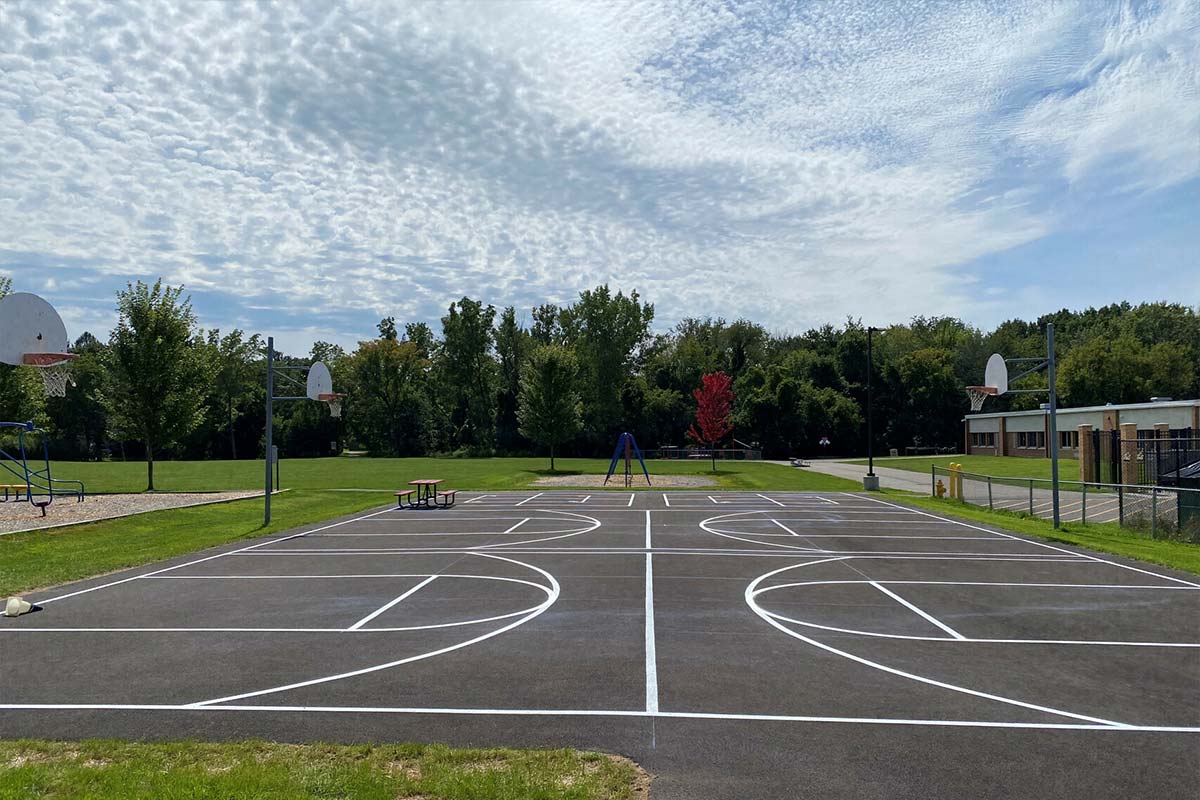
Basketball Court Striping
Basketball is the opposite of pickleball where dimensions are concerned — the court size depends entirely on the level of play. A high school court, a collegiate court and a recreational half-court are different sizes, and the governing body for your league publishes the dimensions that apply.
We mark to the specification you or your association gives us, or to the published dimensions of the governing body for your level of play. What we will not do is stripe a court to a number we picked off the internet and hand you a slab that fails a league inspection. Bring us the spec, or tell us the level and we will confirm it against the governing body before we lay out.
The work itself is layout, key and lane markings, three-point arc, free-throw line, center circle and sidelines, in acrylic court paint that holds an edge.
Tennis Court Striping
Same principle. Tennis court dimensions are published by the sport’s governing bodies, and the right layout for your court depends on whether it is a club court, a school court or a residential court, and whether it will be shared with other sports.
Where tennis gets interesting in this market is conversion and overlay. A tired tennis court is frequently more valuable to an HOA as two or four pickleball courts, and a shared tennis-and-pickleball surface is a common compromise when the association cannot agree. Both are layout problems before they are paint problems, and both need the line hierarchy worked out in advance so players can tell which lines are theirs.
Multi-Sport Court Layouts
Here is where courts go wrong. Put four sports on one slab without a plan and you get a surface nobody can read — competing lines in similar colors, intersections that hide a baseline, and players arguing about whether a ball was in.
Readable multi-sport layouts come from a color and weight hierarchy, decided before the first line goes down. The primary sport gets the dominant color and the heaviest line. Secondary sports get distinct, clearly separated colors. Where lines cross, the primary line runs continuous and the secondary breaks. Line widths stay consistent within each sport so the eye can group them.
We work the hierarchy out with you on paper, then chalk it on the slab so you can walk it before anything is permanent. On a shared tennis-and-pickleball court that walk-through is worth more than any amount of discussion beforehand.
Playground Game Markings
Playground markings are the cheerful end of this work and they wear the hardest, because they take foot traffic, sun and hose water without the maintenance a sports court gets.
The usual catalog: hopscotch, four square, foursquare variants, tetherball circles, kickball diamonds, number grids and alphabet grids, running tracks around a play area, compass roses, and map or maze layouts for schools that want the surface to teach something. Schools in Tomball, Magnolia and Cypress order these in batches, usually over a summer break when the slab is free for a few days.
We use the same acrylic court coatings we use on sports courts rather than traffic paint, because the wear pattern is closer to a court than to a parking lot.
Court Paint and Surface Preparation
Why not traffic paint? Because a sports court is a different job for the coating. Traffic paint is built for vehicle tires on asphalt at driving speed. Court coatings are acrylic systems built for foot traffic, ball impact, sliding shoes and constant ultraviolet exposure, and they hold a crisper line edge over a longer service life on a court surface.
Preparation decides the result more than the product does. The slab has to be clean, sound and dry. Organic growth, chalking, oil and old flaking coating come off first. Cracks and low spots get addressed before layout, because a line that crosses a depression will hold water and fail early. New asphalt or concrete needs its full cure before it takes a court coating, and a Gulf Coast summer helps with cure but works against application windows — we schedule around humidity and afternoon storms rather than fighting them.
Our Court Striping Process
- Measure the slab. Usable area, run-off clearance, slope and drainage, existing lines and their condition.
- Confirm the specification. USA Pickleball dimensions for pickleball; your league or governing body’s published dimensions for basketball and tennis.
- Agree the hierarchy. On multi-sport surfaces, colors and line weights get settled before layout.
- Prepare the surface. Clean, repair, and let it dry.
- Chalk and walk. We lay out the geometry and you see the actual court before it is painted.
- Paint and cure. Lines go down in acrylic court coating; the court stays closed until cured.
Areas We Serve
We stripe sports courts across Harris, Montgomery, Waller and Fort Bend counties — Cypress, Katy, Tomball, Spring, northwest Houston, The Woodlands, Conroe, Magnolia, Brookshire, Pattison and Fulshear. Most of the work comes from HOA amenity areas, schools, churches, apartment communities and municipal recreation facilities.
For a full list of our pavement marking services, visit our parking lot striping in Northwest Houston page.
Businesses We Serve




How it Works

GET A FREE ESTIMATE
Contact us today and we’ll have a quote to you in 24 hours

SCHEDULE AN INSTALLATION
We’ll have your play space restriped in less than 7 days, without affecting your playtime

GET A PARKING LOT THAT POPS
For a budget-friendly price, you’ll get a parking lot that looks like new
We proudly work with:


We proudly work with:


Frequently Asked Questions About Sports Court Striping in Northwest Houston, TX
What are the dimensions of a pickleball court?
20 feet wide by 44 feet long, for both singles and doubles. The net is 36 inches high at the sidelines and 34 inches at the center, and each side has a 7-foot non-volley zone — the Kitchen. Those are USA Pickleball’s published figures. Remember that the playing area needs run-off clearance beyond the lines, so the slab has to be larger than 20 by 44.
Can pickleball lines be added to an existing tennis court?
Yes, and it is one of the most common jobs we do for HOAs and schools around Cypress and The Woodlands. A tennis court can take one or several pickleball courts depending on its size and how you want to use it. The decision that matters is whether tennis stays primary — if it does, tennis keeps the dominant line color and weight and pickleball gets a clearly distinct secondary color, so players can read the surface at a glance.
What paint is used on a sports court, and why not traffic paint?
Acrylic court coatings. Traffic paint is engineered for vehicle tires on a road surface; a court takes foot traffic, sliding shoes, ball impact and constant sun. Court coatings hold a sharper line edge and a longer service life under that wear pattern. Using parking-lot paint on a court is a false economy — it dulls, picks up under shoes, and needs redoing far sooner.
Can you stripe a basketball court on an existing parking lot?
Often, yes, if the pavement is sound and the area can be taken out of parking use. The considerations are surface condition, slope and drainage, run-off clearance around the playing area, and how the court will be separated from live vehicle traffic. Asphalt in reasonable condition takes a court coating well. We will tell you if the slab needs repair first rather than painting a court onto failing pavement.
How soon can the court be played on?
Longer than a parking lot, and the difference matters. Acrylic court coatings need to cure properly before foot traffic, sliding and ball impact — releasing a court early is the most common cause of premature line wear we get called back to fix. Cure time depends on the coating, the number of coats, temperature and humidity, and a humid Gulf Coast day stretches it. We give you a firm reopen time for your specific job at the estimate rather than a generic figure.
What playground game markings can you install?
Hopscotch, four square, tetherball circles, kickball diamonds, number and alphabet grids, running tracks, compass roses and map or maze layouts. Schools usually batch these into a summer window when the slab is free. If you have a specific layout your teachers want, send it over — most playground markings are straightforward to reproduce once the geometry is agreed.
Do you resurface courts as well?
No. We stripe and mark courts; we do not resurface or build them. If your slab needs crack repair, a resurfacing system or new construction before it can hold lines, that is a different trade and we will say so at the estimate rather than painting over a surface problem. Once the court is resurfaced by someone who does that work, we are happy to come back and lay out the lines.
How are multi-sport courts laid out so the lines stay readable?
With a hierarchy agreed before anything is painted. The primary sport takes the dominant color and the heaviest line weight. Each secondary sport gets a distinct, well-separated color. Where lines intersect, the primary runs continuous and the secondary breaks so the eye follows the right one. We chalk the whole layout first and walk it with you, because a surface that reads well on paper can still be confusing underfoot.