Warehouse Line Painting
In East Kansas City, MO
OSHA-Compliant Safety Markings
1-800-STRIPER provides professional warehouse line painting in East Kansas City, MO — aisle lines, pedestrian walkways, and safety zone markings that satisfy the OSHA 29 CFR 1910.176(a) duty to keep permanent aisles and passageways appropriately marked in industrial facilities.
1-800-STRIPER® of East Kansas City PROVIDes Warehouse Floor Markings Services NEAR YOU
Want your indoor space to operate more efficiently?
Warehouse and interior markings ensure clear traffic lanes, organized storage zones, and designated spaces designed to help your business operate safely and efficiently.
Benefits:
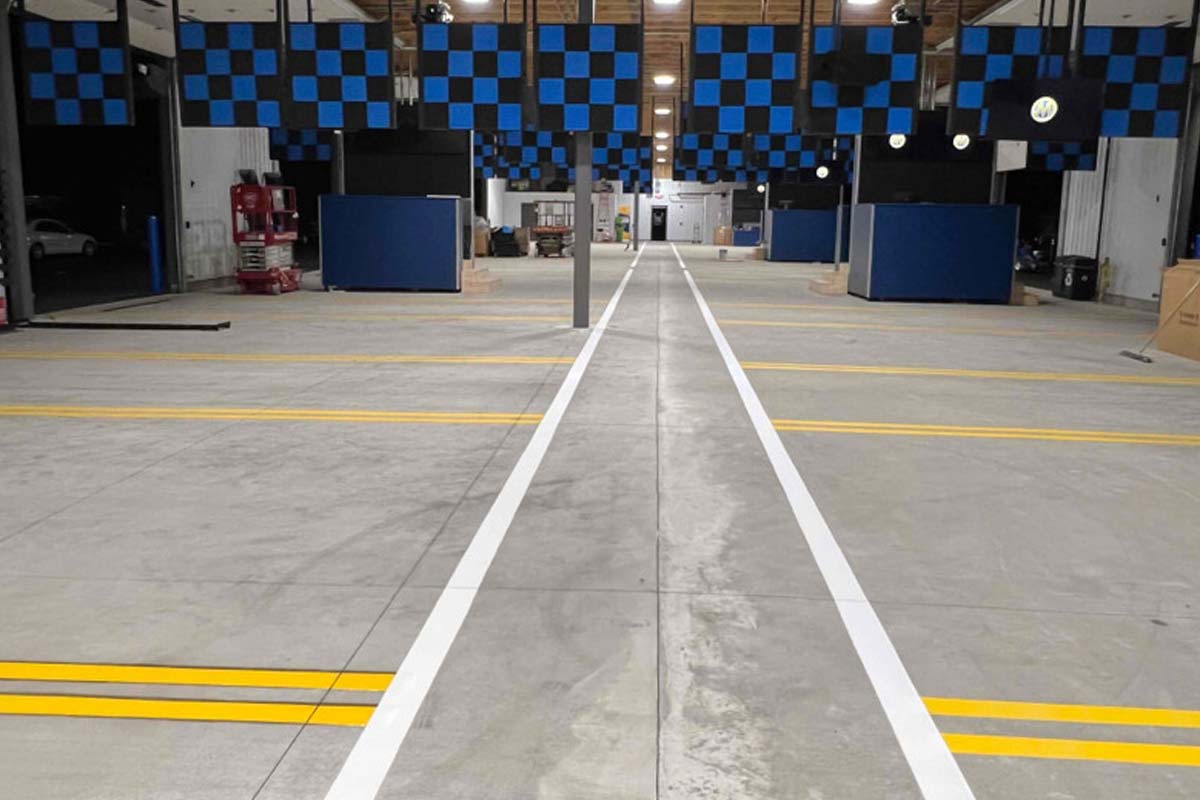
Warehouse Line Painting in East Kansas City, MO
Kansas City is a distribution town. The intersection of two interstates, a river, and more rail than almost anywhere else in the country means a lot of the metro’s floor space is warehouse floor space — and every one of those buildings has forklifts and people moving through the same aisles.
We paint aisle lines, pedestrian walkways, safety zones, dock markings and floor legends inside operating facilities on both sides of the state line.
What OSHA Actually Requires — and What It Doesn’t
This is worth getting right, because most of what you will read about it is wrong.
The federal duty lives in 29 CFR 1910.176(a) — a subsection headed Use of mechanical equipment — and this is the whole of it:
> “Where mechanical handling equipment is used, sufficient safe clearances shall be allowed for aisles, at loading docks, through doorways and wherever turns or passage must be made. Aisles and passageways shall be kept clear and in good repair, with no obstruction across or in aisles that could create a hazard. Permanent aisles and passageways shall be appropriately marked.”
Three sentences. Almost everyone quotes only the last one, and in doing so drops the two things that actually matter.
It opens on a condition. The duty is framed around buildings where mechanical handling equipment is used — forklifts, pallet jacks, order pickers, reach trucks. Nearly every distribution facility in Kansas City is squarely inside that. A quiet storage room with nothing powered moving through it is not, and a contractor who tells you otherwise is selling paint rather than reading the standard. We would rather tell you which one you are.
It specifies no color, no line width, and no line dimension. Not yellow. Not four inches. We went and checked: the words “yellow,” “color” and “width” do not appear anywhere in 1910.176. Nor do they reach it from OSHA’s safety-color code at 1910.144, which assigns red to fire equipment and yellow to physical hazards — and never mentions aisles at all. Those numbers are industry convention: widely used, sensible, and worth following. They are not what the law says. If a striping contractor tells you OSHA requires a 4-inch yellow line, they are repeating something they have read on another contractor’s website.
Two things follow from that, and they matter:
- “Appropriately” is judged against your facility, not against a number. An aisle that a forklift and a pedestrian share needs clearer, more visible marking than a low-traffic storage row. The standard puts the design burden on you, which is exactly why it is worth doing deliberately.
- Convention is still worth following. Yellow lines for aisles and walkways are what your people already recognize, and consistency across a facility is itself a safety feature. We use the convention. We just will not tell you a regulation compels it when it does not.
You can read 1910.176 yourself on the Occupational Safety and Health Administration‘s site. It takes a minute, and it is the shortest safety standard you will ever read.
Aisle, Walkway, and Safety-Zone Markings
What we typically lay out in a Kansas City distribution facility:
- Aisle lines defining forklift travel routes and keeping them clear of storage.
- Pedestrian walkways giving people a marked path through the same space, ideally against a wall and away from the forklift turn.
- Safety zones around electrical panels, eyewash stations, fire extinguishers and emergency exits, keeping them unobstructed.
- Staging and storage zones so product does not creep into an aisle that has to stay clear.
- Dock and loading areas. Kansas City’s zoning code (section 88-420-17-B) sizes off-street loading spaces at 10 feet by 25 feet, and 12 feet by 60 feet for semi-trailers, and requires No Idling signage at loading areas. Those dimensions are a useful sanity check on how a yard and dock apron get marked.
- Floor legends and stencils — directional arrows, “no pedestrians,” rack numbering, hazard hatching.
Coatings and Traffic Durability
A warehouse floor is a harder surface to hold paint than an asphalt lot, because a loaded forklift wheel does something to a line that a car tire never will.
Coating choice comes down to traffic, downtime and surface. Traffic paint goes down fast and re-coats easily, which suits facilities that can only give us a weekend. Epoxy coatings are tougher and last longer under heavy wheel loads, but they want more cure time, which means more of your floor out of service. Sealed and unsealed concrete behave differently again.
We will tell you which one your building actually needs rather than defaulting to the most expensive option.
Working Around an Operating Facility
Almost nobody can shut a distribution center down so we can paint the floor. So we do not ask.
We phase the work — one aisle, one zone, one shift at a time — so the building keeps running. We work around your operating hours, including nights and weekends. We agree cure times and re-opening windows with your operations lead before we start, because a line that gets driven on before it sets is a line we have to paint twice.
For a full list of our pavement marking services, visit our parking lot striping in East Kansas City page.
Businesses We Serve




How it Works

GET A FREE ESTIMATE
Contact us today and we’ll have a quote to you in 24 hours

SCHEDULE A STRIPING
We’ll have your space restriped in less than 7 days, without affecting your business hours

GET A PARKING LOT THAT POPS
For a budget-friendly price, you’ll get a parking lot that looks like new
We proudly work with:


We proudly work with:

Frequently Asked Questions About Warehouse Line Painting in East Kansas City, MO
Does OSHA require warehouse aisles to be marked?
In buildings where mechanical handling equipment is used, yes. That is how the standard is framed: 29 CFR 1910.176(a) opens with “Where mechanical handling equipment is used,” and closes by requiring that permanent aisles and passageways be appropriately marked. If forklifts, pallet jacks or order pickers move through your building, the duty reaches you. If nothing powered moves through it, this particular standard does not — and we would rather say so than sell you a line you do not owe.
What color does OSHA require for aisle lines?
It doesn’t. The words “yellow,” “color” and “width” appear nowhere in 1910.176, and OSHA’s safety-color code at 1910.144 never mentions aisles. Yellow is industry convention — near-universal, easily understood, and what we would recommend — but it is a convention, not a federal requirement. Anyone telling you OSHA mandates yellow is repeating a myth.
How wide does an OSHA aisle marking have to be?
There is no width in the standard. The “4-inch rule” you will see quoted across this industry is not in it. What the regulation asks is that marking be appropriate, which is a judgment about your facility — traffic type, forklift volume, sightlines, whether pedestrians share the aisle. We will help you make that judgment rather than invent a number to justify it.
Is yellow required, or just conventional?
Conventional. And still the right answer for most facilities, because your staff, your contractors and your visitors all already read yellow as “stay inside this line.” We use it. We just want you to know why.
Can you paint while the warehouse is operating?
Yes, and it is how most of this work gets done. We phase by aisle or zone and schedule around your shifts, including nights and weekends, so the building never fully stops.
What coating holds up to forklift traffic?
Under heavy, repeated wheel loads, an epoxy coating outlasts standard traffic paint — it is harder and bonds tightly to a prepared concrete floor. The trade-off is cure time, and therefore downtime. Traffic paint is faster to apply and re-coat, which is often the better answer for a facility that can only give us a narrow window. The right choice depends on your floor, your traffic and how long you can take the aisle out of service.