Parking Lot Restriping
In West Fort Worth, TX
Restripe Existing Lines and Markings
1-800-STRIPER provides professional parking lot restriping in West Fort Worth, TX — refreshing faded lines, ADA stalls, fire lanes, and directional arrows using Sherwin-Williams Fast-Dry Traffic Paint and Graco LineLazer equipment for commercial properties across western Tarrant and Parker counties.
1-800-STRIPER of West Fort Worth PROVIDes Restriping Services NEAR YOU
Need to brighten up your faded parking lot?
Keep your parking lot safe and attractive by restriping annually to freshen up lines and symbols that have faded from the sun, weather, and traffic. Nothing beats a fresh coat of paint!
Benefits:
Why Faded Parking Lines Cost You More Than You Think
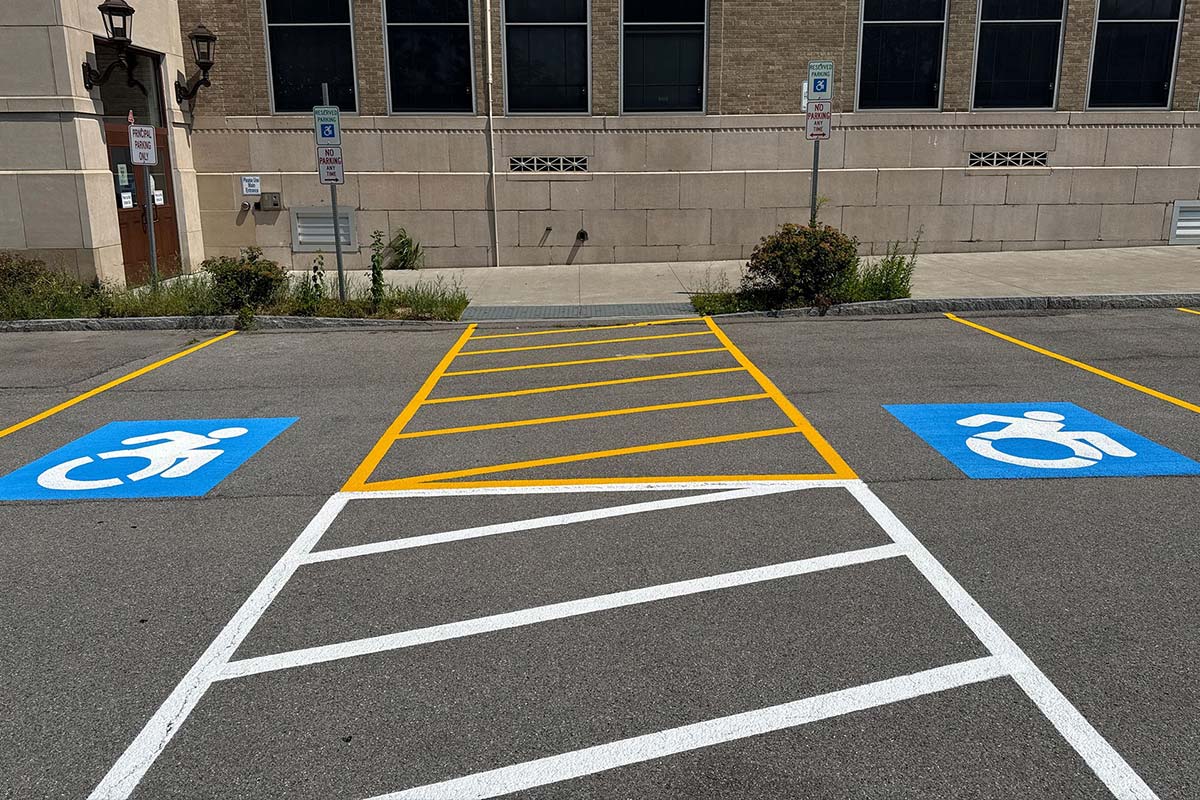
Faded parking lines hit your property three ways at once — they break ADA compliance, they slow traffic flow, and they make a managed lot read as neglected. Each one is a real liability, and each one is fixed in the same restripe job. The lines are the cheapest part of your asphalt to maintain and the first thing every customer judges.
Compliance is the piece that surprises most owners. Worn accessible-stall borders, missing van-accessible access aisles, faded International Symbol of Accessibility (ISA) markings, and washed-out fire-lane stencils all create exposure to ADA Title III complaints and local fire marshal citations. Crisp pavement markings also keep traffic moving the way the lot was designed to move, which matters most at retail centers and medical parks where stop bars, arrows, and crosswalks guide drivers and pedestrians safely.
The first-impression piece is the one tenants and shoppers actually notice. A property with sharp white stalls and clean yellow arrows reads as well-run; the same lot with ghost lines and washed-out arrows reads as deferred maintenance. For retail anchors, medical office parks, HOA-managed communities, and quick-service restaurants across western Tarrant and Parker counties, restriping is one of the highest-visibility, lowest-cost upgrades on the property calendar.
How Often North Texas Heat Forces You to Repaint
Plan on restriping every 18 to 24 months for high-traffic commercial lots — and the reason is the Texas sun, not normal wear. North Texas runs one of the harshest ultraviolet and pavement-heat loads in the country, and that load degrades latex traffic paint faster than the national average. The line you painted in spring is already fighting a summer where asphalt surface temperatures push well past the air temperature on a 100°F afternoon.
That 18-to-24-month window is the high-traffic commercial baseline for lots in West Fort Worth — retail centers, medical office parks, distribution-yard employee parking. UV breaks down the binder in latex paint, summer pavement heat softens the asphalt and bleeds oils up into the coating, and the constant tire scrub of a busy lot finishes the job. ADA-stall borders and fire-lane edges usually fade first because they take the most foot and tire traffic.
Lower-traffic lots stretch longer. HOA visitor parking, church lots, and owner-occupied office lots in Aledo, Willow Park, and Hudson Oaks can often run 30 to 36 months between restripes because the tire-scrub component is so much lighter. The UV load is the same, but with less traffic abrasion the paint holds its reflectivity longer. When we assess your lot we read the actual wear pattern rather than guess off a calendar.
Our Five-Step Restriping Process
Our restriping work follows a five-step process that takes a typical 100-stall lot from first sweep to dry in a single day. The sequence is built so nothing gets painted onto a dirty surface and nothing reopens before it has cured.
- Site assessment. We walk the lot, count existing stalls, and check ADA gaps against the 2010 ADA Standards for Accessible Design (§208 stall count, §502 van-accessible width, §216.5 ISA signage). We flag any layout issues worth correcting now rather than carrying forward.
- Surface prep and power-sweep. We power-sweep the full lot to clear dirt, dust, and gravel, then hot-water pressure wash heavily oil-stained areas. Paint bonds to clean asphalt and nothing else — this step is the difference between a two-year line and a six-month failure.
- Layout and chalk. We chalk-line the existing line locations off the ghost lines, plus any approved layout adjustments. ADA stalls get re-measured to confirm §502.2 width (11-foot stall plus 5-foot aisle, or 8-foot stall plus 8-foot aisle for van-accessible per §502.4).
- Paint application. Graco LineLazer ride-on or walk-behind stripers lay down Sherwin-Williams Fast-Dry. Standard stalls go 4-inch white, fire lanes 4-inch red, and arrows and curbs follow the pavement-marking conventions in the Texas Manual on Uniform Traffic Control Devices.
- Cure and reopen. Sherwin-Williams Fast-Dry releases to vehicle traffic in 60 to 90 minutes depending on pavement temperature, so most lots reopen the same evening.
For larger sites — big-box anchors, distribution-center employee lots, school and church campuses — we stage the work in sections so the property stays open while we restripe.
The Equipment and Paint Behind a Clean Restripe
The equipment-and-paint pairing matters more on restriping than on a fresh layout, because restripe lines have to register exactly on the existing locations without drift. Ghost lines are unforgiving — a sloppy second pass that misses the original by even an inch reads as a double line. We run gear and paint chosen to overwrite cleanly.
We use Graco LineLazer ride-on and walk-behind airless line stripers. The LineLazer system handles 4-inch standard lines and the wider curb and fire-lane edges in controlled passes, with laser guidance that holds a straight line across the patched and weathered asphalt common on older West Fort Worth commercial lots. Straight registration over irregular pavement is exactly where cheaper equipment loses the line.
Paint selection is Sherwin-Williams Fast-Dry Traffic Paint, a waterborne acrylic engineered for fast cure-to-traffic turnaround in warm climates. It sets to touch quickly and releases to vehicle traffic in 60 to 90 minutes, which is what makes single-day and after-hours restriping practical in a region where summer heat actually speeds the cure rather than fighting it. Sharp line edges at cure are the point — faded ghost-line edges are exactly what a crisp restripe has to cover.
How We Reset ADA Compliance During Every Restripe
A restripe is the standard moment to bring a lot back into ADA compliance, because the accessible markings are getting repainted anyway. We re-measure every accessible element against the 2010 ADA Standards for Accessible Design and the 2012 Texas Accessibility Standards (TAS), which adopt the federal requirements for Texas commercial properties. The paint cost is the same whether the layout is right or wrong — fixing it is the only delta.
We confirm stall counts against §208 Table 208.2 for the lot’s total spaces, re-measure stall and access-aisle widths to §502.2 and the §502.3.1 minimums, refresh ISA symbols per §502.7, and restripe access-aisle hash markings. If a lot is short on van-accessible stalls or has aisles below the width minimum, the restripe is the right time to correct it. We capture all of this during the assessment so you approve the layout before the first line goes down.
Restriping Without Shutting Down Your Lot
For most lots under 200 stalls, a single after-hours or weekend restripe with the lot fully closed is the cleanest answer — Sherwin-Williams Fast-Dry releases each section back to traffic in 60 to 90 minutes. For larger lots, or tenants who need the lot open during business hours, we stage the work in sections of 40 to 60 stalls, coning off the active zone while the rest of the lot keeps running.
After-hours scheduling is where the North Texas climate works in your favor. Early-morning starts, evening starts after store close, and full overnight projects are all on the table, and the warm pavement that degrades paint over two years also cures a fresh coat fast. We coordinate the staging plan around anchor-tenant access and your property manager’s schedule so the disruption stays minimal across Aledo, Weatherford, Benbrook, Saginaw, and the rest of the service area.
Why Surface Prep Decides How Long the Restripe Lasts
Surface prep is the single biggest factor in how long a restripe holds, and it is the step most often skipped to cut a corner. Power-sweeping the full lot to clear dirt, dust, and gravel is the baseline — paint laid over a dusty surface never bonds and starts shedding within months. We do not skip it, and we do not paint over a surface that is not ready.
For lots with heavy oil staining around drive-through lanes, fuel islands, or tenant drop-zones, we add hot-water pressure washing on the stained sections, because oil is the one contaminant traffic paint will not adhere through. Any failed existing paint that would block new-coat adhesion gets scraped clean first. The rule is simple — paint bonds to clean asphalt — and skipping prep on a dirty or oil-stained surface is the most common cause of premature paint failure within the first six months. To set up an assessment of your lot, call 1-800-STRIPER at (682) 262-7612.
For a full list of our pavement marking services, visit our parking lot striping in West Fort Worth page.
Businesses We Serve




How it Works

GET A FREE ESTIMATE
Contact us today and we’ll have a quote to you in 24 hours

SCHEDULE AN INSTALLATION
We’ll have your installation scheduled in less than 7 days, without affecting your business hours

GET A PARKING LOT THAT POPS
For a budget-friendly price, you’ll get a parking lot that looks like new
We proudly work with:


We proudly work with:

Frequently Asked Questions About Parking Lot Restriping in West Fort Worth, TX
How often should I restripe my parking lot in West Fort Worth?
Plan on every 18 to 24 months for high-traffic commercial lots — retail centers, medical office parks, distribution-yard employee parking. North Texas runs an intense ultraviolet and summer-heat load that breaks down latex traffic paint faster than the national average, so a busy lot fades inside two years. Lower-traffic lots — HOA visitor parking, church lots, owner-occupied office in Willow Park or Hudson Oaks — can often stretch to 30 to 36 months between restripes.
Will restriping fix my ADA compliance issues?
A restripe is the standard moment to bring a lot up to current ADA requirements. We re-measure stall and access-aisle widths against §502.2 and §502.4 of the 2010 ADA Standards for Accessible Design, confirm stall counts against §208 Table 208.2, refresh ISA symbols per §502.7, and apply the 2012 Texas Accessibility Standards that govern Texas commercial properties. If your lot is short on van-accessible stalls or has aisles below the minimum width, the restripe is the right time to correct it.
Can you restripe my lot without closing it?
Yes. For lots under 200 stalls, a single after-hours or weekend restripe with the lot fully closed is the standard answer, since Sherwin-Williams Fast-Dry releases each section to traffic in 60 to 90 minutes. For larger lots or tenants who need to stay open during business hours, we stage the work in sections of 40 to 60 stalls, coning off the active zone. The trade-off is duration — a sectioned restripe runs a little longer but keeps the property operating.
Does the Texas heat really wear paint out faster?
Yes, and it is the main driver of the repaint cycle here. North Texas combines high ultraviolet exposure with summer pavement temperatures that climb well above the air temperature on a 100°F day. UV breaks down the binder in latex traffic paint while the heat softens the asphalt and bleeds oils up into the coating. That is why the 18-to-24-month baseline for high-traffic commercial lots runs shorter than the national average.
What surface prep do you do before restriping?
Power-sweeping the full lot to clear dirt, dust, and gravel is the baseline on every job. For lots with heavy oil staining around drive-through lanes or tenant drop-zones, we add hot-water pressure washing on the stained sections, because traffic paint will not bond through oil. Any failed existing paint that would block adhesion gets scraped clean. Paint bonds to clean asphalt — skipping prep is the most common cause of paint failure inside the first six months.
Do you follow Texas standards for the line markings?
Yes. We follow the pavement-marking conventions in the Texas Manual on Uniform Traffic Control Devices for line widths, colors, arrows, stop bars, and crosswalk markings, so your lot matches the standards drivers expect statewide. Accessible parking is reset to the 2010 ADA Standards for Accessible Design and the 2012 Texas Accessibility Standards. Following both keeps your markings consistent, legible, and defensible if your compliance ever comes into question.