
Warehouse Line Painting
In Fairfax, VA
OSHA-Compliant Safety Markings
1-800-STRIPER provides professional warehouse line painting in Fairfax, VA — laying out marked permanent aisles, pedestrian walkways, equipment zones, and dock staging areas that satisfy the OSHA aisle-marking requirement for industrial and distribution facilities.
1-800-STRIPER® of Fairfax PROVIDes Warehouse Floor Markings Services NEAR YOU
Want your indoor space to operate more efficiently?
Warehouse and interior markings ensure clear traffic lanes, organized storage zones, and designated spaces designed to help your business operate safely and efficiently.
Benefits:
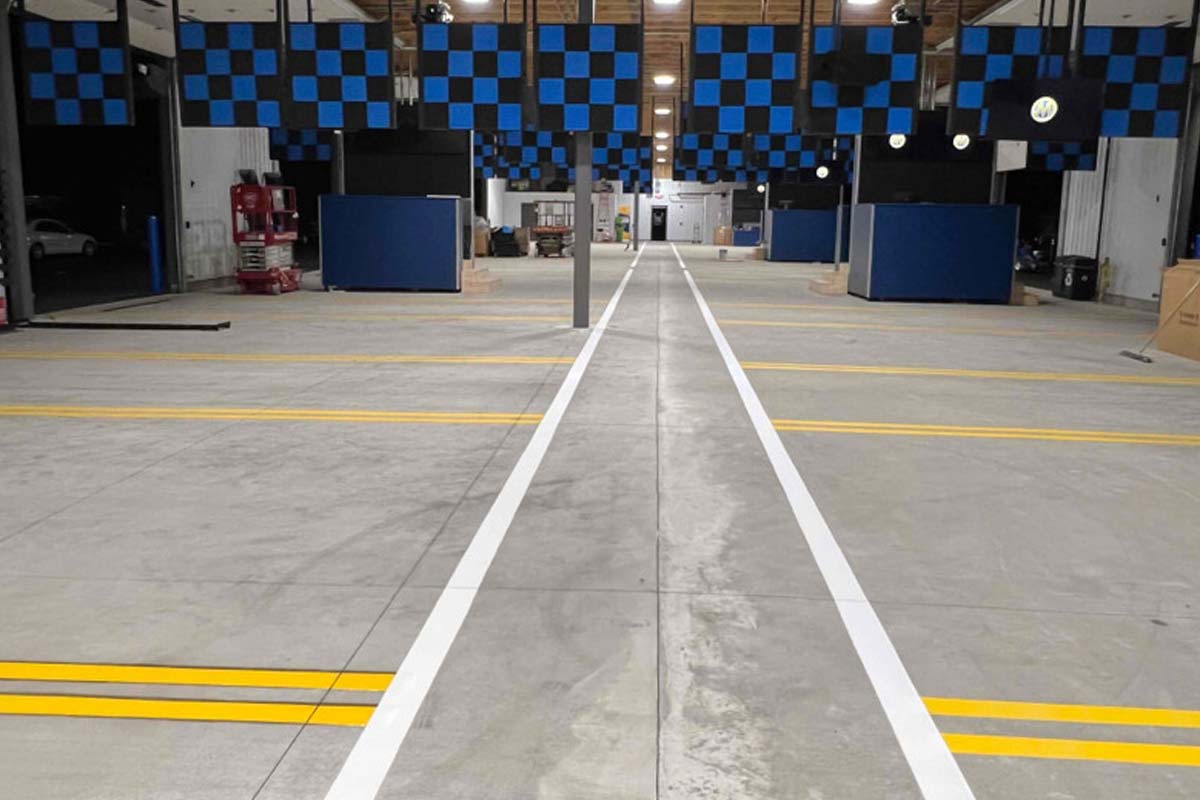
Warehouse Line Painting in Fairfax, VA
A forklift operator and someone walking the floor have to read the same surface and reach opposite conclusions about where each of them belongs. Getting that right, from a distance and under warehouse lighting, is the whole job. Aisles, pedestrian routes, equipment zones, dock staging, and hazard areas are laid out to make the answer obvious rather than inferable.
We mark distribution centers, manufacturing floors, self-storage facilities, and warehouse space across Fairfax County and Northern Virginia. The work divides into two situations. A new or newly resurfaced floor is a clean layout problem. An operating facility is a scheduling problem as much as a striping one, because the floor has to be released to us in sections and returned to service on a timetable that does not stop the operation.
What OSHA Actually Requires
This is where most published guidance goes wrong, so it is worth being exact. The federal requirement to mark aisles is 29 CFR 1910.176(a), which states that permanent aisles and passageways shall be appropriately marked. It is frequently misattributed to 1910.22, which contains no occurrence of the word “aisle” at all.
What 1910.176(a) actually says about dimensions is nothing. It requires that sufficient safe clearances be maintained for mechanical handling equipment, that aisles be kept in good repair and clear of obstruction, and that permanent aisles be marked. It does not specify a width. It does not specify a color. It does not specify a line thickness.
That silence is deliberate — the standard is performance-based, so the correct clearance is the one that is genuinely safe for the equipment actually operating in that facility. A 36-inch aisle is fine for foot traffic and dangerous for a reach truck. Any page that quotes you a specific OSHA-mandated aisle width is quoting a convention and attributing it to a regulation.
Aisle and Walkway Marking Layout
Because the regulation sets no dimensions, the layout is driven by the equipment and the traffic. We start from the largest vehicle that uses each route and work outward: the aisle has to accommodate the machine’s turning envelope and load width with genuine clearance, not nominal clearance.
Pedestrian walkways are the part worth spending time on. A walkway that runs alongside a forklift aisle needs to be wide enough to use naturally, positioned so that people are not tempted to cut across the aisle, and continuous — a walkway that stops at a corner sends people into traffic at exactly the point where visibility is worst. Crossing points are marked deliberately and kept to as few as the layout allows.
Dock staging, battery charging areas, eyewash and extinguisher access, and electrical panel clearances are all laid out at the same time, because they compete for the same floor and are far cheaper to reconcile on a drawing than in paint.
Color Conventions and What They Mean
Since OSHA mandates no color for aisle marking, color in a warehouse is convention rather than regulation — but it is a convention worth following, because its value is that everyone recognizes it. The widely used reference is the ANSI Z535.1 safety color standard.
In general practice the conventions line up like this, and the third column is the part worth keeping straight:
| Marking | Conventional color | Governing reference |
|---|---|---|
| Permanent aisles and traffic paths | Yellow | 29 CFR 1910.176(a) requires the marking; the color is convention |
| Pedestrian walkways and crossings | Yellow, or white where aisles are yellow | Convention; no federal color rule |
| Equipment, racking and staging locations | White | Convention, ANSI Z535.1 palette |
| Fire equipment and danger | Red | Convention, ANSI Z535.1 palette |
| Energized equipment and hazardous machine areas | Orange | Convention, ANSI Z535.1 palette |
| Safety equipment and first aid | Green | Convention, ANSI Z535.1 palette |
| Keep-clear areas | Black and yellow, or black and white | Convention; no federal color rule |
Only the first row carries a federal duty, and even there the duty is to mark, not to mark in a particular color. Every other row is convention.
The single most useful rule is internal consistency. A facility that uses yellow for aisles in one building and white for aisles in the next has created a hazard out of a convention, because a driver moving between the two reads the floor wrongly for the first few seconds.
Coatings for Forklift Traffic
Warehouse floor markings fail from abrasion and from point loading, not from weather, so the coating choice is different from anything used outdoors. On concrete taking forklift traffic, a two-part epoxy or a polyurethane line coating substantially outlasts a conventional traffic paint, which is formulated for tires on asphalt in the open air.
Surface preparation is what actually decides service life. Concrete that has been sealed, is contaminated with oil, or still holds construction laitance will reject a coating regardless of the product. Where the floor allows, we abrade to give the coating a mechanical key. Where a facility needs an aisle back in service within hours rather than days, a fast-cure system or a heavy-duty floor tape is the honest recommendation, and we say so rather than applying a coating that will not have cured before the traffic returns.
Working Around Your Operating Schedule
Very few of the warehouses we mark can close. The practical answer is sectional work: the floor is divided into zones, each zone is released, prepared, marked, and cured, and the operation moves around the sequence rather than stopping for it. Night and weekend work is normal for us on this type of job.
The planning conversation happens before the first zone, not during it. We walk the floor with whoever runs the operation, agree the zone sequence against the pick paths and dock schedule, and confirm the cure window for the chosen product so that a zone is not returned to forklift traffic early. Where a full cure cannot be accommodated in the available window, that constrains the product selection, and it is better to discover that at the walk than at two in the morning.
For a full list of our pavement marking services, visit our parking lot striping in Fairfax page.
Businesses We Serve




How it Works

GET A FREE ESTIMATE
Contact us today and we’ll have a quote to you in 24 hours

SCHEDULE A STRIPING
We’ll have your space restriped in less than 7 days, without affecting your business hours

GET A PARKING LOT THAT POPS
For a budget-friendly price, you’ll get a parking lot that looks like new
We proudly work with:


We proudly work with:


Frequently Asked Questions About Warehouse Line Painting in Fairfax, VA
Does OSHA require aisles to be marked in a warehouse?
Yes. The requirement is 29 CFR 1910.176(a), which states that permanent aisles and passageways shall be appropriately marked. The same provision requires that sufficient safe clearances be maintained where mechanical handling equipment is used, and that aisles be kept in good repair with no obstruction across them. It is worth noting the word “permanent” — the duty attaches to established aisles and passageways rather than to every temporary lane created by how pallets happen to be stacked on a given day.
What aisle width does OSHA require?
None. This is the answer most sources get wrong. 29 CFR 1910.176(a) specifies no aisle width whatsoever; it requires only that sufficient safe clearances be maintained where mechanical handling equipment is used. The standard is performance-based by design, because the clearance that is genuinely safe depends on the equipment operating in that facility. Any specific figure you see quoted as an OSHA-mandated aisle width is a convention or a manufacturer recommendation being attributed to a regulation that does not contain it.
What color should warehouse floor lines be?
OSHA mandates no color for aisle marking. The aisle-marking provision requires appropriate marking without specifying what color that marking must be, so color in a warehouse is convention rather than regulation. The widely used reference is the ANSI Z535.1 safety color standard, and in general practice yellow marks aisles and traffic paths, white marks equipment and staging locations, red identifies fire equipment, and black-and-yellow striping designates keep-clear areas. What matters most is internal consistency across a facility.
What paint holds up to forklift traffic?
On concrete under forklift traffic, a two-part epoxy or a polyurethane line coating substantially outlasts conventional traffic paint, which is formulated for tires on asphalt outdoors rather than for point loading and abrasion indoors. Preparation matters as much as product: sealed, oily, or laitance-covered concrete will reject a coating no matter how good it is, so we abrade to give a mechanical key where the floor allows. Where an aisle must return to service in hours, a fast-cure system or heavy-duty floor tape is the honest choice.
Can a warehouse be striped without shutting down operations?
Almost always, and it is how most of our warehouse work is done. The floor is divided into zones; each zone is released to us, prepared, marked, and left to cure while the operation runs around it. Night and weekend scheduling is routine for this type of job. The planning happens up front — we walk the floor with whoever runs the operation, sequence the zones against pick paths and the dock schedule, and confirm the cure window for the chosen coating so no zone goes back under forklift traffic early.
Do you mark pedestrian walkways and equipment zones as well as aisles?
Yes, and they are laid out at the same time as the aisles because they compete for the same floor. Pedestrian walkways, crossing points, dock staging, battery charging areas, racking and equipment locations, eyewash and extinguisher access, and electrical panel clearances all get marked as part of one layout. Walkways get particular attention: a route needs to be wide enough to use naturally, positioned so people are not tempted to cut across a forklift aisle, and continuous, because a walkway that stops at a corner puts people into traffic where visibility is worst.