Sports Court Striping
In Fairfax, VA
Multi-Sport Court Line Marking
1-800-STRIPER provides professional sports court striping in Fairfax, VA — marking pickleball courts to USA Pickleball Rulebook dimensions, basketball courts, tennis courts, and playground game markings with durable acrylic court coatings for schools, HOAs, and commercial properties.
1-800-STRIPER® of Fairfax PROVIDes Sport Court and Playground Markings Services NEAR YOU
Want to get people to come out to play?
Brighten up your faded sport courts or turn your playground into a safe, colorful, and engaging space that entices people to come out and play.
Sport Court Specialties:
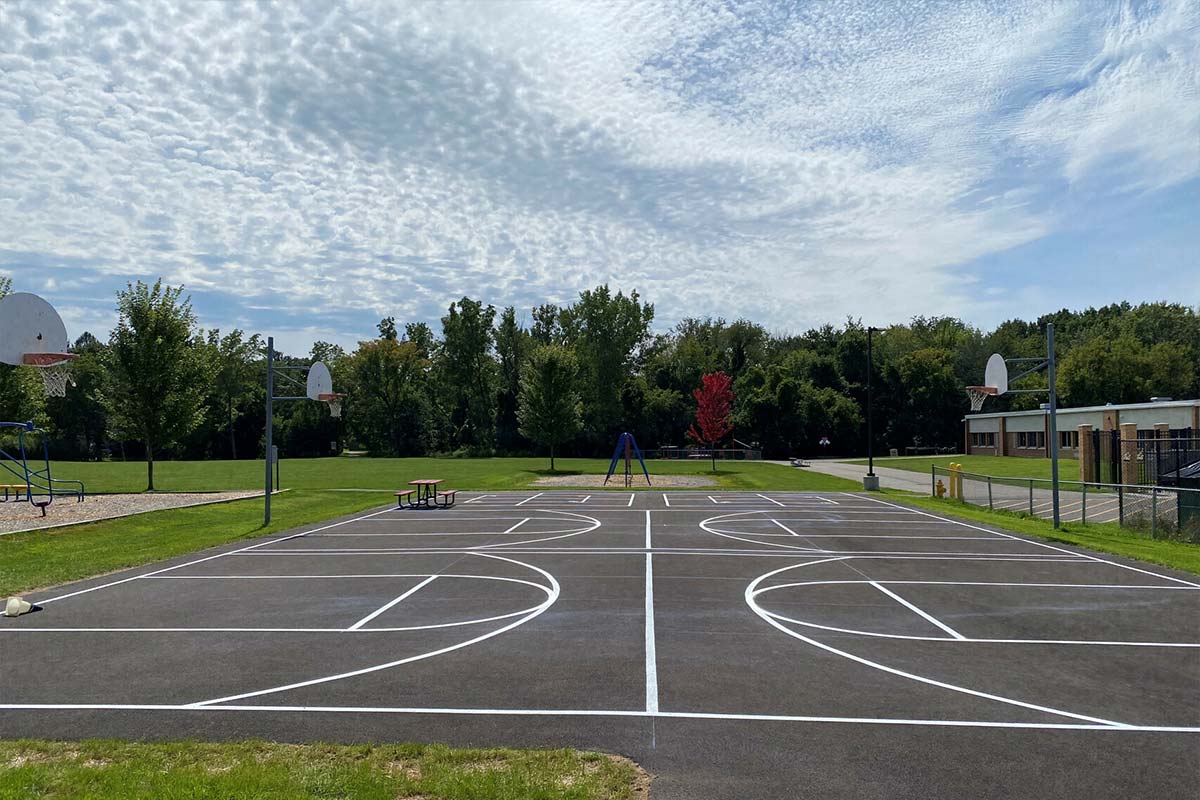
Sports Court Striping in Fairfax, VA
Sports court striping is a different trade from parking lot striping, and the difference is not marketing. Court markings go onto an acrylic or cushioned sport surface, they are laid out to a governing body’s published dimensions rather than to site convenience, and they are applied with textured acrylic line paint formulated to bond to a coated athletic surface instead of to asphalt binder. A crew that stripes lots with fast-dry traffic paint cannot simply point the same equipment at a tennis court.
We stripe pickleball, tennis, and basketball courts along with playground game markings for schools, HOAs, parks, apartment communities, and commercial properties across Northern Virginia. Most of the work we see in this market is not a fresh court. It is an existing surface that has faded, or a tennis court that a community wants to share with pickleball without giving up tennis.
The numbers a facility needs first are the playing area and the total surface, and they are not the same figure:
| Court type | Playing dimensions | Recommended total surface | Line width |
|---|---|---|---|
| Pickleball | 20 ft by 44 ft, singles and doubles | 30 ft by 60 ft minimum | 2 in |
| Tennis | 78 ft by 36 ft doubles, 27 ft singles | 60 ft by 120 ft for a single court | 2 in, baseline up to 4 in |
| Basketball, high school | 84 ft by 50 ft | Slab plus safety run-off | Per governing body |
| Basketball, college and professional | 94 ft by 50 ft | Slab plus safety run-off | Per governing body |
| Playground games | No governing standard | Space and age group decide | Design choice |
The pickleball row is the one worth reading twice, because a slab sized to the playing area leaves no run-off at all. The pickleball figures are from the USA Pickleball Rulebook; the tennis and basketball figures are the published dimensions for each governing body, and we confirm which standard applies with the facility before laying out.
Pickleball Court Striping and Dimensions
Pickleball is the reason most Northern Virginia facilities call about court striping at all. A regulation court measures 20 feet by 44 feet for both singles and doubles, the same footprint as a doubles badminton court. The non-volley zone, universally called the kitchen, extends 7 feet from the net on each side. Lines are 2 inches wide and are included in the dimensions they bound. These figures come from the USA Pickleball Rulebook, which is the governing specification for sanctioned play.
The number that catches facilities out is the total pad. A 20 by 44 playing area is not a 20 by 44 slab. USA Pickleball’s recommended minimum total playing surface is 30 feet by 60 feet, and tournament configurations call for more. When a property tells us it has room for a court, the first thing we check is whether it has room for the run-off as well as the lines.
Basketball Court Striping
Basketball is the most size-variable court we mark, because the dimension depends entirely on who plays on it. A full-size high school court is 84 feet by 50 feet, and the college and professional court in the United States is 94 feet by 50 feet. The free-throw line sits 15 feet from the face of the backboard at each of those levels. Three-point distance is the figure that moves most, and it differs between high school, college, and professional play. International play is governed by FIBA and is specified in meters rather than feet, so a facility marking to that standard needs the FIBA figures rather than a converted American number.
Because those dimensions are set by the governing body for each level of play, we mark to the standard the facility actually needs rather than to a default, and we confirm which one applies before laying out. For a community or HOA court that will never host sanctioned play, the practical constraint is usually the existing slab, and the layout is scaled to fit it while keeping the key, the free-throw line, and the arc in correct proportion.
Tennis Court Striping
A regulation tennis court playing area is 78 feet long and 36 feet wide for doubles, narrowing to 27 feet for singles, with service boxes set 21 feet from the net. As with pickleball, the enclosed area is considerably larger than the playing area — the standard recommendation is 60 feet by 120 feet for a single court, which is what allows players to run down a ball behind the baseline.
Tennis lines are 2 inches wide except the baseline, which may be up to 4 inches. On a court being restriped rather than newly built, the sequence matters: the existing lines are assessed for position before anything is applied, because a resurfaced court can shift line positions slightly and a layout copied from faded paint inherits whatever error was already there.
Playground Game Markings
Playground markings are the highest-volume court-adjacent work in this market, largely because of the density of schools and HOA common areas in Fairfax and Loudoun. Hopscotch, four square, foursquare variants, kickball diamonds, running tracks, number grids, alphabet paths, compass roses, and map outlines all fall into this category.
Unlike sports courts, playground markings have no governing dimensional standard, which means the design constraint is the space and the age group rather than a rulebook. What does carry over from court work is the coating: these markings take direct foot traffic, sun, and play equipment, so they are applied in the same durable acrylic system used on courts rather than in parking lot traffic paint, which will not hold up on a play surface.
Court Coatings and Surface Preparation
Preparation decides how long the lines last, and it is the step most often skipped. The surface has to be clean, sound, and dry. Cracks and low spots are addressed before coating, because a line laid over a crack will fail along the crack no matter how good the paint is. On an asphalt or concrete slab that has never been coated, an acrylic resurfacer and color coating system goes down first; lines are the last step, not the first.
Line paint on a court is textured acrylic, not the fast-dry traffic paint used on parking lots. The two products are engineered for different substrates and different failure modes. Court coatings also need a genuine weather window: application wants dry conditions and surface temperatures within the manufacturer’s range, which in Northern Virginia realistically means late spring through early autumn for most systems.
For a full list of our pavement marking services, visit our parking lot striping in Fairfax page.
Businesses We Serve




How it Works

GET A FREE ESTIMATE
Contact us today and we’ll have a quote to you in 24 hours

SCHEDULE AN INSTALLATION
We’ll have your play space restriped in less than 7 days, without affecting your playtime

GET A PARKING LOT THAT POPS
For a budget-friendly price, you’ll get a parking lot that looks like new
We proudly work with:


We proudly work with:


Frequently Asked Questions About Sports Court Striping in Fairfax, VA
What are the official dimensions of a pickleball court?
A regulation pickleball court is 20 feet wide by 44 feet long for both singles and doubles play, with the non-volley zone, or kitchen, extending 7 feet from the net on each side. Lines are 2 inches wide and are counted as part of the area they bound. Those dimensions come from the USA Pickleball Rulebook. The figure facilities most often miss is the surrounding space: the recommended minimum total playing surface is 30 feet by 60 feet, so the pad needs to be considerably larger than the court itself.
Can pickleball and tennis lines share the same court surface?
Yes, and in this market it is the most common request we get. One tennis court comfortably accommodates pickleball lines, and the two sets of markings coexist as long as the color hierarchy is deliberate. The standard approach is to keep the tennis lines in the dominant color and lay the pickleball lines in a clearly contrasting one, so a player reads the correct set without hesitating. The layout has to be planned before any paint is applied, because a shared court laid out badly makes both sports harder to play rather than one easier.
What are regulation basketball court dimensions?
It depends on the level of play. A full-size high school court is 84 feet by 50 feet, while the college and professional court in the United States is 94 feet by 50 feet. The free-throw line is 15 feet from the backboard face at both levels. Three-point distance varies most between high school, college, and professional rules, and international play follows FIBA, which specifies its court in meters. We confirm which governing standard a facility needs before laying out, and for community and HOA courts that will never host sanctioned play we scale the layout to the existing slab.
How is court paint different from parking-lot traffic paint?
They are different products for different substrates. Court line paint is a textured acrylic engineered to bond to a coated athletic surface and to stay playable underfoot, with a finish that gives grip rather than a slick film. Parking lot traffic paint is a fast-dry coating formulated for asphalt and concrete under vehicle tires. Traffic paint applied to a court surface tends to fail at the bond line and can leave a slick stripe, which on a playing surface is a safety problem as much as a durability one. The systems are not interchangeable.
How long does a court need to cure before play?
Longer than a parking lot, and the difference surprises people. Acrylic court line paint is typically dry to the touch within an hour or two in warm dry conditions, but the coating system underneath needs considerably more time before it takes play. A full resurfacing and coating system generally wants several days before the court is opened, with each coat cured before the next goes down. Cool temperatures, humidity, and shade all extend it. We give a facility the specific window for the product being used rather than a generic figure.
Do you stripe playground game markings as well as sports courts?
Yes. Hopscotch, four square, kickball diamonds, running tracks, number and alphabet grids, compass roses, and map outlines are all regular work for us, and in Fairfax and Loudoun the school and HOA density means playground markings are a large share of what we do. Because there is no governing dimensional standard for playground games, the layout is driven by the available space and the age group rather than by a rulebook. The coating is the same durable acrylic system used on sports courts, not parking lot traffic paint.