
Fire Lane Striping
In Fairfax, VA
Code-Compliant Fire Lane Markings
1-800-STRIPER provides professional fire lane striping in Fairfax, VA — yellow traffic-grade curb painting, six-inch edge stripes where no curb exists, and metal fire lane signs marked to the Fairfax County Fire Marshal specification under the Virginia Statewide Fire Prevention Code.
1-800-STRIPER® of Fairfax PROVIDes Fire Lane Striping Services NEAR YOU
Is your parking lot ready for first responders?
Our team is well-versed in local fire regulations and will parter with you to design a fire lane striping plan that creates unobstructed emergency access to protect your customers and property.
Core Services:
Fire Lane Striping in Fairfax, VA
A fire lane is a designated route that has to stay clear so fire apparatus can reach a building and firefighters can work. In Fairfax County it is not an advisory zone the property owner draws where convenient — the Fire Marshal designates fire lanes, on private property as well as public streets, and once designated the marking and its upkeep are the responsibility of the owner or the owner’s agent.
The governing instrument in Virginia is the Virginia Statewide Fire Prevention Code, which is based on the International Fire Code rather than on NFPA 1. That distinction is worth stating plainly, because a great deal of striping marketing cites NFPA 1 at properties in states that have not adopted it. In Fairfax County the practical specification is the one the Fairfax County Office of the Fire Marshal publishes, and it has been required county-wide since July 1986.
What follows is that specification, with its actual numbers. The county publishes it; almost nobody in this market reproduces it.
What Fairfax County Requires
Fire lane marking in Fairfax County has two halves — the pavement and the signs — and both have to be present.
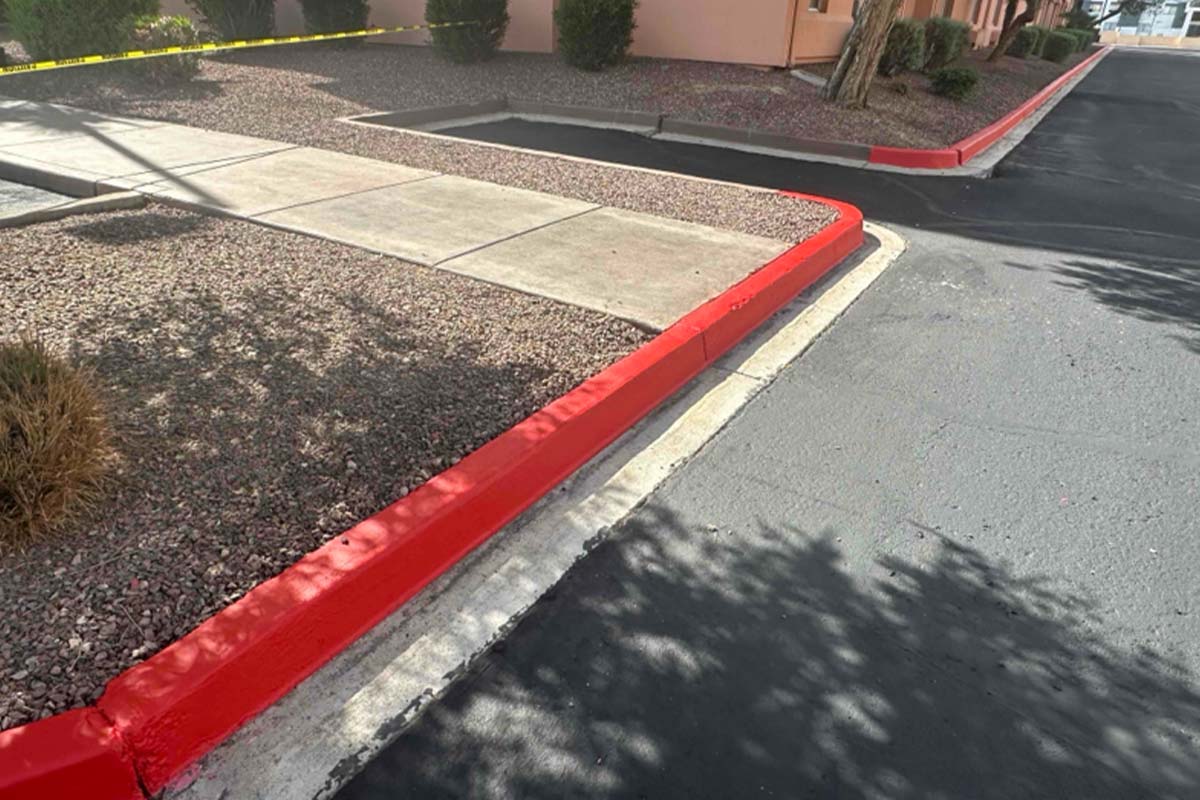
On the pavement, curbs along a designated fire lane are painted with yellow highway traffic-grade paint. Where a fire lane has no curb, the requirement does not disappear; instead a 6-inch yellow stripe is applied along the edge of the pavement to define the boundary. This is the detail most often missed on sites with flush curbing or an asphalt edge, and it is a common reason a lot fails an inspection it expected to pass.
Separately from the fire lane itself, parking is prohibited within 15 feet of a fire hydrant, measured along the curb line or the edge of any public or private roadway. That prohibition operates on its own, and no special curb marking is needed for it to be enforceable.
The apparatus access road behind the marking has dimensional requirements of its own under the Virginia Statewide Fire Prevention Code: a minimum unobstructed width of 20 feet and a minimum vertical clearance of 13 feet 6 inches. Marking a fire lane on a route that cannot physically accommodate apparatus solves nothing, so on new work we check the geometry before the paint.
Fire Lane Signs: Legend, Size, Height, and Spacing
The sign specification is unusually precise, and the precision is the point — a sign that reads correctly but is built wrongly is not a compliant sign.
The legend is NO PARKING OR STANDING FIRE LANE. Not the shorter “NO PARKING FIRE LANE” that circulates widely and that we have seen carried in reference material for this region; the county’s specification includes OR STANDING, and those two words are part of a legally-specified legend.
| Element | Requirement |
|---|---|
| Legend | NO PARKING OR STANDING FIRE LANE |
| Material | Metal, on metal posts |
| Size | 12 inches by 18 inches |
| Colors | Red letters on a reflective white background |
| Border | 3/8 inch red trim strip around the entire outer edge |
| Lettering | NO PARKING and STANDING at 2 inches; OR at 1 inch; FIRE LANE at 2 1/2 inches |
| Arrow | Solid shaft, 1 inch by 6 inches |
| Mounting height | 7 feet from the ground to the bottom of the sign |
| Maximum spacing | 70 feet along long stretches |
| Curb marking | Yellow highway traffic-grade paint |
| No-curb marking | 6 inch yellow stripe at the pavement edge |
| Hydrant clearance | No parking within 15 feet |
| Apparatus access | 20 feet unobstructed width, 13 feet 6 inches vertical clearance |
Two of those rows account for most of the deficiencies we correct. The 7-foot mounting height is measured to the bottom of the sign rather than to its center or top, which catches out installers used to standard traffic-sign practice. And the 70-foot maximum spacing means a long fire lane needs a run of signs rather than one at each end.
For a full list of our pavement marking services, visit our parking lot striping in Fairfax page.
Businesses We Serve




How it Works

GET A FREE ESTIMATE
Contact us today and we’ll have a quote to you in 24 hours

SCHEDULE AN INSTALLATION
We’ll have your installation scheduled in less than 7 days, without affecting your business hours

GET A PARKING LOT THAT POPS
For a budget-friendly price, you’ll get a parking lot that looks like new
We proudly work with:


We proudly work with:


Frequently Asked Questions About Fire Lane Striping in Fairfax, VA
Who decides where a fire lane goes in Fairfax County?
The Fire Marshal does. Fire lanes in Fairfax County are designated by the Office of the Fire Marshal, and that authority extends to private property as well as to public streets — a shopping center, office park, or apartment community does not choose its own fire lanes. Once a lane is designated, installing and maintaining the required markings and signs becomes the property owner’s responsibility. If you are unsure whether a route on your site is a designated fire lane, that is a question for the Fire Marshal’s office rather than for a striping contractor.
What must a fire lane be marked with in Fairfax County?
Curbs along a designated fire lane are painted with yellow highway traffic-grade paint. Where the fire lane has no curb, the requirement is met with a 6-inch yellow stripe applied along the edge of the pavement. That no-curb case is the one most often missed on sites with flush curbing or a plain asphalt edge, and it is a frequent reason a lot fails an inspection the owner expected to pass. Pavement marking alone is not sufficient — the posted signs described below are required as well.
What must a fire lane sign say?
The legend specified by Fairfax County is NO PARKING OR STANDING FIRE LANE. The shorter wording NO PARKING FIRE LANE circulates widely and is not the county’s specification — OR STANDING is part of the legend. The sign is metal, 12 inches by 18 inches, with red letters on a reflective white background and a 3/8 inch red trim strip around the entire outer edge. Lettering is sized within the sign: NO PARKING and STANDING at 2 inches, OR at 1 inch, and FIRE LANE at 2 1/2 inches, with a solid-shaft arrow 1 inch by 6 inches.
How high and how far apart do fire lane signs go?
Signs are mounted 7 feet from the ground to the bottom of the sign, on metal posts. The measurement is to the bottom edge rather than to the center or the top, which is the detail installers accustomed to general traffic-sign practice most often get wrong. Along long stretches of fire lane, the maximum spacing between signs is 70 feet, so an extended fire lane requires a run of signs rather than one at each end. Both figures come from the Fairfax County Fire Marshal’s published specification.
How wide does a fire apparatus access road have to be?
A fire apparatus access road requires a minimum unobstructed width of 20 feet and a minimum vertical clearance of 13 feet 6 inches under the Virginia Statewide Fire Prevention Code. The vertical dimension is the one that catches properties out, because canopies, covered walkways, low signage, parking-deck entrances, and mature tree canopy can all intrude on it without anyone noticing. Marking a fire lane along a route that cannot physically accommodate apparatus achieves nothing, so on new work we check the geometry before applying any paint.
Who is responsible for installing and maintaining fire lane markings?
The property owner or the owner’s agent. Fairfax County designates the fire lane, but the duty to install the required curb painting, edge striping, and signs — and to keep them legible afterwards — sits with the property. That maintenance obligation is continuing rather than one-off: a designation does not lapse when the paint fades or a sign is knocked down in a plow season. In practice this means faded fire lane markings should be treated as a compliance issue with a deadline rather than as a cosmetic item awaiting the next budget cycle.
How close to a fire hydrant can vehicles park?
Parking is prohibited within 15 feet of a fire hydrant, measured along the curb line or the edge of any public or private roadway. This prohibition operates independently of fire lane designation — it applies whether or not the area around the hydrant has been designated and marked as a fire lane. No special curb marking is required for it to be enforceable, although many properties choose to paint the area anyway so that drivers can see the restriction rather than having to know it. Fire lane marking and hydrant clearance are separate requirements.