
Bollard Installation
In Fairfax, VA
Safety and Security Bollards
1-800-STRIPER provides professional bollard installation in Fairfax, VA — setting embedded and surface-mounted steel bollards at storefronts, loading docks, utility cabinets, and the fire lane entrances where the Fairfax County Fire Marshal calls for roughly four-foot bollards with chain between them.
1-800-STRIPER® of Fairfax PROVIDes Bollard Installation Services NEAR YOU
Want to prevent accidents and protect your property?
Bollards provide physical protection for your customers and your property.
Safety and security:
Bollards create a physical barrier between vehicles and pedestrians, protecting people in walking areas from accidental or intentional vehicle intrusions.
Bollards act as a protective barrier around storefronts, gas stations, and other vulnerable areas, minimizing the risk of costly damage from vehicle impacts.
Strategic Placement Locations:
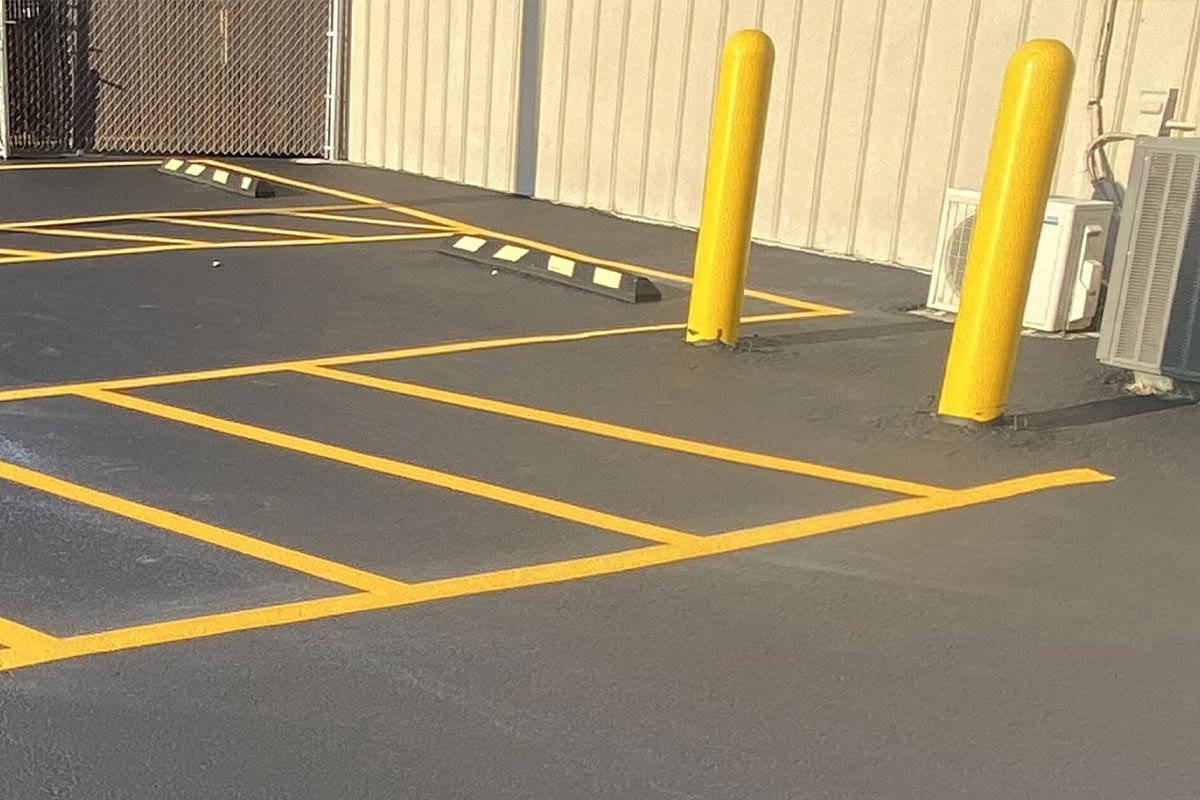
Bollard Installation in Fairfax, VA
The gap between a bollard and a wheel stop is the gap between stopping a vehicle and positioning one. A wheel stop guides where a tire comes to rest. A bollard is a vertical post, engineered and anchored to take a strike, and its job is to keep a vehicle from reaching whatever sits behind it.
The commercial cases are consistent: protecting storefronts and glazing from vehicles at parking stalls that face the building, shielding loading dock equipment and dock levelers, guarding utility cabinets, gas meters, transformers, and fire risers, defining pedestrian areas against vehicle traffic, and controlling access at fire lane entrances.
We install embedded and surface-mounted steel bollards across Fairfax County, usually as part of a wider striping or site-safety scope, since where a bollard belongs is normally decided by the same layout review that decides where the stalls and the fire lane go.
Where Bollards Are Required and Where They Are Recommended
It is worth separating the two, because most bollard work is a recommendation and one important case in this county is a requirement.
The requirement is local and published. The Fairfax County Office of the Fire Marshal fire lane specification calls for approximately 4-foot-high bollards with steel chain locked between them at curbside entrances to access lanes. That is a first-party, county-level requirement that applies to properties here, and it is not something most striping contractors in this market publish.
Everything else is a recommendation driven by risk. Storefront protection at stalls that face glazing. Dock equipment, which is expensive and sits directly in the path of reversing trucks. Utility assets, where a strike creates a hazard rather than just damage. Pedestrian areas where a vehicle route runs alongside people on foot.
| Bollard type | Typical application | Impact protection | Relevant test method |
|---|---|---|---|
| Embedded | Storefronts, dock equipment, utility assets | Highest, with correct footing | ASTM F3016 for low-speed |
| Surface-mounted | Concrete slabs where excavation is impractical | Moderate; depends on slab and anchors | ASTM F3016 for low-speed |
| Removable | Fire lane and service access needing occasional entry | Lower; sleeve dependent | Varies by product |
| Chain-linked | Fire lane entrances per the county specification | Access control rather than impact | Not an impact application |
The last row is the one to read carefully. Chained bollards at a fire lane entrance control access; they are not there to stop a vehicle at speed, and they should not be specified as though they were.
For a full list of our pavement marking services, visit our parking lot striping in Fairfax page.
Businesses We Serve




How it Works

GET A FREE ESTIMATE
Contact us today and we’ll have a quote to you in 24 hours

SCHEDULE AN INSTALLATION
We’ll have your installation scheduled in less than 7 days, without affecting your business hours

GET A PARKING LOT THAT POPS
For a budget-friendly price, you’ll get a parking lot that looks like new
We proudly work with:


We proudly work with:


Frequently Asked Questions About Bollard Installation in Fairfax, VA
Do you need a permit to install a bollard?
It depends on the installation rather than on the bollard. Setting a surface-mounted bollard on existing pavement on private commercial property generally does not require a building permit. Embedded bollards involve excavation and a concrete footing, which can engage permitting, and any excavation requires utility locating beforehand regardless of permits. Work associated with a designated fire lane brings the Fire Marshal into it. We confirm what a specific site and scope require with the county before scheduling rather than assuming from the product type.
What type of contractor installs bollards?
Bollard installation sits with site and pavement contractors rather than with general builders, because the work is excavation, concrete, and pavement repair around a small vertical element. Striping and site-marking contractors commonly handle it, since bollard placement is usually decided by the same layout review that decides stall geometry, pedestrian routes, and fire lane extents. Where the bollard is structural protection for a specific asset, the manufacturer’s installation specification governs the footing and the embedment, and the installer needs to be working to that document.
How deep should a bollard be set?
There is no universal depth, and any figure quoted as a general rule should be treated with suspicion. Embedment depth is set by the manufacturer’s installation specification for the specific product, and by the level of impact protection being achieved — a bollard rated to resist a vehicle strike needs a footing engineered for that, while a bollard marking a pedestrian boundary does not. Soil conditions and whether the bollard is embedded or surface-mounted change it again. The honest answer is that the product specification governs.
What does a “crash-rated” bollard actually mean?
It means the bollard has been tested to a published standard, and which standard matters enormously. ASTM F3016 is the standard test method for surrogate testing of vehicle impact protective devices at low speeds — that is the standard relevant to storefronts and parking lots. ASTM International publishes it. ASTM F2656 covers crash testing of vehicle security barriers at facilities with a defined moving-vehicle threat, which is high-security perimeter work. The two are not interchangeable, and marketing frequently blurs them into an undifferentiated crash-rated claim.
Does Fairfax County require bollards at fire lane entrances?
Yes. The Fairfax County Fire Marshal’s fire lane specification calls for approximately 4-foot-high bollards with steel chain locked between them at curbside entrances to access lanes. It is a published, first-party county requirement rather than a general recommendation, and it is one of the few places where bollards are genuinely mandated rather than advised on a commercial property here. Worth noting what the requirement is for: chained bollards at a fire lane entrance control access, and are not specified as impact protection.