Warehouse Line Painting
In Tulsa, OK
OSHA-Compliant Safety Markings
1-800-STRIPER® provides professional warehouse line painting in Tulsa, OK — marking permanent aisles, pedestrian walkways, equipment zones, and dock lanes on concrete floors per the OSHA aisle-marking requirement at 29 CFR 1910.176(a) for industrial and distribution facilities.
1-800-STRIPER® of Tulsa PROVIDes Warehouse Line Painting Services NEAR YOU
Want your indoor space to operate more efficiently?
Warehouse and interior markings ensure clear traffic lanes, organized storage zones, and designated spaces designed to help your business operate safely and efficiently.
Benefits:
Warehouse Line Painting in Tulsa, OK
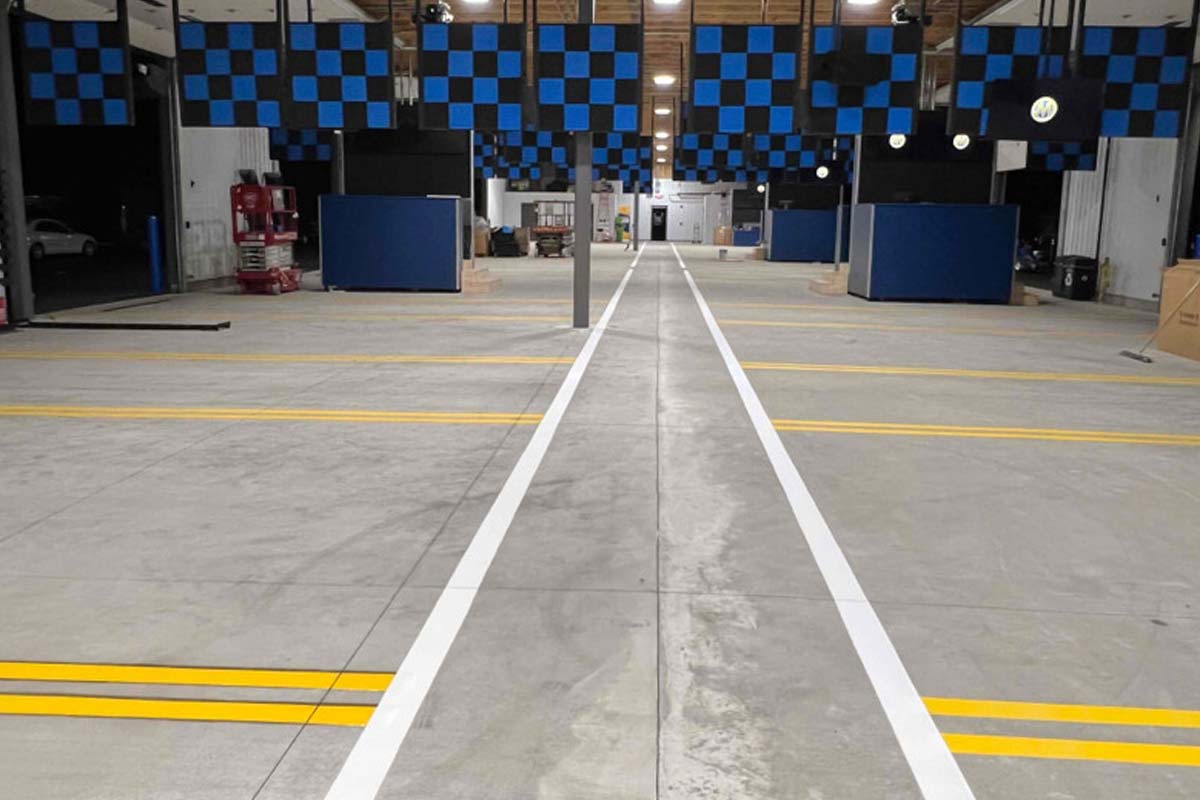
Warehouse line painting in Tulsa, OK means marking the floor inside an industrial building — the permanent aisles forklifts travel, the walkways that keep people out of their path, equipment and staging zones, and the dock lanes at the loading bays. It is floor marking, not wall or building painting, and it is worth saying so plainly because the phrase is used both ways in this market and the search results mix the two.
This work is also called warehouse floor marking or warehouse striping. Whatever it is called, the driver is the same: a facility where people and powered equipment share the same concrete needs the boundary between them drawn where everyone can see it.
OSHA Aisle Marking Requirements for Warehouse Floors
The federal requirement is short and specific. Under 29 CFR 1910.176(a), permanent aisles and passageways shall be appropriately marked. The same provision requires sufficient safe clearances for aisles at loading docks, through doorways, and wherever turns or passage must be made, and requires that aisles and passageways be kept clear and in good repair.
Two things surprise most facility managers. The first is that the regulation gives no dimensions — no mandated aisle width, no mandated line width. It requires marking and sufficient safe clearance, and leaves the specifics to the facility. The second is that no color is mandated for aisle marking either. OSHA’s safety color code at 29 CFR 1910.144 assigns red and yellow to particular hazard classes, but it does not set a color for aisle lines. Yellow is overwhelmingly the convention and a sensible default, but nothing in the regulation requires it.
One correction worth making, because it circulates widely: the aisle-marking duty sits at 1910.176(a), not at 1910.22(b). That older subsection was removed when OSHA rewrote the walking-working surfaces standard, and citations to it are stale.
Set out plainly, what the rule does and does not settle:
What the regulation requires. Permanent aisles and passageways are to be appropriately marked, with sufficient safe clearances at loading docks, through doorways, and wherever turns or passage must be made — and kept clear and in good repair.
What it leaves to the facility — width. No aisle width and no line width are mandated. The standard asks for marking and sufficient safe clearance and leaves the dimensions to you and your equipment.
What it leaves to the facility — color. No color is mandated for aisle marking. OSHA’s safety color code at 29 CFR 1910.144 assigns red and yellow to particular hazard classes but sets no color for aisle lines. Yellow is the overwhelming convention and a sensible default — convention, not regulation.
Which citation is current. 29 CFR 1910.176(a). Not 1910.22(b), which OSHA removed in the walking-working surfaces rewrite.
For a full list of our pavement marking services, visit our parking lot striping in Tulsa page.
Businesses We Serve




How it Works

GET A FREE ESTIMATE
Contact us today and we’ll have a quote to you in 24 hours

SCHEDULE A STRIPING
We’ll have your space restriped in less than 7 days, without affecting your business hours

GET A PARKING LOT THAT POPS
For a budget-friendly price, you’ll get a parking lot that looks like new
We proudly work with:


We proudly work with:

Frequently Asked Questions About Warehouse Line Painting in Tulsa, OK
What does OSHA actually require for warehouse aisle marking?
Under 29 CFR 1910.176(a), permanent aisles and passageways must be appropriately marked. The same provision requires sufficient safe clearances where mechanical handling equipment is used, including at loading docks and doorways, and requires aisles be kept clear and in good repair. The requirement applies to permanent aisles, which is why the first step is deciding which routes in your facility are permanent. Temporary staging lanes that move with the season are a different question from the main forklift routes.
Does OSHA specify a line color or width for aisles?
No. This is the most common misunderstanding about the rule. 29 CFR 1910.176(a) requires appropriate marking and sufficient safe clearance without giving a single dimension, and it sets no color. OSHA’s safety color code at 29 CFR 1910.144 assigns colors to specific hazard classes but does not assign one to aisle lines. Yellow is the near-universal convention and a sensible default, but it is convention rather than a regulation, and a facility can choose otherwise.
How long does warehouse floor marking last under forklift traffic?
Longer than most people expect, but it depends almost entirely on traffic type. Forklift wheels are hard and they pivot, and a pivot point on a line wears far faster than a straight run. Turn radii, dock approaches, and pinch points are always the first areas to go. Surface preparation matters more than paint choice here. Marking applied to clean, sound concrete lasts substantially longer than marking laid over dust or old sealer. We assess the floor before quoting.
Do we have to shut the warehouse down for the work?
Rarely. Most facilities are marked in sections, working around live operations so one area is closed at a time while the rest of the floor keeps running. Facilities on multiple shifts often schedule the work between shifts or on a weekend. Tell us your shift pattern when you request the estimate and the sequence will be planned around it. The practical constraint is cure time on the marked section, not the marking work itself.
Is this the same as painting the warehouse walls or building?
No. Warehouse line painting is floor marking — aisles, walkways, equipment zones, and dock lanes applied to interior concrete. It is sometimes called warehouse floor marking or warehouse striping. We do not paint walls, ceilings, or building exteriors. The phrase causes genuine confusion in Tulsa search results, where building painters and floor marking contractors appear alongside each other, so it is worth confirming which one you need before requesting quotes.
Can you mark pedestrian walkways as well as forklift aisles?
Yes, and on a shared floor it is the more important half of the job. Separating people from powered equipment is the whole point of marking an industrial floor, and pedestrian walkways, crossing points, and equipment exclusion zones are marked as part of the same visit. We walk the site and map the traffic pattern as it actually runs, because the route people really take is not always the one the original floor plan intended.