
Fire Lane Striping
In Tulsa, OK
Code-Compliant Fire Lane Markings
1-800-STRIPER® provides professional fire lane striping in Tulsa, OK — curb painting, no-parking zones, and NO PARKING—FIRE LANE lettering applied to the Oklahoma Fire Code Section 503.3 marking specification, where the Tulsa Fire Department requires fire apparatus access roads to be marked.
1-800-STRIPER® of Tulsa PROVIDes Fire Lane Striping Services NEAR YOU
Is your parking lot ready for first responders?
Our team is well-versed in local fire regulations and will parter with you to design a fire lane striping plan that creates unobstructed emergency access to protect your customers and property.
Core Services:
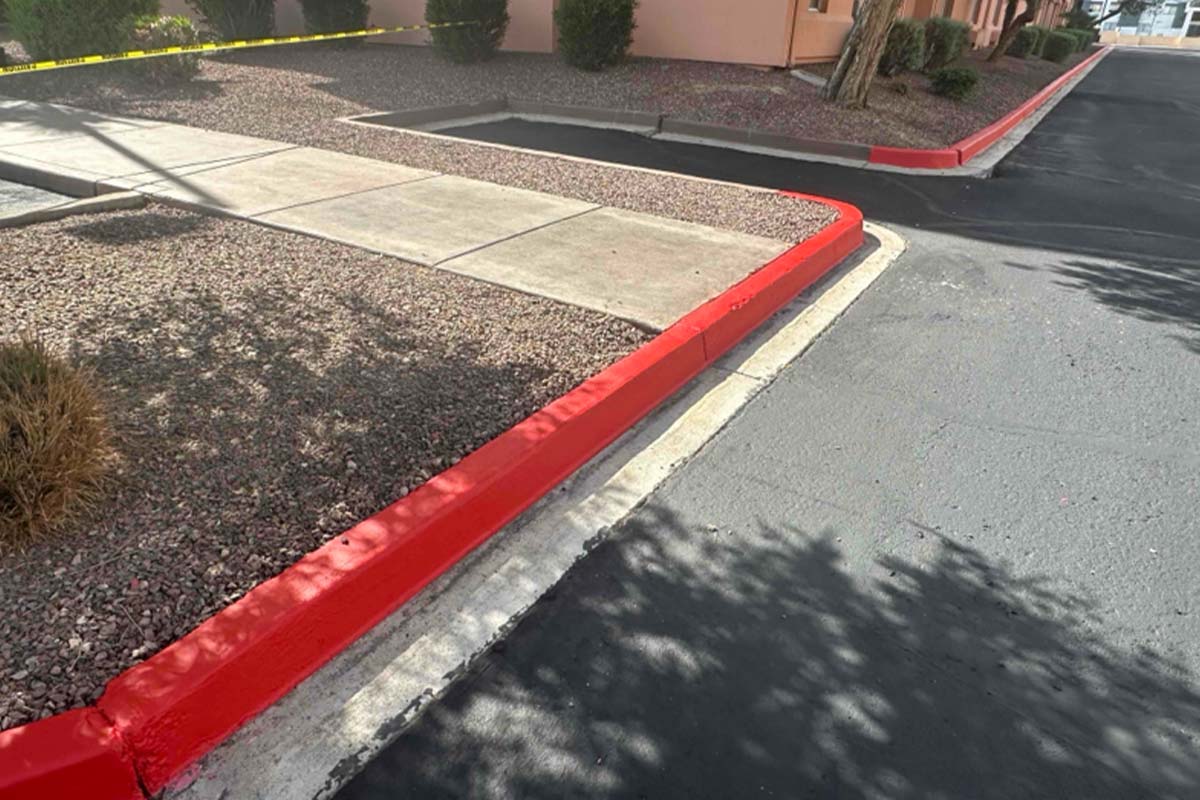
Fire Lane Striping in Tulsa, OK
Fire lane striping in Tulsa, OK is the marking that keeps fire apparatus access roads clear and identifiable: painted curbs, no-parking zones along the access route, and the lettering that tells drivers the lane is not a parking space. On most commercial properties it runs along the building frontage and the drive aisles a fire truck would use to reach it.
It is the one striping service on a commercial lot with a code requirement sitting directly behind it, and also the one where the most misinformation circulates. What follows is what Oklahoma actually adopts, and what it does not.
What the Oklahoma Fire Code Requires
Oklahoma adopts the International Fire Code, 2018 Edition, as the statewide minimum code for fire prevention and fire protection. The adopting body is the Oklahoma Uniform Building Code Commission, acting under state statute.
That single fact settles a question that gets answered wrongly all the time: Oklahoma is an International Fire Code state. NFPA 1, the model fire code published by the National Fire Protection Association, is not the operative instrument here. Some states do adopt it. Oklahoma adopts the IFC.
Section 503 of the adopted code covers fire apparatus access roads, and Oklahoma adopts it without modification. It requires approved access roads for facilities constructed or moved into the jurisdiction after the code took effect, extending to within 150 feet of all portions of the facility and of the exterior walls of the first story, measured along an approved route. Section 503.4 requires that access roads not be obstructed in any manner, including by parked vehicles, and that the minimum widths and clearances the code establishes be maintained at all times.
One important limit: Oklahoma has adopted none of the code’s appendices. That matters because the specific dimensional requirements people often quote for fire lanes live in Appendix D, which is not part of the statewide minimum code. Individual jurisdictions in Oklahoma may adopt appendices locally, so the dimensional question is a local one, not a statewide one.
NO PARKING—FIRE LANE Markings and Curb Painting
The marking specification itself is Section 503.3. Where the fire code official requires marking, approved signs, notices, or markings including the words NO PARKING—FIRE LANE must be provided to identify the access road or prohibit its obstruction.
The exact wording matters. It is NO PARKING—FIRE LANE — not FIRE LANE on its own, and not NO PARKING on its own. Markings carrying only half the phrase are common on older Tulsa properties and are worth correcting at the next restripe.
Section 503.3 also carries a maintenance duty that most property owners have never heard of: the means by which fire lanes are designated must be maintained in a clean and legible condition at all times, and replaced or repaired when necessary to provide adequate visibility. Faded fire lane markings are therefore a code condition with a remedy named in the code itself, not merely an appearance issue.
What the code does not do is specify a color. There is no statewide red-curb requirement in Oklahoma. Red curbing is a widely used convention and many authorities prefer it, but a property owner told that Oklahoma law mandates red curbs is being told something the code does not say. Where a local authority specifies a color, that preference governs.
Who Decides Where Fire Lanes Go in Tulsa
Section 503.3 is conditioned on the phrase “where required by the fire code official.” That is the single most important qualifier in the whole provision, and it means fire lane marking is not automatic and universal.
The fire code official is the authority having jurisdiction for your property. Within the city, that is the Tulsa Fire Department. Our service area spans Tulsa, Wagoner, Rogers, Osage, and Creek counties and includes Broken Arrow, Bixby, Jenks, Glenpool, Catoosa, and Coweta, and those communities have their own fire authorities. Jurisdiction is resolved municipality by municipality, so the answer for a property in Coweta is not automatically the answer for one in Tulsa.
In practice this means the sequence runs: your fire authority determines whether and where access roads on your property must be marked, and we apply markings to the specification the adopted code sets out. If you have received a notice or an inspection finding, bring it to the estimate — it tells us exactly what has been required.
Our Fire Lane Striping Process
- Start with what your fire authority has required. Section 503.3 applies where required by the fire code official, so the first question is what your authority having jurisdiction has actually determined. Within the city that is the Tulsa Fire Department; Broken Arrow, Bixby, Jenks, Glenpool, Catoosa and Coweta each answer to their own.
- Read the notice. If an inspection finding or notice exists, bring it to the estimate — it states exactly what has been required and where.
- Walk the access route. We map the frontage and drive aisles a fire truck would use to reach the building, and note where markings have faded past legibility.
- Mark the full phrase. The wording is NO PARKING—FIRE LANE — not FIRE LANE alone and not NO PARKING alone. Half-phrase markings on older Tulsa properties get corrected at this step.
- Paint curbs to the local preference. Oklahoma prescribes no color. Red curbing is a widely used convention; where your local authority specifies a color, that preference governs and we apply it.
- Leave it legible, and keep it that way. Section 503.3 makes clean and legible condition a continuing duty, so the finish is checked for readability from a moving vehicle and re-checked at each restripe.
For a full list of our pavement marking services, visit our parking lot striping in Tulsa page.
Businesses We Serve




How it Works

GET A FREE ESTIMATE
Contact us today and we’ll have a quote to you in 24 hours

SCHEDULE AN INSTALLATION
We’ll have your installation scheduled in less than 7 days, without affecting your business hours

GET A PARKING LOT THAT POPS
For a budget-friendly price, you’ll get a parking lot that looks like new
We proudly work with:


We proudly work with:


Frequently Asked Questions About Fire Lane Striping in Tulsa, OK
What does Oklahoma require fire lane markings to say?
Fire lane striping in Oklahoma follows the International Fire Code, 2018 Edition, which the state adopts as its statewide minimum code. Section 503.3 provides that where the fire code official requires marking, approved signs, notices, or markings including the words NO PARKING—FIRE LANE must identify the fire apparatus access road or prohibit its obstruction. The full phrase is what the code specifies. Markings that read only FIRE LANE, or only NO PARKING, do not carry the wording the code names, and older Tulsa properties frequently have one or the other.
Does Oklahoma require every commercial property to have marked fire lanes?
No, and this is the most misunderstood part of the rule. Section 503.3 is conditioned on the words “where required by the fire code official.” Marking is triggered by your authority having jurisdiction rather than applying automatically to every property in the state. Separately, the requirement to provide access roads at all is written for facilities constructed or moved into the jurisdiction after the code took effect. Your local fire authority is the one that determines what your specific property needs.
Does Oklahoma require fire lane curbs to be painted red?
No. Oklahoma prescribes no color for fire lane marking anywhere in the adopted code. Red curbing is a widespread convention and many fire authorities prefer it, which is why it is so common, but a claim that state law mandates red curbs is not supported by the code. Where your local authority having jurisdiction specifies a color, that specification governs your property. We apply what your authority requires, and we ask.
Are faded fire lane markings a code violation?
Section 503.3 requires that the means by which fire lanes are designated be maintained in a clean and legible condition at all times, and be replaced or repaired when necessary to provide adequate visibility. That makes legibility a continuing duty rather than a one-time installation, with the remedy named in the code itself. Whether a given faded marking is written up is a matter for your fire authority, but the maintenance obligation is in the text and repainting is the specified fix.
Who is the fire code official for my property?
It is the authority having jurisdiction where the property sits, and that is settled municipality by municipality. Within the city of Tulsa it is the Tulsa Fire Department. Properties in Broken Arrow, Bixby, Jenks, Glenpool, Catoosa, and Coweta fall under their own local fire authorities, so a property in one community can face a different determination than one a few miles away. We confirm which authority applies to your address as part of the estimate.
How wide does a fire lane have to be in Oklahoma?
The dimensional requirements most often quoted for fire lanes come from Appendix D of the model code, and Oklahoma has adopted none of the code’s appendices into the statewide minimum. That leaves fire lane dimensions to local adoption, since individual Oklahoma jurisdictions may adopt appendices themselves. The adopted code does require that the minimum widths and clearances it establishes be maintained at all times and kept unobstructed. Ask your local fire authority for the figure that binds your property.
Can you stripe fire lanes without closing our parking lot?
Usually yes. Fire lane marking follows building frontage and access routes; it does not cross the parking field, so most of a lot stays usable while the work is done. Where a section has to be closed we stage it so the property keeps a working entrance and exit throughout. Retail and medical properties often schedule the work early morning or on a weekend. Traffic paint dries quickly enough that marked sections generally reopen the same day.