Parking Lot Sign Installation
In Tulsa, OK
ADA, Fire Lane, and Directional Signage
1-800-STRIPER® provides professional parking lot sign installation in Tulsa, OK — mounting R7-8 accessible-parking signs, van-accessible R7-8a plates, fire lane no-parking signs, and directional signage per Oklahoma Statutes Title 11 Section 36-101A and the 2010 ADA Standards for Accessible Design.
1-800-STRIPER® of Tulsa PROVIDes Parking Lot Sign Installation Services NEAR YOU
Are you communicating clearly?
We install new signs in adherence with local regulatory standards and can repair or replace damaged signs so you can clearly communicate your parking requirements.
Parking Lot Sign Installation in Tulsa, OK
Parking lot sign installation in Tulsa, OK covers the posted signage that makes a commercial lot work and keeps it compliant. That means accessible parking signs, fire lane no-parking signs, directional and one-way signs, stop signs, reserved and visitor signage, speed and pedestrian warnings, and tow-away notices.
Signs are the half of a parking lot that pavement markings cannot do. A painted accessible symbol on the ground disappears the moment a vehicle parks on it. That is precisely why the sign requirement exists — the sign stays visible when the space is occupied.
The compliance picture here is the most layered on this site. Three separate bodies of rule apply to signage on a Tulsa commercial lot: federal accessibility standards, an Oklahoma statute that specifies the accessible parking sign directly, and the City of Tulsa‘s own sign regulations. Local sign companies here sell the signs. What they do not publish is the code that requires them.
Oklahoma’s R7-8 Accessible Parking Sign Rule
Oklahoma does not leave accessible parking signage to federal standards alone. Title 11, Section 36-101A of the Oklahoma Statutes sets a state requirement for the sign itself, and it is specific.
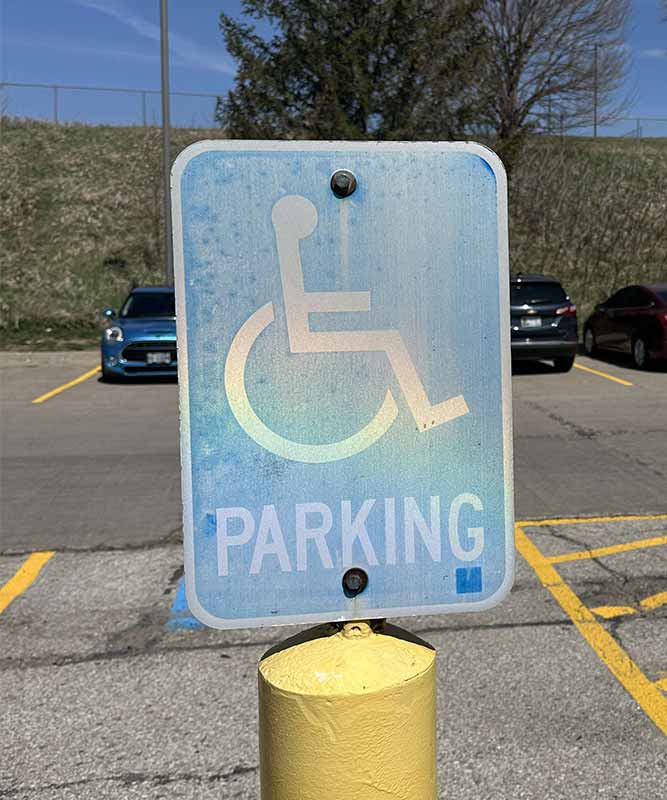
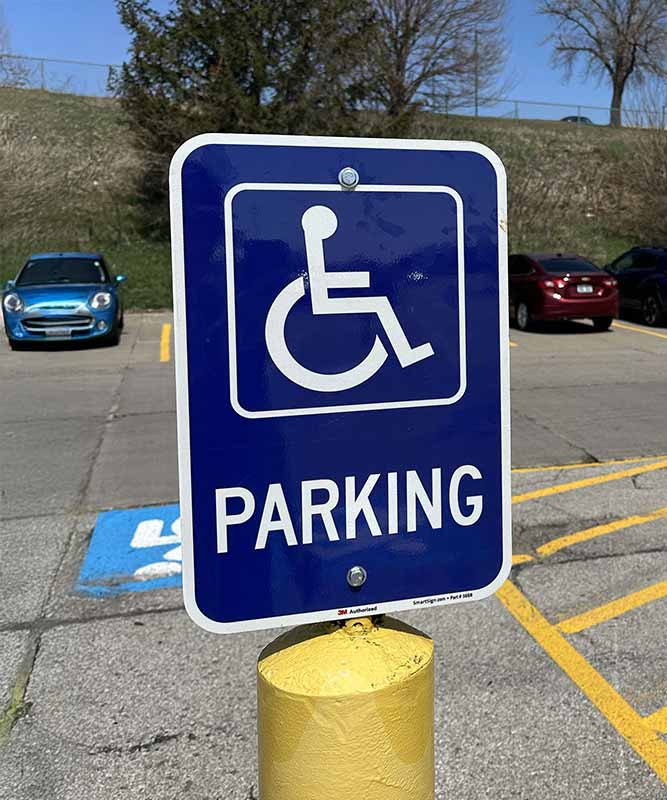
Since 1 January 2010, every parking space designated and posted as reserved for a physically disabled person must display sign R7-8. The sign is the one provided in the latest edition of the Manual on Uniform Traffic Control Devices, carrying the words RESERVED PARKING together with the blue and white international symbol of access. Van-accessible spaces must additionally display sign R7-8a immediately below the R7-8. The statute directed Oklahoma municipalities to adopt conforming ordinances by that same date. It also states expressly that the requirement adds to any other federal or state signage requirement; it does not replace one.
The grandfather clause is narrow and worth checking against your own property. Under subsection C, the blue and white symbol may be used in place of R7-8 where it is accompanied by wording such as Handicapped Parking, Reserved for Handicapped, or Permit Required-Towing Enforced. That allowance applies only where the sign was erected before 1 January 2010. A sign installed after that date carrying the older wording does not meet the requirement.
That gives a Tulsa property owner an unusually concrete self-check: walk the lot and read the signs. Older wording on a sign that is not clearly pre-2010 is worth reviewing.
One point of precision, because it is commonly muddled. The Manual on Uniform Traffic Control Devices is a roadway standard. Federal regulation expressly excludes parking areas and the driving aisles within them from the definition of roadways open to public travel that the manual governs. So the MUTCD does not, by itself, reach into a private parking lot. What brings the R7-8 sign onto a private Oklahoma lot is the state statute referencing that sign directly. The distinction matters: the requirement is Oklahoma law, not a roadway convention someone has extended by analogy.
Sign Height, Size and Mounting
Mounting height is set federally and is the specification most often missed. Under Section 502.6 of the 2010 ADA Standards for Accessible Design, signs identifying accessible parking spaces must be mounted at least 60 inches above the finish floor or ground surface, measured to the bottom of the sign. Signs identifying van parking spaces must contain the designation van accessible.
The reason for the 60-inch minimum is practical rather than arbitrary: a sign mounted lower disappears behind a parked vehicle, and a sign that cannot be seen when the space is occupied cannot do its job. Low-mounted accessible signage is one of the two most common findings on older Tulsa lots, the other being the pre-2010 wording described above.
Sign face size comes from the MUTCD series that the Oklahoma statute references, and there is no single universal figure — the correct size depends on the application and the viewing distance. We confirm the size required for your specific installation before anything is ordered.
Mounting method depends on the surface and location. Signs go on dedicated posts set into the pavement or into landscaping, on existing bollards, or wall-mounted where a space abuts a building. Post-mounted signs in a parking field need to be set so they survive contact and weather, and positioned so they are not themselves an obstruction in an accessible route or an access aisle.
The three regulated sign categories on a Tulsa commercial lot, and what each one answers to:
| Sign | What it must show | Set by | Trigger |
|---|---|---|---|
| Accessible parking | R7-8 — RESERVED PARKING with the blue and white international symbol of access | 11 O.S. § 36-101A | every space designated and posted as reserved, from 1 January 2010 |
| Van accessible | R7-8a mounted immediately below the R7-8 | 11 O.S. § 36-101A | every van-accessible space |
| Mounting height | at least 60 inches above the ground surface, measured to the bottom of the sign | 2010 ADA Standards § 502.6 | every sign identifying an accessible space |
| Fire lane | approved signs, notices or markings including the words NO PARKING—FIRE LANE, maintained clean and legible at all times | Oklahoma Fire Code § 503.3 | where required by the fire code official — the Tulsa Fire Department within the city |
| Pre-2010 wording | “Handicapped Parking”, “Reserved for Handicapped” or “Permit Required-Towing Enforced” with the symbol | 11 O.S. § 36-101A(C) | permitted only where the sign was erected before 1 January 2010 |
| Directional and circulation | one-way arrows, entrance and exit markers, stop signs, pedestrian and speed warnings, reserved and visitor designations | unregulated | installed for circulation and liability, not to satisfy a code |
Fire Lane and Directional Signs
Fire lane signage is the other regulated category, and it works differently from accessible parking signage because it is triggered locally rather than applying automatically.
Oklahoma adopts the International Fire Code, 2018 Edition, as its statewide minimum code. Section 503.3 provides that where the fire code official requires marking, approved signs, notices or markings including the words NO PARKING—FIRE LANE must be provided to identify fire apparatus access roads or prohibit their obstruction. It also requires that the means of designation be maintained in a clean and legible condition at all times. So the wording is specified by the code. Whether your property needs the signage at all is a determination for your local fire authority — within the city, the Tulsa Fire Department.
Directional signage is unregulated by comparison and driven by how the lot actually functions: one-way arrows, entrance and exit markers, stop signs at internal intersections, pedestrian crossing warnings, speed signage, and reserved or visitor designations. These are installed for circulation and liability, not to satisfy a code.
Separately, the City of Tulsa regulates signs through Chapter 60 of the Tulsa Zoning Code, in Title 42 of the city’s code of ordinances. Chapter 60 runs from general provisions through prohibited signs, sign exceptions, regulations of general applicability, district-specific rules, administration, and nonconforming signs. Whether a particular sign on your property needs a city permit is answered there, and we check it. Tow-away notices are worth mentioning here too. Oklahoma Statutes Title 47, Section 11-1007 provides that vehicles parked unlawfully in accessible spaces and access aisles are subject to immediate tow at the request of the landowner or their appointed agent.
For a full list of our pavement marking services, visit our parking lot striping in Tulsa page.
Businesses We Serve




How it Works

GET A FREE ESTIMATE
Contact us today and we’ll have a quote to you in 24 hours

SCHEDULE AN INSTALLATION
We’ll have your installation scheduled in less than 7 days, without affecting your business hours

GET A PARKING LOT THAT POPS
For a budget-friendly price, you’ll get a parking lot that looks like new
We proudly work with:


We proudly work with:

Frequently Asked Questions About Parking Lot Sign Installation in Tulsa, OK
How high does a parking lot sign need to be mounted?
For accessible parking, Section 502.6 of the 2010 ADA Standards for Accessible Design requires signs to be at least 60 inches above the finish floor or ground surface, measured to the bottom of the sign. That minimum exists so the sign remains visible when a vehicle is parked in the space — a lower sign disappears behind the vehicle and stops doing its job. Low-mounted accessible signage is one of the most common findings on older Tulsa properties.
What is the standard parking lot sign size?
There is no single universal size. Sign face dimensions come from the Manual on Uniform Traffic Control Devices series that Oklahoma’s accessible parking statute references, and the correct size depends on the application and the distance from which the sign must be read. What is fixed is the mounting height for accessible parking signs, at least 60 inches to the bottom of the sign, and the required content. We confirm the size for your specific installation.
What must an accessible parking sign in Oklahoma say?
Oklahoma Statutes Title 11, Section 36-101A requires that every space designated and posted as reserved for a physically disabled person display sign R7-8 from the latest Manual on Uniform Traffic Control Devices, carrying the words RESERVED PARKING and the blue and white international symbol of access. Van-accessible spaces must display sign R7-8a immediately below it. Federally, Section 502.6 of the 2010 ADA Standards also requires van spaces to carry the van accessible designation.
Our signs say “Handicapped Parking” — do they need replacing?
Possibly, and the test is when they went up. Oklahoma Statutes Title 11, Section 36-101A permits the blue and white symbol with older wording such as Handicapped Parking, Reserved for Handicapped, or Permit Required-Towing Enforced in place of R7-8 only where the sign was erected before 1 January 2010. Signs installed after that date must carry R7-8, with R7-8a beneath it at van-accessible spaces. If your signs use older wording and are not clearly pre-2010, they are worth reviewing.
Is a stop sign enforceable on private property?
Generally not in the same way as one on a public street, because state traffic law is written primarily for highways rather than private lots, so a citation for running an internal stop sign is not the usual outcome. That does not make the sign pointless: drivers remain liable for collisions, and signage is a significant factor in how fault is assessed. Note also that some Oklahoma provisions do expressly reach private property open to the public — the accessible parking statute is one — so private does not mean unregulated.
Do I need a permit for parking lot signs in Tulsa?
It depends on the sign. Signs in the City of Tulsa are regulated through Chapter 60 of the Tulsa Zoning Code, which includes sections on prohibited signs, sign exceptions, regulations of general applicability, and administration, where permitting is addressed. Whether a given parking lot sign falls into a permitted category is answered in that chapter, and it can differ between regulatory signage inside a lot and identification signage facing the street. We check it as part of the estimate.