ADA Parking Lot Striping
In Tulsa, OK
ADA-Compliant Accessible Parking
1-800-STRIPER® provides ADA parking lot striping in Tulsa, OK — accessible stalls, van-accessible spaces, access aisles, and ISA symbols laid out per the 2010 ADA Standards for Accessible Design, with R7-8 signage as Oklahoma Statutes Title 11 Section 36-101A requires.
1-800-STRIPER® of Tulsa PROVIDes ADA Parking Lot Striping Services NEAR YOU
Need to make your property more accessible?
Upgrade your facility to become fully ADA compliant by partnering with us to create clear, accessible parking for all your visitors.
Our ADA Compliant line striping services include:
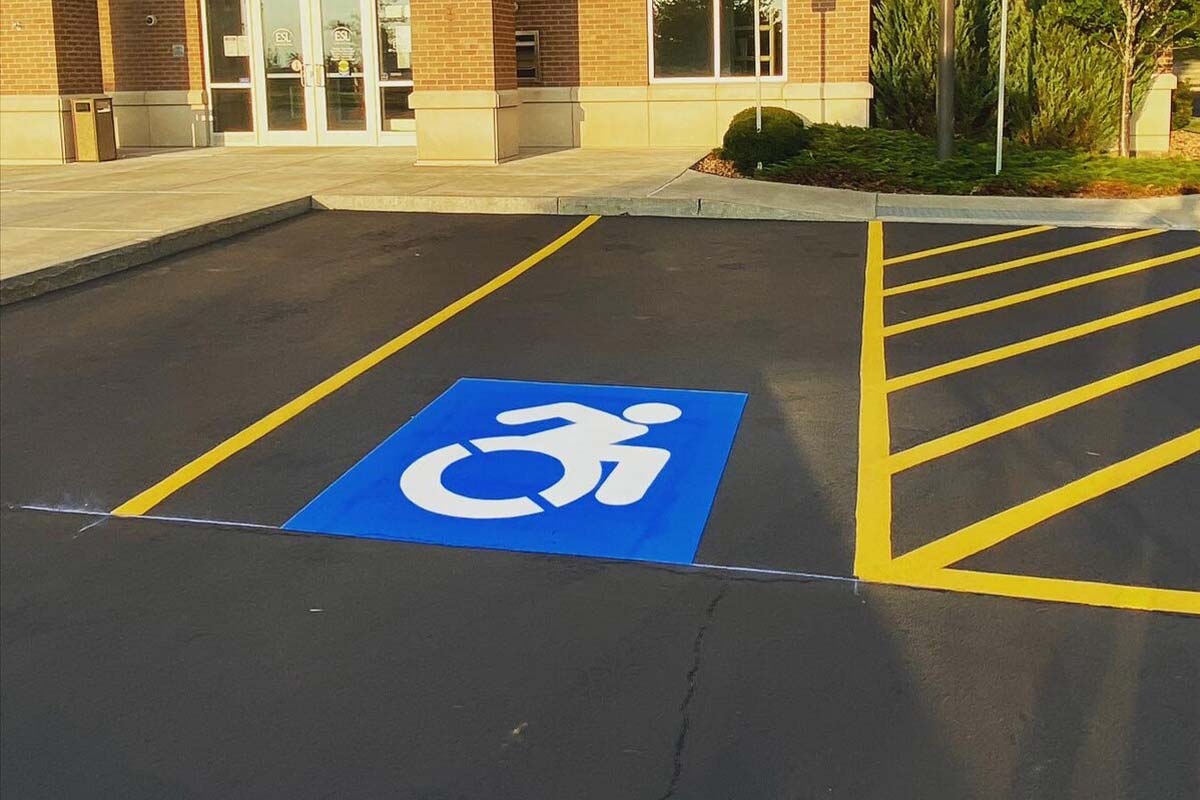
ADA Parking Lot Striping in Tulsa, OK
ADA parking lot striping in Tulsa, OK answers to two layers of requirement at once, and most property owners only know about one of them. The work covers the stalls themselves, the striped access aisles beside them, the International Symbol of Accessibility on the surface, and the signage identifying each space. Getting it right is partly a federal question and partly an Oklahoma one, and most property owners only know about the federal half.
The federal half is the 2010 ADA Standards for Accessible Design, which set how many accessible spaces a lot needs, how wide they and their aisles must be, and where they have to sit. The Oklahoma half is a state statute that specifies the sign, and another that makes blocking an access aisle unlawful even for permit holders. Both are covered below, because neither is something Tulsa striping contractors typically publish.
Oklahoma’s Accessible Parking Sign Requirement
Oklahoma does not leave accessible-parking signage to the ADA alone. Title 11, Section 36-101A of the Oklahoma Statutes sets a state requirement for the sign itself.
Since 1 January 2010, the posted signage for every parking space designated and posted as reserved for a physically disabled person must display sign R7-8 as provided in the latest edition of the Manual on Uniform Traffic Control Devices, which carries the words RESERVED PARKING and the blue and white international symbol of access. Van-accessible spaces must also display sign R7-8a immediately below the R7-8. The statute directed municipalities to adopt conforming ordinances by that same date, and it states expressly that it is an addition to any federal or state requirement rather than a replacement for one.
There is a grandfather provision, and it is narrow. Under subsection C, the blue and white symbol accompanied by wording such as “Handicapped Parking”, “Reserved for Handicapped” or “Permit Required-Towing Enforced” may be used in place of R7-8 only if the sign was erected before 1 January 2010. A sign put up after that date carrying the older wording does not qualify.
This is the single most useful compliance check a Tulsa property owner can run, because it is concrete: look at the signs. If they carry older wording and were installed within roughly the last fifteen years, they are worth reviewing.
It is also worth being precise about why the MUTCD is involved at all. The Manual on Uniform Traffic Control Devices is a roadway standard and does not by itself govern private parking lots — federal regulation expressly excludes parking areas and their driving aisles from the definition it applies to. What brings the R7-8 sign onto a private Oklahoma lot is the state statute referencing it directly.
Access Aisles, Van-Accessible Spaces and the ISA Symbol
The striped area next to an accessible stall is an access aisle, and it is not spare space. It is where a wheelchair lift deploys or a door opens fully, and under the 2010 Standards it must be at least 60 inches wide and marked so as to discourage parking in it.
Oklahoma adds real force here. Under Title 47, Section 11-1007 of the Oklahoma Statutes it is unlawful to park a vehicle, whether or not it displays a disabled placard or plate, in a disabled parking space access aisle, wheelchair ramp, or wheelchair loading or unloading area. A permit does not authorize blocking the aisle. The same section provides that vehicles parked in violation are subject to immediate tow at the request of the landowner or the landowner’s appointed agent, which gives property managers a direct remedy.
That is the strongest practical argument for keeping access aisle striping crisp: the aisle is separately protected in state law, and it cannot be enforced if it cannot be seen.
On dimensions, a car accessible space is at least 96 inches wide and a van accessible space at least 132 inches, or 96 inches where its access aisle is at least 96 inches. One point that surprises people: federal ADA does not mandate that access aisles be painted blue. Blue is convention, and a good one for visibility, but the standard requires marking that discourages parking; it does not specify a color.
How Many Accessible Spaces Your Lot Needs
The count is set federally by the total number of spaces in the lot, and it scales — a small lot needs at least one accessible space, and larger lots need proportionally more. Of whatever accessible spaces are required, at least one in every six must be van accessible. That ratio is federal, so a state or local code repeating it is restating the requirement rather than adding to it.
Placement is governed too. Accessible spaces must sit on the shortest accessible route to the accessible entrance, and under Section 502.7 spaces and aisles must be arranged so that a parked vehicle cannot obstruct the clear width of an adjacent accessible route. Signs identifying accessible spaces must be mounted at least 60 inches above the ground surface, measured to the bottom of the sign, so they remain visible when a vehicle is parked in the space.
We work the count and placement out from your actual stall total during the site visit, because the most common finding on an older Tulsa lot is accessible stalls that were simply painted at the end of a row.
The specifications above, in one place — federal on the left of the source column, Oklahoma on the right:
| Element | Specification | Source |
|---|---|---|
| Car accessible space | at least 96 inches wide | 2010 ADA Standards |
| Van accessible space | at least 132 inches wide — or 96 inches where its access aisle is at least 96 inches | 2010 ADA Standards |
| Access aisle | at least 60 inches wide, marked to discourage parking | 2010 ADA Standards |
| Van-accessible ratio | at least 1 in every 6 accessible spaces | 2010 ADA Standards |
| Space and aisle placement | on the shortest accessible route; a parked vehicle may not obstruct the clear width of an adjacent accessible route | 2010 ADA Standards § 502.7 |
| Sign mounting height | at least 60 inches above the ground surface, measured to the bottom of the sign | 2010 ADA Standards |
| Access aisle color | no color mandated — blue is convention; the standard requires marking that discourages parking | 2010 ADA Standards |
| Sign face | R7-8, plus R7-8a immediately below on van-accessible spaces | 11 O.S. § 36-101A |
| Parking in an access aisle | unlawful with or without a placard; immediate tow at the landowner’s request | 47 O.S. § 11-1007 |
For a full list of our pavement marking services, visit our parking lot striping in Tulsa page.
Businesses We Serve




How it Works

GET A FREE ESTIMATE
Contact us today and we’ll have a quote to you in 24 hours

SCHEDULE AN INSTALLATION
We’ll have your installation scheduled in less than 7 days, without affecting your business hours

GET A PARKING LOT THAT POPS
For a budget-friendly price, you’ll get a parking lot that looks like new!
We proudly work with:


We proudly work with:


Frequently Asked Questions About ADA Parking Lot Striping in Tulsa, OK
What are the requirements for ADA parking in Oklahoma?
ADA parking lot striping in Oklahoma answers to two layers of requirement. Federally, the 2010 ADA Standards for Accessible Design set the number of accessible spaces based on your lot’s total, require at least one in six of them to be van accessible, and specify stall and access aisle dimensions and placement. On top of that, Oklahoma Statutes Title 11, Section 36-101A requires that every reserved accessible space display sign R7-8, with sign R7-8a directly beneath it at van-accessible spaces. Oklahoma also makes blocking an access aisle unlawful even for placard holders.
How many accessible parking spaces does my lot need?
The number is set by the total number of spaces in the lot under the 2010 ADA Standards, and it scales with lot size — even a small lot needs at least one accessible space. Of the accessible spaces required, at least one in every six must be van accessible. That ratio is federal and applies in Tulsa exactly as anywhere else. We work the requirement out from your actual stall count during the free estimate. What is painted on the lot today may not meet it.
How wide does an accessible space and its access aisle have to be?
Under the 2010 ADA Standards, a car accessible space is at least 96 inches wide. A van accessible space is at least 132 inches wide, or 96 inches where its adjacent access aisle is also at least 96 inches. Access aisles are at least 60 inches wide and must be marked so as to discourage parking in them. The aisle is the working space for a lift or a fully opened door, which is why its width is specified separately from the stall.
Can someone with a disabled placard park in the striped access aisle?
No. Oklahoma Statutes Title 47, Section 11-1007 makes it unlawful to park in a disabled parking space access aisle, wheelchair ramp, or loading and unloading area whether or not the vehicle displays a disabled placard or plate. The placard does not authorize it. The same section provides that offending vehicles are subject to immediate tow at the request of the landowner or their appointed agent. Keeping the aisle clearly striped is what makes that enforceable.
Is our old “Handicapped Parking” sign still compliant?
It depends entirely on when it went up. Oklahoma Statutes Title 11, Section 36-101A permits the blue and white symbol with older wording such as “Handicapped Parking” or “Reserved for Handicapped” in place of the R7-8 sign only where the sign was erected before 1 January 2010. Signs installed after that date must carry R7-8, with R7-8a below it at van-accessible spaces. If your signs use older wording and are not clearly pre-2010, they are worth reviewing.
Do access aisles have to be painted blue?
Federal ADA does not require it. The 2010 Standards require that access aisles be marked so as to discourage parking in them, without specifying a color. Blue is the near-universal convention in the United States and it is a sensible choice because it reads immediately as accessible parking, but no federal rule mandates it. Diagonal hatching in a contrasting color is what actually does the work of signalling that the area is not a parking space.
How is a handicap parking space laid out and striped?
The stall is marked to its required width, the access aisle is striped alongside it with hatching that discourages parking, and the International Symbol of Accessibility is applied within the stall. The space must sit on the shortest accessible route to the accessible entrance, and be arranged so a parked vehicle cannot block the clear width of that route. Signage goes in last, mounted at least 60 inches above the ground to the bottom of the sign so it stays visible over a parked vehicle.