Bollard Installation
In Tulsa, OK
Safety and Security Bollards
1-800-STRIPER® provides professional bollard installation in Tulsa, OK — setting concrete-filled steel pipe bollards and decorative sleeves at storefronts, drive-throughs, utility cabinets, and loading docks, with impact-rated options specified to ASTM F3016 for low-speed vehicle protection.
1-800-STRIPER® of Tulsa PROVIDes Bollard Installation Services NEAR YOU
Want to prevent accidents and protect your property?
Bollards provide physical protection for your customers and your property.
Safety and security:
Bollards create a physical barrier between vehicles and pedestrians, protecting people in walking areas from accidental or intentional vehicle intrusions.
Bollards act as a protective barrier around storefronts, gas stations, and other vulnerable areas, minimizing the risk of costly damage from vehicle impacts.
Strategic Placement Locations:
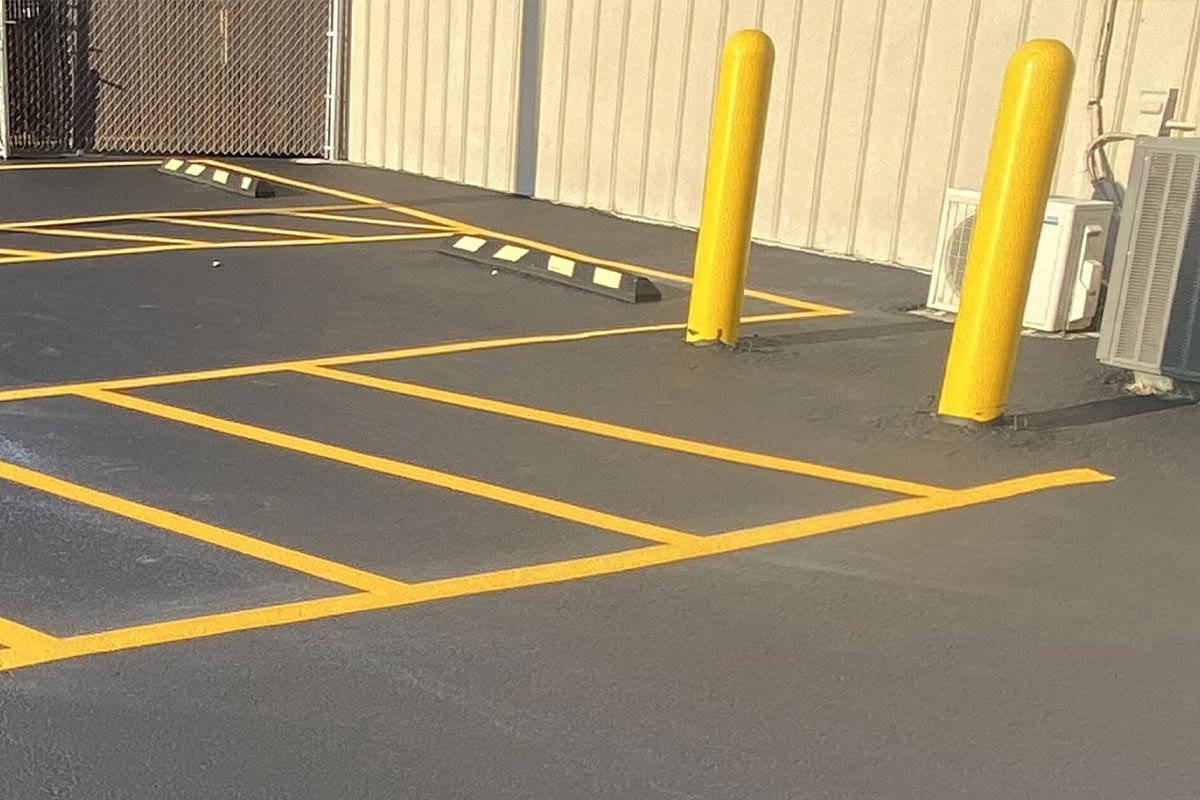
Bollard Installation in Tulsa, OK
Bollards are the vertical posts that stand between a vehicle and something that must not be hit. On a commercial property in Tulsa that usually means a storefront, an entrance, glass frontage, a drive-through lane, a fuel or utility installation, or a loading dock.
They are the answer to a specific risk: vehicle strike. Not a car creeping forward into a curb, which is what wheel stops handle, but a vehicle arriving with force — a driver hitting the accelerator instead of the brake in a parking stall facing a storefront, or a delivery vehicle misjudging a dock approach.
We install bollards as a standalone job or alongside other work on the same property. The interesting part of this service is that the Tulsa competitive field for it is fence and concrete contractors, none of whom cite a standard for what they are selling. Bollards have standards, and they are worth understanding before you buy.
Where Bollards Protect a Commercial Property
The most common placement by a distance is in front of storefront glass and building entrances, particularly where parking stalls face the building directly. A vehicle in a stall pointed at a storefront is separated from it by a few feet of curb, and that is the scenario bollards exist for.
After that: drive-through lanes, where they protect the order point and the building corner from repeated close maneuvering; loading docks and the dock equipment around them; fuel dispensers, gas meters, electrical cabinets, transformers and backflow preventers, which are expensive and dangerous to have struck; ATM and pickup points; pedestrian islands and walkways crossing vehicle areas; and outdoor seating areas, which have become a much more common request.
The right question at each location is what the consequence of a strike would be. That determines not just whether to install a bollard but which specification of bollard belongs there.
Impact-Rated vs. Visual-Barrier Bollards
This is the distinction that matters most and the one least often explained.
Visual-barrier bollards. These mark a boundary. They tell drivers where not to go, protect against slow contact, and do the job by being seen. Decorative sleeved bollards and lighter posts fall into this category. For most storefront and walkway applications this is genuinely what is needed.
Impact-rated to ASTM F3016 — low speed. The standard test method for surrogate testing of vehicle impact protective devices at low speeds. This is the parking-lot and pedestrian-area scenario, where a vehicle is traveling at the speeds actually possible on a commercial site. For a typical Tulsa retail or restaurant property, this is the relevant standard.
Crash-rated to ASTM F2656 — high speed. The standard test method for crash testing of vehicle security barriers, covering high-speed anti-ram applications for security-sensitive sites. Specifying this for an ordinary storefront is over-buying.
Construction, which matters as much as rating. A concrete-filled steel pipe bollard set into a footing behaves entirely differently from a post surface-mounted to existing pavement. Embedment depth and footing size are what actually resist a strike.
Installing a decorative sleeve where genuine impact protection is needed is under-buying, and the reverse is over-buying. We will tell you which category your situation calls for. Defaulting to the more expensive answer is not how we quote.
Bollard Placement and Accessible Routes
Bollards are permanent obstructions, and permanent obstructions have to respect accessible circulation.
Where bollards are installed along or across a pedestrian route, the route has to retain its required clear width — under the 2010 ADA Standards for Accessible Design, an accessible route requires a minimum clear width of 36 inches. Spacing bollards so that a wheelchair, a walker or a pushchair cannot pass between them defeats the accessible route as surely as parking a car across it.
This comes up most on entrance frontages, where a line of bollards protecting glass runs directly across the path people take to the door. The bollards and the route both have to work, and that is a layout question to answer before anything is set in concrete.
For a full list of our pavement marking services, visit our parking lot striping in Tulsa page.
Businesses We Serve




How it Works

GET A FREE ESTIMATE
Contact us today and we’ll have a quote to you in 24 hours

SCHEDULE AN INSTALLATION
We’ll have your installation scheduled in less than 7 days, without affecting your business hours

GET A PARKING LOT THAT POPS
For a budget-friendly price, you’ll get a parking lot that looks like new
We proudly work with:


We proudly work with:


Frequently Asked Questions About Bollard Installation in Tulsa, OK
Do you need a permit to install a bollard?
It depends on the location and the scope. Simple protective bollards on private commercial property frequently do not require one, but the answer changes with what you are attaching to, whether you are excavating, and whether the work touches fire access, utilities or the public right of way. Bollards protecting fire equipment or affecting a fire apparatus access route can also involve your fire authority. We raise the question at the estimate, because it is far cheaper to check first.
What type of contractor installs bollards?
Several trades do, which is why quotes vary so widely. Fence contractors, concrete contractors and general contractors all install them, and so do parking lot service companies like us. The advantage of using a company that works on parking lots is that bollard placement is a layout question as much as a construction one: it has to work with your stall arrangement, your traffic flow and your accessible routes, not just be set solidly in the ground.
What is the difference between an impact-rated and a decorative bollard?
A decorative or visual-barrier bollard marks a boundary and protects against slow contact — it works by being seen. An impact-rated bollard is engineered and tested to absorb a vehicle strike. ASTM F3016 is the test method for vehicle impact protective devices at low speeds, which covers the parking lot and pedestrian scenario. ASTM F2656 covers crash testing of vehicle security barriers for high-speed anti-ram applications. Most commercial storefronts need the low-speed category rather than the security barrier.
How deep does a bollard need to be set?
Deeper than most people expect, because it is the footing, not the post, that actually resists a strike. A concrete-filled steel pipe bollard set into a proper footing behaves entirely differently from one surface-mounted to existing pavement, and surface mounting is the most common shortcut in this trade. Required embedment depends on the pipe diameter, the protection level you need, and the surface you are setting into. We specify it per location; one depth everywhere is how bollards fail.
Can bollards block an accessible route?
They must not, and this is the most frequently missed requirement. Under the 2010 ADA Standards for Accessible Design an accessible route requires a minimum clear width of 36 inches, so bollards spaced too tightly across a pedestrian path defeat the route just as effectively as an obstruction parked on it. The conflict arises most often at entrance frontages, where a protective line of bollards crosses the path to the door. Spacing has to be planned before anything is set.
Should I use bollards or wheel stops?
It depends on the risk. Wheel stops are low blocks that stop a parked vehicle at a set depth — they position cars and prevent slow overrun into a curb, sidewalk or landscaping. Bollards are vertical posts designed to stop or absorb a vehicle strike and protect a building, entrance or equipment from impact. Creeping forward is a wheel stop problem. Arriving with force is a bollard problem. Many properties need both, in different places, and we install both.