Warehouse Line Painting
In Dayton, OH
OSHA-Compliant Safety Markings
1-800-STRIPER® provides professional warehouse line painting in Dayton, OH — marking permanent aisles, pedestrian walkways, forklift lanes, and hazard zones per OSHA 29 CFR 1910.176(a) using durable epoxy and traffic paint for industrial facilities throughout the Dayton logistics corridor.
1-800-STRIPER® of Dayton PROVIDes Warehouse Floor Markings Services NEAR YOU
Want your indoor space to operate more efficiently?
Warehouse and interior markings ensure clear traffic lanes, organized storage zones, and designated spaces designed to help your business operate safely and efficiently.
Benefits:
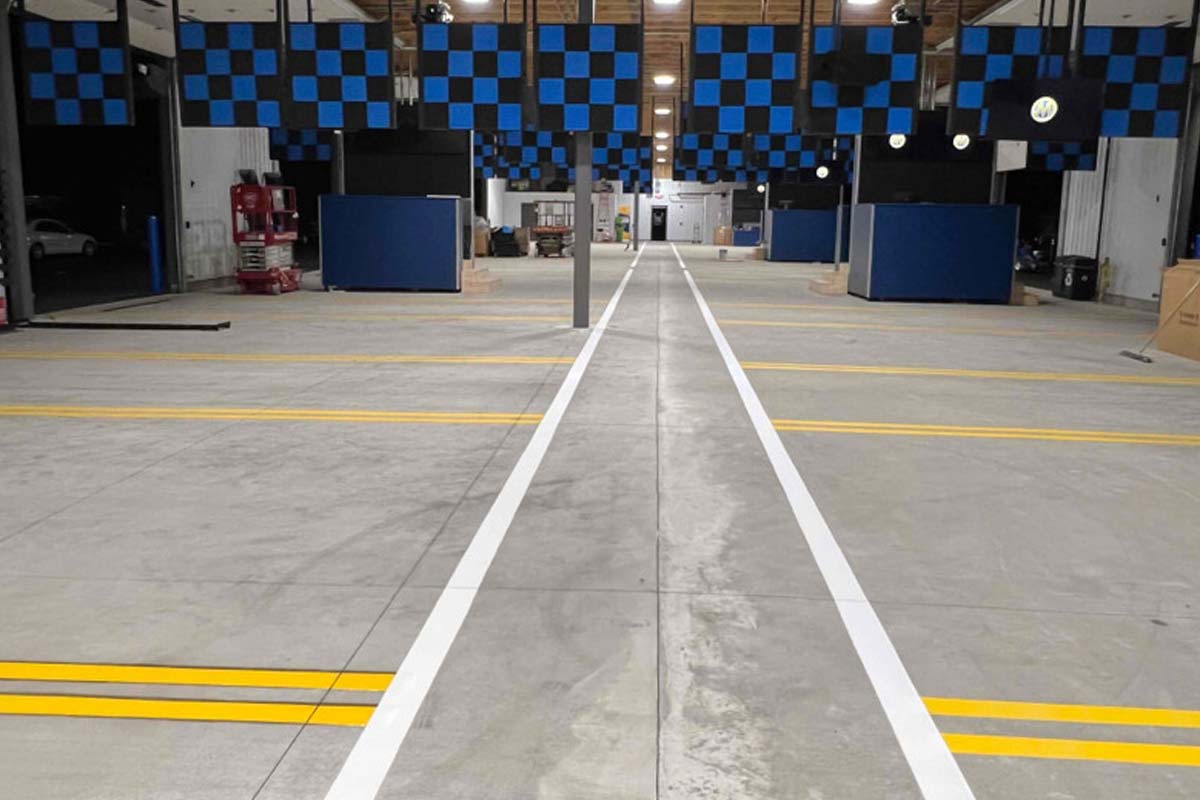
Warehouse Line Painting in Dayton, OH
The I-70 and I-75 interchange put a lot of warehouse square footage in this region, and the floor marking inside those buildings does more work than most people give it credit for. It separates people from powered equipment, it defines where inventory can and cannot sit, and it is usually the first thing an auditor looks at.
We paint aisles, walkways, forklift lanes, staging and laydown boundaries, hazard zones, dock approaches and equipment footprints inside distribution centers, manufacturing plants and industrial facilities across the Miami Valley. New layouts, re-marking on worn floors, and re-layouts when a facility reconfigures.
Most of this work happens around production. Facilities rarely stop, so we phase by zone and work the shifts that keep the floor moving.
What OSHA Actually Requires for Aisle Marking — and What It Doesn’t
This is the part that gets stated wrong more often than anything else on this page, including by companies selling the service.
The marking duty lives in 29 CFR 1910.176(a), which governs materials handling and storage. Its operative sentence is short:
> “Permanent aisles and passageways shall be appropriately marked.”
The same provision requires that where mechanical handling equipment is used, sufficient safe clearances be allowed for aisles, at loading docks, through doorways and wherever turns or passage must be made, and that aisles be kept clear and in good repair.
Now the part nobody publishes. No OSHA regulation specifies an aisle width, a line width, or a line color for warehouse floor marking. Section 1910.176 says “sufficient safe clearances” — a performance requirement, not a dimension. Search 1910.22, the general walking-working-surfaces section that gets cited constantly for aisle marking, and the word “aisle” does not appear in it at all.
So when a vendor tells you OSHA requires a four-inch yellow line and a six-foot aisle, they are quoting industry convention and calling it regulation. The convention is genuinely useful: it is legible, consistent and what your staff already expect — but you should know which is which, because “OSHA requires it” and “this is good practice” lead to different conversations with your safety committee.
Safety Color Meanings Under OSHA 1910.144
Where OSHA does address color, it addresses meaning rather than marking.
29 CFR 1910.144(a)(1) makes red the basic color for identifying fire protection equipment and apparatus, danger, and emergency stop devices. 1910.144(a)(3) makes yellow the basic color for designating caution and for marking physical hazards — the striking-against, stumbling, falling, tripping and caught-between class.
Read that carefully and the distinction matters: 1910.144 assigns meanings to colors. It does not mandate that you mark your aisles, and it does not tell you what color an aisle line has to be. Combined with 1910.176(a)’s requirement to mark permanent aisles without specifying how, you have real latitude — and a real obligation to be internally consistent, because a floor where yellow means three different things in three zones is worse than one with no color coding at all.
ANSI Z535.1, the Safety Colors standard, is the conventional reference facilities use to fill that gap. It is a voluntary consensus standard rather than a regulation, and it is worth naming as the convention it is.
5S and Lean Floor Marking Layouts
Most of the warehouse marking we do in the Dayton corridor is driven by a continuous-improvement program rather than by a compliance finding.
A 5S floor marking scheme puts a visible boundary around everything that has a home: pallet positions, staging areas, work-in-progress zones, finished goods, quarantine and hold areas, equipment parking, and the footprint of anything that gets moved and returned. The value is that a misplaced item becomes visually obvious rather than something a supervisor has to notice.
We work from your scheme, not ours. If your facility has a color standard, we mark to it. If you are building one, we will lay out what is workable to install and maintain on your floor surface, and flag where a scheme is going to be impossible to keep clean under forklift traffic.
Coating Options: Epoxy, Traffic Paint, and Tape
| Epoxy coating | Traffic paint | Floor marking tape | |
|---|---|---|---|
| Durability under forklift traffic | Highest | Moderate | Lowest in high-traffic lanes |
| Downtime to install | Longest — cure time before traffic | Short | Immediate |
| Best for | Main aisles, high-traffic lanes, permanent layouts | General marking, walkways, large areas | Temporary layouts, frequently changed zones, trial schemes |
| Changing the layout | Difficult — removal is a project | Overstriped or removed | Peeled up and repositioned |
| Surface requirements | Clean, sound, properly prepped concrete | Clean and dry | Clean, smooth, sealed |
The usual answer for a Dayton distribution facility is epoxy in the main forklift lanes and traffic paint everywhere else, with tape reserved for zones that genuinely change. Putting tape in a high-traffic lane is the most common mistake we get called to fix.
Our Warehouse Line Painting Process
- Walk the floor with your operations lead. Traffic patterns, pinch points, where pedestrians and equipment currently share space.
- Confirm the scheme. Your existing color standard, or a proposed one if you do not have one written down.
- Written scope covering linear footage, materials by zone, phasing, and the downtime each zone needs.
- Schedule by zone and shift so the facility keeps running. Nights, weekends and planned shutdowns are all normal for this work.
- Surface prep. Concrete needs cleaning and, for epoxy, mechanical preparation. Skipping this is why marking fails within months.
- Layout and apply. Snapped and measured before anything is painted.
- Cure and release zone by zone, then walk it with you.
For a full list of our pavement marking services, visit our parking lot striping in Dayton page.
Businesses We Serve




How it Works

GET A FREE ESTIMATE
Contact us today and we’ll have a quote to you in 24 hours

SCHEDULE A STRIPING
We’ll have your space restriped in less than 7 days, without affecting your business hours

GET A PARKING LOT THAT POPS
For a budget-friendly price, you’ll get a parking lot that looks like new
We proudly work with:


We proudly work with:

Frequently Asked Questions About Warehouse Line Painting in Dayton, OH
Does OSHA require aisle marking in a warehouse?
Yes, for permanent aisles, and that requirement is the baseline every warehouse line painting scope is built on. It sits in 29 CFR 1910.176(a), which governs materials handling and storage and states that permanent aisles and passageways shall be appropriately marked. It is worth knowing which provision that is — 1910.22, the general walking-working-surfaces section frequently cited for this, does not contain the word “aisle” anywhere in its text. We checked directly rather than repeating the common citation.
What width does OSHA require for a marked aisle?
It does not specify one. Section 1910.176(a) requires “sufficient safe clearances” for aisles where mechanical handling equipment is used, which is a performance requirement rather than a dimension, and no OSHA regulation sets a warehouse aisle width, line width or line color. The four-inch line and the standard aisle widths you have seen quoted are industry convention. Useful convention, worth following, but it is not what the regulation says.
What do red and yellow mean on a warehouse floor?
OSHA 29 CFR 1910.144 assigns the meanings. Red is the basic color for fire protection equipment and apparatus, danger, and emergency stop devices. Yellow designates caution and marks physical hazards — the striking-against, stumbling, falling, tripping and caught-between class. Note what that section does not do: it assigns meanings to colors without mandating that aisles be marked or specifying an aisle color. ANSI Z535.1 is the voluntary consensus standard facilities use to fill the gap.
Epoxy or traffic paint?
Epoxy where forklifts run constantly, traffic paint for general marking and walkways. Epoxy holds up far better under powered equipment but needs proper concrete preparation and a longer cure window before the zone reopens. Traffic paint installs faster and is easier to change. Most Dayton-area distribution facilities end up with a mix — epoxy in the main lanes, paint elsewhere, and tape only in zones that genuinely get reconfigured.
Can you work around our shifts?
Yes, and for an operating facility that is the only realistic approach. We phase the work zone by zone so production continues in the areas we are not in, and we schedule against nights, weekends or planned shutdown windows. Cure time is the real constraint rather than application time, particularly for epoxy, so the scope will tell you exactly how long each zone is out of service before we start.
How do you separate forklift lanes from pedestrian walkways?
With a marked, continuous walkway carrying its own boundary lines, kept off the equipment lane wherever the building allows it. Crossing points get marked deliberately rather than left implicit. Because OSHA specifies neither width nor color, the scheme is yours to set — what matters is that it stays consistent across the whole floor and that the walkway reads as visually distinct under working light.