Fire Lane Striping
In Dayton, OH
Code-Compliant Fire Lane Markings
1-800-STRIPER® provides professional fire lane striping in Dayton, OH — marking fire apparatus access roads, curbs, and no-parking zones to the NO PARKING-FIRE LANE wording the Ohio Fire Code (OAC 1301:7-7-05) specifies when a fire code official requires marking, for commercial properties across the Miami Valley.
1-800-STRIPER® of Dayton PROVIDes Fire Lane Striping Services NEAR YOU
Is your parking lot ready for first responders?
Our team is well-versed in local fire regulations and will parter with you to design a fire lane striping plan that creates unobstructed emergency access to protect your customers and property.
Core Services:
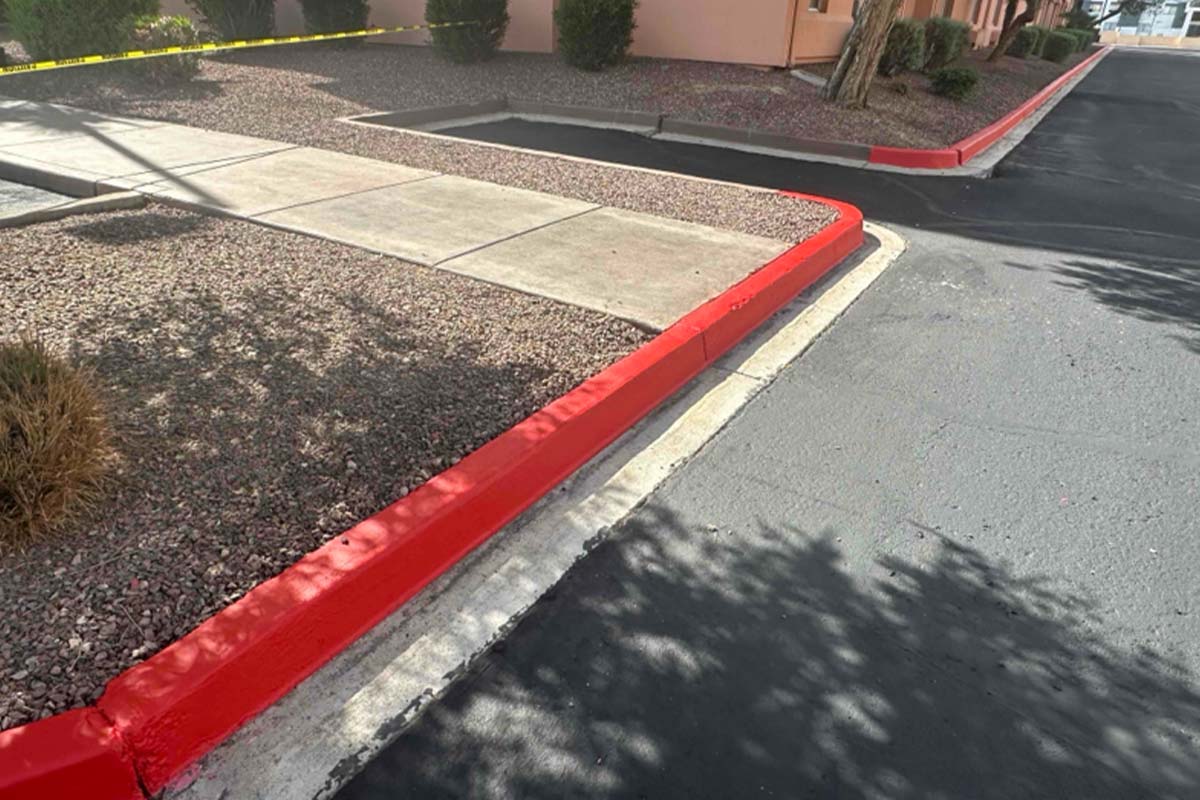
Fire Lane Striping in Dayton, OH
Fire lane marking is the one striping job on a commercial property where the standard is written down, enforceable, and checked by someone with authority to make you fix it.
We mark fire apparatus access roads, curb faces, and the no-parking zones that keep them clear, on commercial and industrial properties across Montgomery, Greene, Miami, Clark, Preble, Darke, Champaign and Madison counties. That covers new marking on properties that have never had it, re-marking on lots where the lettering has worn illegible, and layout corrections after a fire inspector has flagged something.
What we do not do is guess at your fire department’s preferences. Ohio is a home-rule state, the fire code official has explicit discretion under the code, and the practical requirements in Huber Heights are not automatically the requirements in Springfield or Eaton. Where the requirement is unclear, the right move is to ask the department that will inspect it — and we will tell you that rather than paint something and hope.
What Ohio’s Fire Code Requires for Fire Lane Marking
Ohio adopts the International Fire Code, 2021 edition as the Ohio Fire Code (OAC 1301:7-7-05), at OAC 1301:7-7. The marking provision is §503.3, and it reads:
> “Where required by the fire code official, approved signs or other approved notices or markings that include the words ‘NO PARKING-FIRE LANE’ shall be provided for fire apparatus access roads to identify such roads or prohibit the obstruction thereof. The means by which fire lanes are designated shall be maintained in a clean and legible condition at all times and be replaced or repaired when necessary to provide adequate visibility.”
Three things in that paragraph get misreported constantly.
The wording is specific. It is NO PARKING-FIRE LANE. Not FIRE LANE on its own, not NO PARKING on its own. Plenty of lots around the Miami Valley carry lettering that says something close but not that.
It is conditional, not automatic. The requirement attaches “where required by the fire code official.” Ohio does not declare that every commercial lot must have marked fire lanes; it says that where your fire code official requires the marking, this is what it has to say.
And the second sentence is a continuing duty. Marking a fire lane once does not discharge the obligation. The designation has to stay clean and legible at all times, and be replaced or repaired when it stops being visible. That converts faded fire lane paint from a cosmetic problem into a code condition.
One more thing worth stating plainly: NFPA 1 has no force in Ohio. The Ohio Fire Code incorporates the International Fire Code, not NFPA 1, and you will find pages from national striping companies citing NFPA requirements at Ohio property owners that simply do not apply here.
Who Approves Fire Lane Marking in the Miami Valley
The fire code official is a local role, and across our eight counties that means a lot of different offices — city fire departments in Dayton, Springfield, Kettering, Beavercreek, Huber Heights, Xenia, Troy, Piqua, Greenville and Eaton, plus township fire districts covering the rural stretches of Preble, Darke, Champaign and Madison counties. Each of them administers the same state code, and each of them has discretion the code explicitly grants.
There is also a plan-review step people miss. OAC 1301:7-7-05 §501.3 requires construction documents showing the location of fire lanes to be submitted to the fire department for review and approval prior to construction. If you are building or substantially reworking a lot, the fire lane layout is supposed to be approved before it is installed, not discovered afterward.
We work to whatever your AHJ has approved. If you do not have anything in writing, that is the first call to make.
Fire Apparatus Access Road vs. Fire Lane — Ohio Treats Them as the Same Thing
A question that comes up on nearly every commercial site: my lot is private property, so how does the fire code reach it at all?
Through a definition. OAC 1301:7-7-02, the Ohio Fire Code’s Chapter 2, defines the term this way:
> “Fire apparatus access road.” Same as “Fire lane.”
The two terms are equivalent in Ohio. So every requirement §503 writes about fire apparatus access roads applies to fire lanes, including the ones on a privately owned parking lot. That single definitional line is the hinge the whole chapter turns on for private property, and almost nobody publishes it.
Section 503.1.1 adds a scope limit worth knowing: approved fire apparatus access roads are required for facilities and buildings “hereafter constructed or moved into or within the jurisdiction which are not readily accessible from a public and/or private street.” The phrase “hereafter constructed” matters — the new-construction trigger is not the same as a blanket retrofit mandate on every existing building in the Miami Valley.
Our Fire Lane Striping Process
- Find out what your AHJ has approved. Existing approved plans, a prior inspection notice, or a direct call to the department that covers your address.
- Walk the property. Access road routing, turning radii, hydrant and FDC locations, curb condition, and what is already marked.
- Written scope. Linear footage of curb and pavement marking, lettering placement and spacing, sign locations if signage is part of it, and the schedule.
- Surface prep. Clean and dry before anything gets painted. Curb faces in particular hold grime and will shed paint within a season if they are not prepped.
- Mark and letter. Curb and pavement marking, then NO PARKING-FIRE LANE lettering at the spacing your department expects.
- Cure and reopen. We keep the lane closed until it can take traffic.
- Walkthrough. Documented so you have something to show at the next inspection.
Fire Lane Striping for Dayton Property Types
Apartment and multi-family communities, where fire lanes run through resident parking and get blocked constantly. Retail centers and strip plazas with loading zones that overlap the access road. Warehouses and distribution facilities along the I-70 and I-75 corridors, where truck movement and fire access compete for the same pavement. Schools, where the drop-off queue is the thing most likely to obstruct the lane. Medical and senior-living campuses. Churches with large occasional-use lots. Hotels with porte-cocheres and constrained approach lanes.
The common failure is the same across all of them: the marking was correct when it went in, and nobody looked at it again until an inspector did.
For a full list of our pavement marking services, visit our parking lot striping in Dayton page.
Businesses We Serve




How it Works

GET A FREE ESTIMATE
Contact us today and we’ll have a quote to you in 24 hours

SCHEDULE AN INSTALLATION
We’ll have your installation scheduled in less than 7 days, without affecting your business hours

GET A PARKING LOT THAT POPS
For a budget-friendly price, you’ll get a parking lot that looks like new
We proudly work with:


We proudly work with:


Frequently Asked Questions About Fire Lane Striping in Dayton, OH
What wording does Ohio require on a fire lane?
NO PARKING-FIRE LANE. That exact phrase is written into OAC 1301:7-7-05 §503.3, which requires approved signs, notices or markings including those words where the fire code official requires them. It is not FIRE LANE alone and not NO PARKING alone, and lots marked with either of those shorter phrases are a common finding. If your lettering does not carry the full phrase, that is worth correcting the next time the lane is re-marked.
Who decides where fire lanes go on my property?
Your fire code official — the fire department with jurisdiction over your address. Fire lane striping follows their determination, not the other way around. Ohio grants that role explicit discretion, and because Ohio is a home-rule state the practical requirements can differ between neighboring communities. There is also a plan-review path: §501.3 requires construction documents showing fire lane locations to be submitted to the fire department for approval prior to construction. If your lot has approved plans, that document governs.
How wide does a fire apparatus access road have to be?
Ohio adopts the International Fire Code’s dimensional requirements for access roads without modification, which set a minimum unobstructed width of twenty feet and a minimum vertical clearance of thirteen feet six inches. Treat those as the baseline rather than the final answer: your fire code official can require more, and local amendments exist. Worth knowing — the twenty-six-foot figure that circulates online comes from IFC Appendix D, and Ohio does not adopt the appendices.
Do faded fire lane markings actually violate code?
Yes, and this is the part most property owners are surprised by. Section 503.3 does not stop at requiring the marking to be installed. It requires that the means by which fire lanes are designated “shall be maintained in a clean and legible condition at all times and be replaced or repaired when necessary to provide adequate visibility.” Illegible lettering is a code condition in Ohio, not a housekeeping preference, and it is a continuing obligation.
Does my private parking lot even have fire lanes?
It can. The Ohio Fire Code reaches private property through a definition rather than a separate rule: Chapter 2 of the code, at OAC 1301:7-7-02, states that “Fire apparatus access road” means the same as “Fire lane.” So the §503 requirements written for fire apparatus access roads apply to fire lanes on privately owned lots. Whether your specific property has a designated lane is a question for your fire code official.
What color does a fire lane have to be in Ohio?
The Ohio Fire Code does not specify one. Section 503.3 addresses wording, approval and legibility, and says nothing about color. Red curbing is widespread convention and many fire departments do expect it, but that is an authority-having-jurisdiction preference rather than a requirement written into the state code. Ask your fire department what they want to see, and be skeptical of anyone claiming Ohio law mandates a color.