Parking Lot Restriping
In Dayton, OH
Restripe Existing Lines and Markings
1-800-STRIPER® provides professional parking lot restriping in Dayton, OH — refreshing faded stalls, ADA spaces, fire lanes, and directional arrows with fast-dry waterborne traffic paint for commercial properties across Montgomery, Greene, and Miami counties.
1-800-STRIPER of Dayton PROVIDes Restriping Services NEAR YOU
Need to brighten up your faded parking lot?
Keep your parking lot safe and attractive by restriping annually to freshen up lines and symbols that have faded from the sun, weather, and traffic. Nothing beats a fresh coat of paint!
Benefits:
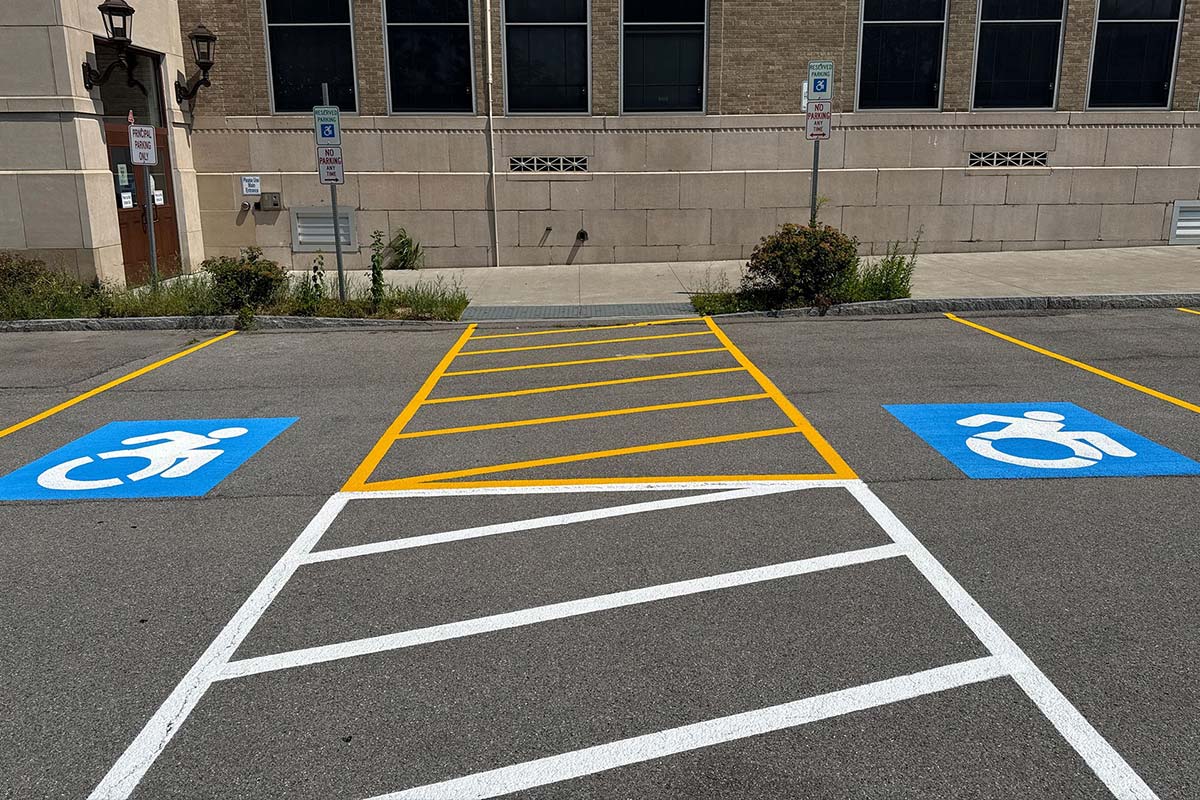
Parking Lot Restriping in Dayton, OH
Restriping is the most common striping call we get, and the reason is the weather.
Markings on a Miami Valley lot take a beating that markings in a mild climate never see. Water works into the pavement surface, freezes, expands, and thaws again — repeatedly, over a single winter. Road salt and brine get tracked in on every tire. And plow blades pass directly over the paint, lifting it off in strips wherever the surface is not perfectly flat.
The result is that a lot striped three or four years ago in Dayton often reads worse than a lot striped six years ago somewhere warmer. We restripe commercial, retail, industrial, medical, institutional and multi-family properties across the region — refreshing what is there, or correcting a layout that never worked properly to begin with.
When Dayton Lots Need Restriping
There is no calendar answer, and anyone giving you a fixed interval is guessing at your property. Condition is what drives it.
The practical tests: can a driver identify the stall boundaries at dusk in the rain? Is the ISA symbol on your accessible spaces still legible, or has it worn to an outline? Are the directional arrows in the drive lanes still readable to someone who has never been on the property? Has the fire lane lettering faded to the point where you would not want an inspector reading it?
There are also trigger events that have nothing to do with wear. Sealcoating covers everything and requires a full re-layout afterward. A tenant change often means a new stall allocation. An ADA complaint or a fire inspection notice comes with its own deadline. And a lot that has been resurfaced is a blank sheet — the layout has to go back down before the property reopens.
Waterborne vs. Thermoplastic Durability in Ohio Weather
The two materials solve different problems, and the right answer depends on the surface, the traffic and the timeline.
| Waterborne traffic paint | Thermoplastic | |
|---|---|---|
| Typical use | Standard parking stalls, ADA markings, arrows, curbs | High-wear lanes, entrances, long-interval installations |
| Application | Sprayed; no heating equipment required | Applied hot, requires specialized equipment |
| Return to service | Fast — usually the same visit | Longer, and more weather-dependent |
| Durability | Shorter service life under plow and salt exposure | Substantially longer under the same exposure |
| Repairability | Easy to touch up or overstripe | Harder to patch; usually replaced in sections |
| Weather window | Wide, but needs dry surface and moderate temperature | Narrower |
For most Miami Valley commercial lots, waterborne paint is the working answer: it goes down fast, it returns the lot to service quickly, and because plow damage is the dominant failure mode here, a longer-lasting material does not always survive proportionally longer. Where thermoplastic earns its place is on high-traffic entrance lanes and crosswalks that see wear rather than blade contact. We will tell you which one your lot actually needs.
What Gets Restriped
Standard parking stalls and end-of-row markings. Accessible spaces, access aisles and ISA symbols. Van-accessible designations. Fire lanes and no-parking zones. Directional arrows and lane lines. Crosswalks and pedestrian paths. Loading zones and dock approach markings. Reserved and visitor stalls. Curb painting. Wheel stop marking. Speed bump and hump marking.
If the layout is changing rather than being refreshed, old lines get removed or blacked out first. A lot with two contradictory sets of markings is worse than a lot with faded ones — drivers follow whichever they see first.
Fire Lane Markings Must Stay Legible — It’s in the Ohio Fire Code
Most of a restriping scope is a maintenance decision you get to make on your own timetable. One part of it is not.
Ohio adopts the International Fire Code as the Ohio Fire Code (OAC 1301:7-7-05), and §503.3 requires that “the means by which fire lanes are designated shall be maintained in a clean and legible condition at all times and be replaced or repaired when necessary to provide adequate visibility.”
Read that carefully. It is a continuing obligation, not a one-time install requirement. Faded fire lane marking on an Ohio property is a code condition with an explicit remedy written alongside it — replaced or repaired. If your fire lane lettering has worn down, restriping it is not a discretionary improvement.
That is also the single strongest reason to schedule restriping before an inspection rather than after one.
Why MUTCD Doesn’t Govern Your Stalls and Drive Aisles
Ask around about parking lot markings and someone will eventually cite the MUTCD — the Manual on Uniform Traffic Control Devices — as though it sets the standard for your stalls and arrows.
It does not, and the exclusion is explicit. 23 CFR 655.603(a) defines the scope of the national standard and states that “parking areas, driving aisles within parking areas, and private highway-rail grade crossings are also not included in this definition.” Worth reading the whole subsection rather than that one line: it also brings privately owned roads through shopping centers and similar facilities inside the definition where the public drives them without restriction. The carve-out is for the parking area itself.
That matters in two directions. It means nobody can cite the MUTCD at you as binding law for your parking stalls and drive aisles. It also means the manual is still worth following as convention, because drivers arriving at your property have been trained by public roadways — arrow shapes, stop bar placement and crosswalk patterns that match what people already expect will be understood faster than anything invented. We mark to those conventions deliberately, and we are clear that they are conventions.
For a full list of our pavement marking services, visit our parking lot striping in Dayton page.
Businesses We Serve




How it Works

GET A FREE ESTIMATE
Contact us today and we’ll have a quote to you in 24 hours

SCHEDULE AN INSTALLATION
We’ll have your installation scheduled in less than 7 days, without affecting your business hours

GET A PARKING LOT THAT POPS
For a budget-friendly price, you’ll get a parking lot that looks like new
We proudly work with:


We proudly work with:

Frequently Asked Questions About Parking Lot Restriping in Dayton, OH
How often should I restripe my parking lot in Ohio?
Condition drives it rather than the calendar. Ohio’s repeated freeze-thaw cycling, deicing chemicals and plow blade contact wear markings faster here than the same paint would wear in a mild climate. Practical tests: whether stall boundaries read at dusk in the rain, whether the ISA symbol on accessible spaces is still legible, and whether fire lane lettering is still clean and legible — that last one is a code requirement in Ohio, not a preference.
What makes parking lot lines fade faster here?
Three things, and they compound. Freeze-thaw cycling works water into the pavement surface repeatedly through a single Ohio winter. Road salt and brine get tracked across every square foot of the lot by every vehicle that enters. And snow plow blades pass directly over the markings, lifting paint off wherever the surface is not perfectly level. Lots with heavy winter plowing lose their lines in strips rather than fading evenly.
Waterborne paint or thermoplastic?
For most commercial lots in the Miami Valley, waterborne traffic paint. It returns the property to service quickly, it is easy to touch up, and because plow damage is the dominant failure mode here a longer-lasting material does not always survive proportionally longer. Thermoplastic earns its place on high-wear entrance lanes and crosswalks where the failure mode is traffic abrasion rather than blade contact. We recommend per lot, not per catalog.
How long before we can drive on fresh lines?
Long enough for the paint to cure undisturbed, which depends on temperature, humidity and how heavily the material was applied. Fast-dry waterborne paint is usually ready within the same visit, which is why we use it on lots that cannot afford a long closure. We phase larger properties so sections reopen while we work elsewhere, and we give you a specific window in the written scope rather than a generic figure.
Can you restripe in winter?
Sometimes, and it depends on the day rather than the month. Paint needs a dry surface and a workable temperature to bond properly, and applying it outside that window produces markings that fail early — which is most of what we get called to fix. Ohio winters do produce usable windows, and we take them when they appear. If conditions will not support a durable result we will tell you to wait rather than take the job.
Do I have to keep the existing layout?
No, and restriping is the natural moment to change it. If the current layout wastes space, has awkward aisles, or is short on accessible stalls, a new layout costs little more than refreshing the old one. Where the layout changes, existing markings are removed or covered first, so drivers are not choosing between two sets of lines. We will tell you if the change affects your accessible count.