
Warehouse Line Painting
In Raleigh, NC
OSHA-Compliant Safety Markings
1-800-STRIPER provides professional warehouse line painting in Raleigh, NC — marking permanent aisles and passageways per OSHA 29 CFR 1910.176(a), plus pedestrian walkways, staging bays, safety zones, and removal of obsolete lines for distribution and manufacturing facilities across Wake, Johnston, and Harnett counties.
1-800-STRIPER of Raleigh PROVIDes Warehouse Floor Markings Services NEAR YOU
Want your indoor space to operate more efficiently?
Warehouse and interior markings ensure clear traffic lanes, organized storage zones, and designated spaces designed to help your business operate safely and efficiently.
Benefits:
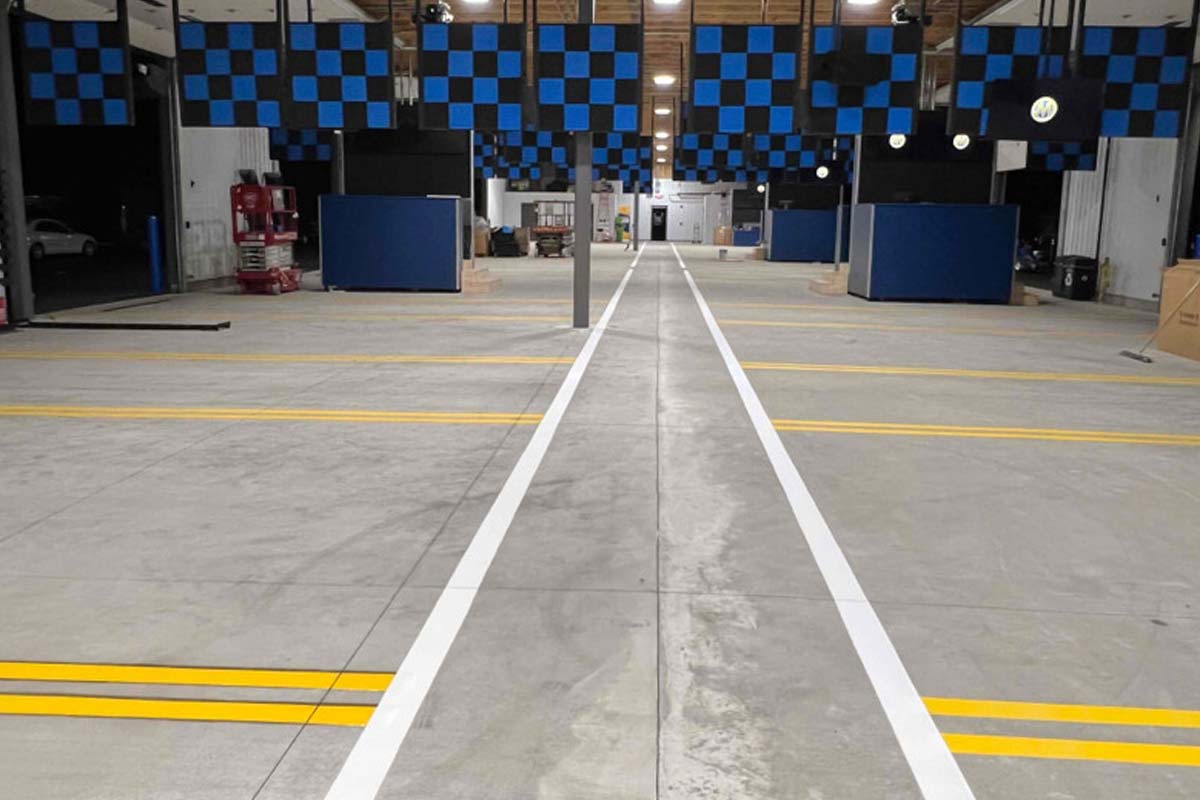
Warehouse Line Painting in Raleigh, NC
Inside a working building the floor is a traffic control system — aisles, walkways, staging areas, exclusion zones, and dock approaches all do their work through paint. We mark and re-mark warehouse and manufacturing floors across Wake, Johnston, and Harnett counties, on sealed and unsealed concrete, and take obsolete lines back off when a layout changes.
What OSHA Actually Requires for Aisle Marking, and What It Doesn’t
This is worth stating plainly, because almost everything published on it is wrong.
The federal requirement for aisle marking is 29 CFR 1910.176(a), a provision headed *”Use of mechanical equipment.”* Where mechanical handling equipment is used, the operative sentence is short: *”Permanent aisles and passageways shall be appropriately marked.”* That is the mandate. The same provision requires *”sufficient safe clearances”* for equipment and passage — and it gives no number for that either.
So: 1910.176(a) specifies no line color, no line width, and no aisle width. The familiar figures — lines of two to six inches, aisles three feet wider than the largest piece of equipment, a four-foot minimum — do not come from it. They come from an OSHA Standard Interpretation letter dated 15 May 1972, which OSHA has since archived with the notice that it *”may no longer represent OSHA Policy,”* and which was written about the old `1910.22(b)(2)` — the aisle-marking provision the 2016 Walking-Working Surfaces rule removed. Today’s `1910.22(b)` sets floor-load duties and says nothing about marking; the marking duty now sits in 1910.176(a).
| 1910.176(a) requires | 1910.176(a) does not specify |
|---|---|
| Permanent aisles and passageways to be “appropriately marked” | Any line color |
| “Sufficient safe clearances” for equipment and passage | Any line width |
| Aisles kept clear, in good repair, unobstructed | Any aisle width |
None of that makes those figures bad practice. Plenty of facilities use them and they work. It does mean that anyone presenting them to you as legal requirements is repeating something they have not checked.
Where color does appear in the regulations is 29 CFR 1910.144, which sets red and yellow as basic identification colors for specific physical hazards. It does not mention aisles at all.
Aisles, Walkways, and Staging Areas
What we mark: permanent aisles and passageways, pedestrian walkways separated from forklift routes, staging and queue areas, dock approaches, exclusion zones around fixed equipment and electrical panels, and the boundaries telling a driver where a racking run begins. The design question is not the paint — it is whether a pedestrian can reach their workstation without crossing a forklift aisle, and where that crossing goes if they cannot.
Line Removal and Re-Marking
Layouts change — racking moves, a line is added, a dock is repurposed — and last year’s markings become this year’s confusion. A floor carrying two generations of markings is more dangerous than one carrying none, because the eye follows whichever line it catches. When we re-mark a changed layout, taking the superseded lines off is part of the scope, not an extra.
Choosing a Coating for Sealed Concrete
Warehouse floors are not parking lots, and the surface decides the material: a sealed or densified slab behaves differently from bare concrete, and both differ from asphalt. Adhesion is the whole question — a coating that will not key into a sealed surface fails at the edges and lifts in sheets under forklift traffic, which is worse than not marking at all. What matters at the estimate is what your slab is, what has been applied to it before, and what traffic it carries.
Working Around an Operating Facility
Most facilities cannot stop, so the work fits around them: zone by zone, on shift changes, weekends, or overnight. Cure time is the constraint that matters, because a section of floor out of service is a section your operation routes around. We sequence so the zones that go first are the ones you can most easily do without, and we agree that sequence with your operations lead rather than with whoever booked the job.
For a full list of our pavement marking services, visit our parking lot striping in Raleigh page.
Businesses We Serve




How it Works

GET A FREE ESTIMATE
Contact us today and we’ll have a quote to you in 24 hours

SCHEDULE A STRIPING
We’ll have your space restriped in less than 7 days, without affecting your business hours

GET A PARKING LOT THAT POPS
For a budget-friendly price, you’ll get a parking lot that looks like new
We proudly work with:


We proudly work with:


Frequently Asked Questions About Warehouse Line Painting in Raleigh, NC
What does OSHA actually require for aisle marking?
One sentence, in 29 CFR 1910.176(a), under the heading *”Use of mechanical equipment”*: *”Permanent aisles and passageways shall be appropriately marked.”* The same provision requires sufficient safe clearances but attaches no figure. 1910.176(a) specifies no line color, no line width, and no aisle width. If a contractor quotes a legal minimum for any of the three, ask which section it is in — the circulating numbers come from a 1972 interpretation letter OSHA has archived, keyed to the old 1910.22(b)(2), a provision removed in 2016.
What color should our aisle lines be?
No color is mandated for aisle lines, so it is a design decision rather than a compliance one. Consistency across the site matters far more than the specific choice — a facility where one color means one thing everywhere is safer than one that followed a chart in one bay and improvised in the next. The federal regulation on color, 29 CFR 1910.144, covers particular physical hazards and does not mention aisles.
Can you remove our old lines?
Yes, and on a changed layout it is part of the scope rather than an add-on. A floor carrying two generations of markings is more hazardous than an unmarked one, because attention follows whichever line it catches first. When we re-mark a revised layout we plan removal of the superseded lines into the same visit.
Our floor is sealed concrete. Will the paint hold?
That depends on the sealer and on what has been applied over it, which is why we want to see the slab rather than answer in advance. Adhesion is the whole question on a sealed floor: a coating that cannot key into the surface fails at the line edges and lifts under forklift traffic. Tell us what the floor is, what has been on it, and what drives across it.
Can you work without shutting the building down?
Yes — almost all of this work happens around a running operation: zone by zone, on shift changes, overnight, or at weekends. The binding constraint is cure time rather than painting time, because a curing zone is a zone your operation has to route around. We set the sequence with your operations lead so the areas that go out of service first are the ones you can most easily spare.