Fire Lane Striping
In Raleigh, NC
Code-Compliant Fire Lane Markings
1-800-STRIPER provides professional fire lane striping in Raleigh, NC — painting fire lane curbs, no-parking legends, and fire apparatus access road markings in the manner your fire code official approves under the North Carolina Fire Code for commercial properties across Wake, Johnston, and Harnett counties.
1-800-STRIPER of Raleigh PROVIDes Fire Lane Striping Services NEAR YOU
Is your parking lot ready for first responders?
Our team is well-versed in local fire regulations and will parter with you to design a fire lane striping plan that creates unobstructed emergency access to protect your customers and property.
Core Services:
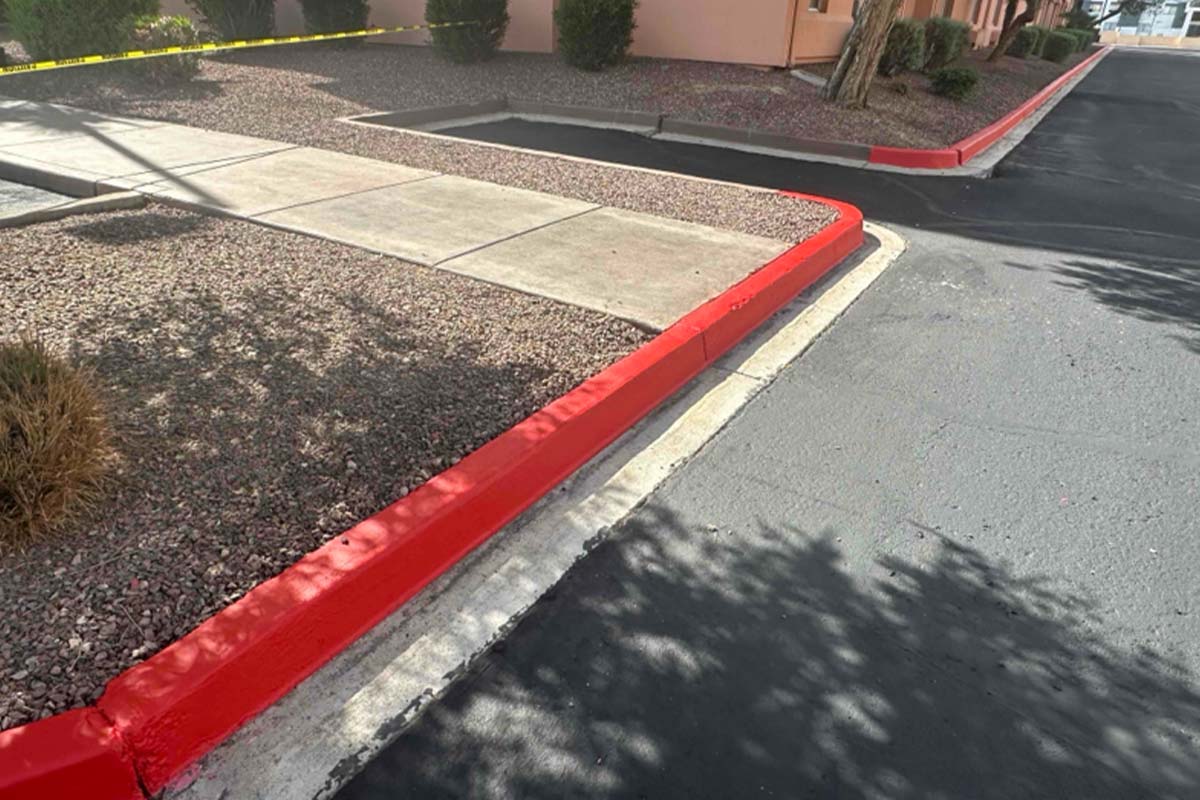
Fire Lane Striping in Raleigh, NC
Fire lane marking is the one striping job where the person who decides what “correct” means is not you and is not us. It is the fire code official with jurisdiction over your property, and everything else follows from that.
We paint fire lane curbs, no-parking legends, and access road markings across Wake, Johnston, and Harnett counties, to whatever designation your local official has approved for the site.
Who Decides Where a Fire Lane Goes
Not the striping contractor. North Carolina Fire Code § 503.3 puts it in the code’s own words: markings are provided *”where required by the fire code official.”* That phrase is the whole governance model — the designation, the extent, and the method are an approval, not a specification you can look up and apply.
In practice that means the authority having jurisdiction for your property — the city’s fire prevention office inside Raleigh limits, or the county fire marshal in unincorporated Wake, Johnston, or Harnett. Re-marking an existing lane to the same layout usually just reinstates an approved designation. Creating one, or moving where it runs, is a conversation to have with your official before anyone paints.
What § 503.3 of the North Carolina Fire Code Requires
Less than the industry claims, and it is worth being precise about.
North Carolina adopts the International Codes, and the operative provision is North Carolina Fire Code § 503.3 (Marking). It requires approved signs, notices, or markings *”that include the words NO PARKING—FIRE LANE”* for fire apparatus access roads, and requires that the means of designation be *”maintained in a clean and legible condition at all times.”*
That is a requirement about words and about legibility. Section 503.3 specifies no color and no dimension. Chapter 5 of the code contains no red-letter requirement, no white-reflective requirement, no stripe width, and no lettering interval.
Six-inch lines and lettering every twenty-five feet appear nowhere in the adopted code — those come from individual AHJ handouts. Red on white is a different case, and worth knowing about: Appendix D, § D103.6 specifies fire lane *signs* with a minimum dimension of 12 inches wide by 18 inches high and red letters on a white reflective background. An appendix is not enforceable unless the local governing authority has specifically adopted it, so whether D103.6 binds your property is itself a question for your fire code official. Which is the same answer § 503.3 already gives you: words, legibility, and whatever your official has approved — asked of them, rather than read off a competitor’s website.
⛔ NFPA 1 does not govern in North Carolina. It is a model code with no legal force here, and any page citing it as the source of your fire lane obligations is citing the wrong instrument.
Fire Apparatus Access Road Dimensions
Where the code does give numbers, it gives them for the road rather than for the paint. § 503.2.1 sets fire apparatus access roads at an unobstructed width of *”not less than 20 feet”* and an unobstructed vertical clearance of *”not less than 13 feet 6 inches.”*
Those are the dimensions the marking exists to protect. A fire lane that is striped correctly but routinely blocked by a delivery vehicle or a dumpster has failed at the thing the code actually cares about, which is the clear width being there when it is needed.
Curb Paint, Pavement Legends, and Signage
Three elements usually make up a fire lane designation, and we can apply all three:
- Painted curbs — the continuous visual boundary of the lane.
- Pavement or curb-face legends — the `NO PARKING—FIRE LANE` wording § 503.3 requires.
- Posted signs — mounted designation, where your official calls for it.
Which combination applies to your property is part of what the fire code official approves.
Curb paint degrades fastest. It takes weather, wheel contact, and the mechanical wear of anything scraping alongside it, and more often than not it is why a lane stops reading as a lane.
People miss the maintenance duty. § 503.3’s requirement that the designation stay *”clean and legible at all times”* is a continuing obligation, not a one-off installation standard.
For a full list of our pavement marking services, visit our parking lot striping in Raleigh page.
Businesses We Serve




How it Works

GET A FREE ESTIMATE
Contact us today and we’ll have a quote to you in 24 hours

SCHEDULE AN INSTALLATION
We’ll have your installation scheduled in less than 7 days, without affecting your business hours

GET A PARKING LOT THAT POPS
For a budget-friendly price, you’ll get a parking lot that looks like new
We proudly work with:


We proudly work with:


Frequently Asked Questions About Fire Lane Striping in Raleigh, NC
Who decides where our fire lane goes and what it looks like?
The fire code official with jurisdiction over the property — for sites inside Raleigh city limits that is the city’s fire prevention office, and in unincorporated Wake, Johnston, or Harnett County it is the county fire marshal. North Carolina Fire Code § 503.3 makes marking a matter of what that official requires and approves. If you are reinstating an existing approved layout we can generally proceed; if you are creating or moving a lane, talk to them first.
What does the North Carolina Fire Code actually require for fire lane markings?
Two things. Signs, notices, or markings *”that include the words NO PARKING—FIRE LANE”* for fire apparatus access roads, and that the designation be *”maintained in a clean and legible condition at all times.”* It is a requirement about words and legibility. Section 503.3 specifies no color and no line dimension.
Isn’t there a rule about six-inch red lines and lettering every twenty-five feet?
Six-inch lines and the twenty-five-foot interval are not in the adopted code — those circulate from individual AHJ handouts, which is why they vary between jurisdictions. Red on white is in the code, but it applies to *signs*: Appendix D § D103.6 specifies 12 inches by 18 inches with red letters on a white reflective background. Appendices bind only where the local governing authority has adopted them, so that one is a question for your official too. If your official specifies a dimension, that is the dimension we use.
Does NFPA 1 apply to our property?
No. North Carolina adopts the International Codes, and the state fire code is built on that family. NFPA 1 is a model code with no legal force in North Carolina. It gets cited constantly on striping websites, including by national operators, and it is the wrong instrument for a property in this state.
How wide does the fire lane itself have to be?
The code gives dimensions for the access road rather than for the paint: § 503.2.1 requires an unobstructed width of not less than 20 feet and unobstructed vertical clearance of not less than 13 feet 6 inches. The marking exists to protect that clear width, which is why a correctly striped lane that is habitually blocked has failed at the thing the code is actually protecting.
How often do fire lane markings need repainting?
There is no interval in the code — there is a standard. § 503.3 requires the designation to be maintained *”in a clean and legible condition at all times,”* which makes it a condition test rather than a calendar. Curb paint degrades fastest because it takes weather and wheel contact, so it usually sets the pace. If the lane no longer reads clearly from a driver’s seat, it is due.