ADA Parking Lot Striping
In Raleigh, NC
ADA-Compliant Accessible Parking
1-800-STRIPER provides ADA parking lot striping in Raleigh, NC — laying out accessible stalls, van-accessible spaces, access aisles, and ISA symbols per the 2010 ADA Standards for Accessible Design and the North Carolina State Building Code, Chapter 11 for commercial properties across Wake, Johnston, and Harnett counties.
1-800-STRIPER of Raleigh PROVIDes ADA Compliance Services NEAR YOU
Need to make your property more accessible?
Upgrade your facility to become fully ADA compliant by partnering with us to create clear, accessible parking for all your visitors.
Our ADA Compliant line striping services include:
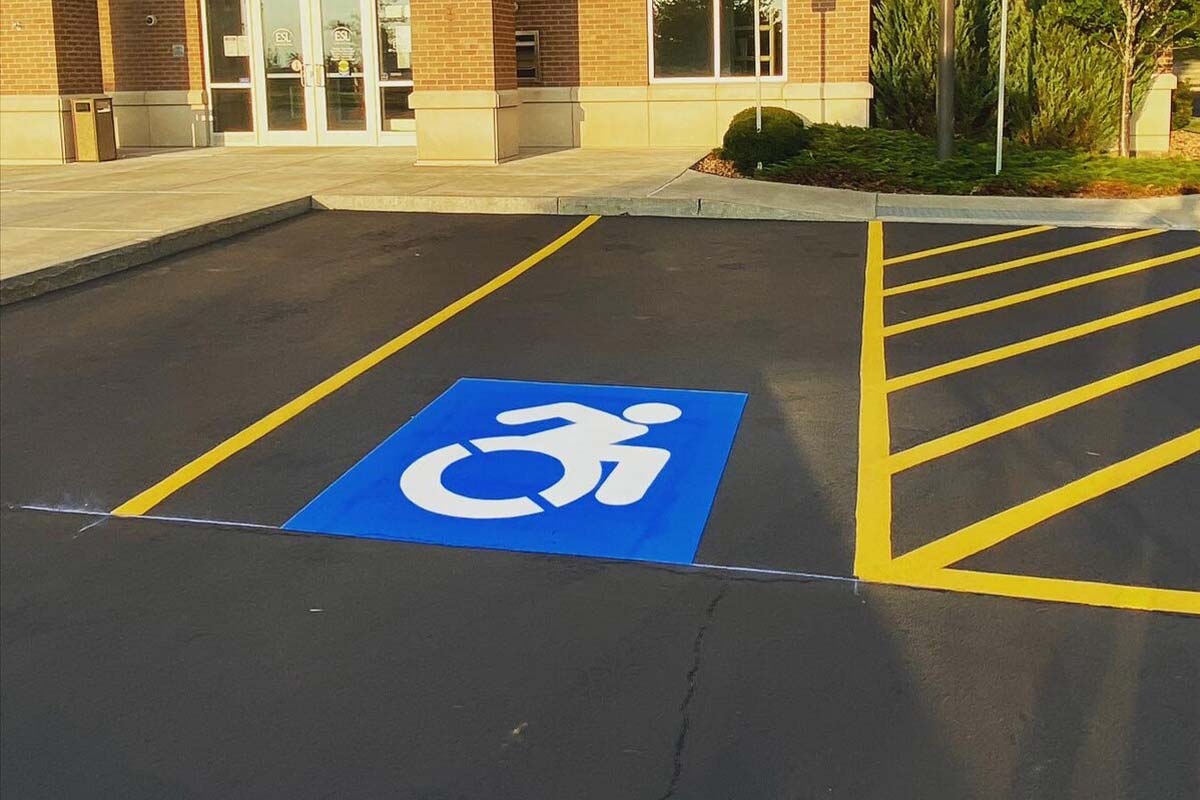
ADA Parking Lot Striping in Raleigh, NC
Accessible parking is where getting it wrong has consequences beyond appearance, and it is most often got wrong by accident — an access aisle faded to nothing, a van space not marked as one, a sign replaced with whatever the hardware store had. We lay out, mark, and refresh accessible parking to the 2010 ADA Standards for Accessible Design, with the North Carolina State Building Code, Chapter 11 as the state’s adopted accessibility layer above it.
How Many Accessible Spaces a Lot Needs
The count is set by the total number of spaces in the lot, on a published scale in the 2010 ADA Standards — not a percentage anyone should estimate from memory — and a share of those must be van-accessible. Two things trip properties up more than the arithmetic: the requirement applies per lot, so several separate lots cannot be pooled; and the spaces must sit on the shortest accessible route to the entrance they serve, so the count can be right and the placement still wrong.
Stall, Access Aisle, and Van-Accessible Dimensions
Section 502 of the 2010 ADA Standards sets the geometry: the width of a car accessible space, of a van accessible space, of the access aisle alongside it, and the requirement that the aisle be marked to discourage parking in it. The aisle is the piece that gets lost — it is not spare asphalt between two spaces but the room someone needs to deploy a ramp, and a vehicle parked in it makes the adjacent space unusable.
In North Carolina, the Access Aisle Is Part of the Space
This is the part that surprises property owners, and it is specific to North Carolina.
Under N.C.G.S. § 20-37.6(d), a parking space designated for handicapped persons *”includes clearly marked access aisles,”* and — in the statute’s own words — *”all provisions, restrictions, and penalties applicable to parking in spaces designated for handicapped persons also apply to clearly marked access aisles.”*
So in this state the aisle is not an ancillary marking. It is legally part of the designated space, and parking in it is treated the same way as parking in the space itself. Section 20-37.6(f)(4) makes that enforceable by state, county, and city authorities *”whether on public or private property”* — which is the answer to the common assumption that a private commercial lot is outside all of this.
Keeping the aisle striped and legible is therefore a compliance item, not a cosmetic one.
Accessible Parking Signs and the ISA Symbol
The International Symbol of Accessibility identifies the space, and under § 502.6 of the 2010 ADA Standards it belongs on the sign. We paint it on the pavement as well, because a painted symbol keeps the space readable when a post gets knocked down — but that is our practice, not the requirement. The sign is also where the North Carolina wrinkle sits: under § 20-37.6(d) a sign designating an accessible space *”shall state the maximum penalty”* for parking there in violation of the law, and § 20-37.6(e)(4) makes it unlawful for those responsible for designating the spaces to use nonconforming signs — putting the duty on the property owner, not the visitor. So a perfect stall with a nonconforming sign is not finished.
For a full list of our pavement marking services, visit our parking lot striping in Raleigh page.
Businesses We Serve




How it Works

GET A FREE ESTIMATE
Contact us today and we’ll have a quote to you in 24 hours

SCHEDULE AN INSTALLATION
We’ll have your installation scheduled in less than 7 days, without affecting your business hours

GET A PARKING LOT THAT POPS
For a budget-friendly price, you’ll get a parking lot that looks like new!
We proudly work with:


We proudly work with:

Frequently Asked Questions About ADA Parking Lot Striping in Raleigh, NC
How many accessible spaces does our lot need?
It scales with the total number of spaces, following the table published in the 2010 ADA Standards for Accessible Design, and a proportion must be van-accessible. Two things catch people out more than the count: the requirement applies per lot, so separate lots cannot be pooled; and the spaces must sit on the shortest accessible route to the entrance they serve. We work count and placement together.
What exactly is the access aisle, and does it really matter?
It is the marked space beside an accessible stall that lets someone deploy a ramp or open a door fully. It matters more here than in most states: under N.C.G.S. § 20-37.6(d) the access aisle is legally part of the designated space, and the restrictions and penalties applying to the space apply to the aisle. A faded aisle is one of the ways accessible parking quietly stops working.
Does any of this apply to a private commercial lot?
Yes. N.C.G.S. § 20-37.6(f)(4) provides for enforcement by state, county, and city authorities *”whether on public or private property.”* The assumption that accessible parking rules stop at the edge of a private lot does not hold in North Carolina, and the duty to designate spaces correctly sits with whoever is responsible for designating them.
What has to be on the accessible parking sign?
Beyond identifying the space, North Carolina requires the sign to state the maximum penalty for parking there in violation of the law. Using a nonconforming sign is itself an infraction under § 20-37.6(e)(4), attributed to the party responsible for designating the space rather than to a driver. If your lot has a mix of inherited signs, check them alongside the striping.
Our lot is old. Do we have to bring it up to current standards?
That is a question about your specific property and its history, and not one we can answer from a page. What we can do is tell you what your lot currently has and measure it against the 2010 ADA Standards and the North Carolina State Building Code, Chapter 11. Decisions about obligation and timing belong with you and your own advisers.
Can you just refresh the accessible spaces without doing the whole lot?
Yes. Refreshed on their own, that covers: – Accessible stall lines – Access aisle striping and hatching – The International Symbol of Accessibility – Accessible parking signage, checked against the North Carolina requirements above It is a common request when a tenant or an inspection raises a specific issue. Ask us to look at the fire lane markings while we are on site; the two tend to reach the end of their life together and it is cheaper in one visit.