
Thermoplastic Striping
In St. Louis, MO
Thermoplastic Pavement Markings
1-800-STRIPER provides professional thermoplastic striping in St. Louis, MO — heat-applied stop bars, crosswalks, directional arrows, and legends in a thick, retroreflective material with glass beads distributed throughout it, bonded into the pavement instead of drying on top of it, for commercial properties across the St. Louis metro.
1-800-STRIPER® of St Louis PROVIDes Thermoplastic Striping Services NEAR YOU
Want to reduce the maintenance requirements for your parking lot?
Thermoplastic pavement markings are a durable, weather and vehicle-resistant striping option for your parking lot or facility.
You can utilize them for stop bars, ADA stalls, no-parking zones, directional arrows, crosswalks, or your entire parking lot.
Benefits:
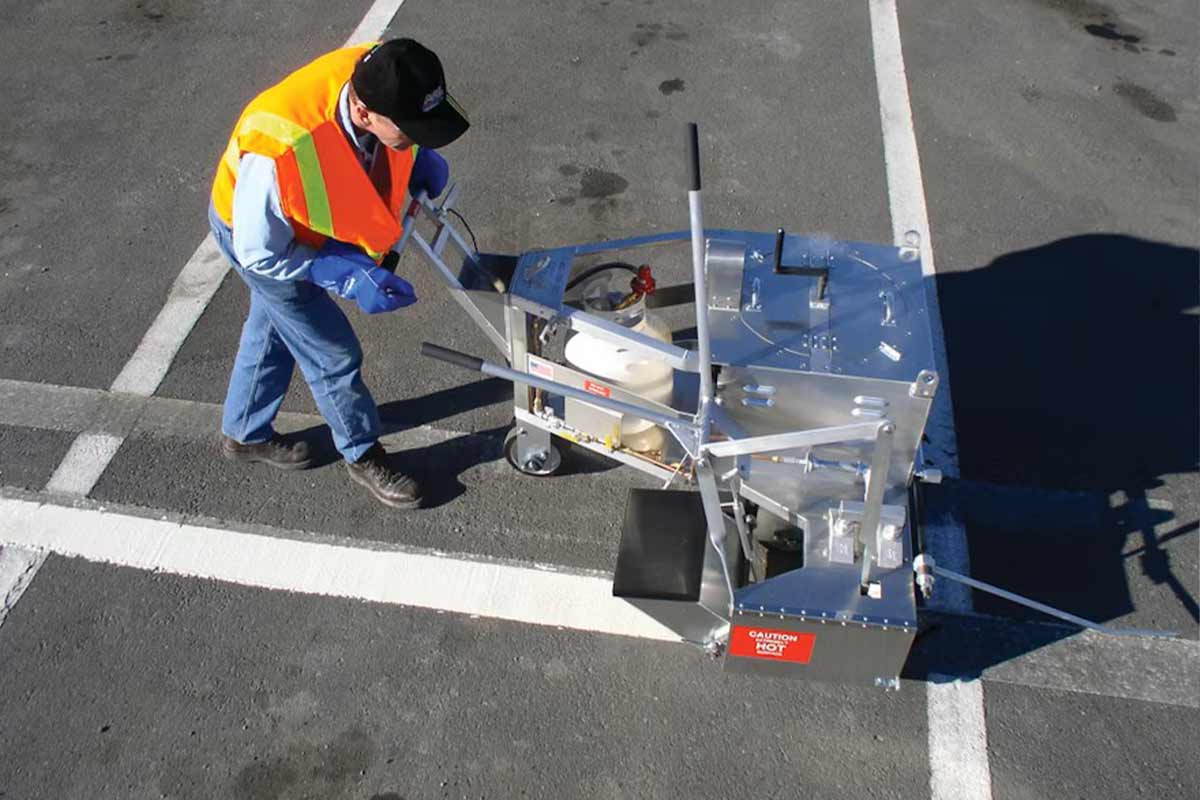
Thermoplastic Striping in St. Louis, MO
Thermoplastic is a different product from the traffic paint most parking lots are striped with. It arrives as a solid, goes down hot, and fuses to the surface rather than drying on top of it. When it cools you get a thick, hard band you can feel with your hand — where a painted line is a thin film sitting on the asphalt, a thermoplastic marking is a raised band with glass beads distributed through the material itself for night visibility.
That last detail is the one that matters most, and it’s worth being precise about. Missouri’s own highway specification describes the material this way: it “shall be solid, formulated and tested to perform as a pavement marking material with glass beads uniformly throughout the marking.” Beads throughout the material — not just sprinkled on the surface — is why a thermoplastic marking keeps reflecting as it wears, instead of going dull once the top layer of beads is gone.
We use it on St. Louis-area properties where a marking has to survive traffic that would wear paint off quickly: stop bars, crosswalks, and arrows that take a tire every few seconds.
What Missouri’s Own Highway Spec Says About Thermoplastic
Missouri publishes a detailed answer to “what is this material supposed to be,” and it’s worth knowing what it does and doesn’t say.
The 2026 Missouri Standard Specifications for Highway Construction — the Missouri Highways and Transportation Commission’s specification book, effective for lettings from October 1, 2026 — splits pavement marking across two sections. Section 620 covers construction and application; Section 1048 covers the material. The thermoplastic material spec lives in Section 1048.20.2.3.1, Preformed Thermoplastic Material, and it sets requirements including an abrasion resistance of no more than 150 mg with a CS-17 wheel under a 1,000-gram load for 1,000 cycles, tested per ASTM C 501, and a maintained retroreflectivity floor expressed in millicandelas per square meter per lux.
Glass beads get their own section. Section 1048.30.3 requires beads in accordance with AASHTO M 247, Type 1, and 1048.30.4 adds that Type 1 beads must be moisture-resistant.
Now the honest part, and there are three pieces of it.
First, Section 1048 and Section 620 govern MoDOT’s own highway construction contracts. They are not a code that binds your parking lot, and we won’t tell you otherwise. A retail lot in Kirkwood is not a state highway letting.
Second, MoDOT does not specify a thickness or a skid number for thermoplastic. You will find contractors quoting “125 mils per MoDOT” or a British Pendulum skid value — those figures are not in Missouri’s book. MoDOT’s mil thicknesses apply to paint, not thermoplastic, and for durable markings the spec explicitly defers to the product: markings “shall be installed according to the manufacturer’s recommendations.” We’d rather tell you that than invent a number.
Third — and this one gets repeated a lot — MoDOT’s specification does not reference AASHTO M 249 at all. That standard exists, and other states cite it, but Missouri’s book does not. If someone tells you Missouri requires thermoplastic meeting M 249, they’re describing a different state’s spec.
How Long Thermoplastic Actually Lasts
You will see “lasts six to eight times longer than paint” in marketing copy for this product, including elsewhere on our own network’s pages. We’d rather give you the measured answer.
The most useful published data comes from the Transportation Research Board’s NCHRP Synthesis 306, Long-Term Pavement Marking Practices, which collected service-life figures from agencies across the country. On sites without supplemental lighting or raised pavement markers, white thermoplastic averaged roughly 26 months of service life against roughly 10 months for waterborne paint — a little over two and a half times, not six to eight. On sites that did have lighting and raised markers, the same comparison narrowed to about 48 months versus 41 — barely more than one and a half times.
Two caveats we’ll state rather than bury: the paint sample in that comparison was small, and these were highway sites, not parking lots. The point isn’t that the numbers transfer directly to your property — it’s that the honest range is “meaningfully longer in the right spots,” not a tidy multiplier. How long any marking lasts on your lot depends on traffic volume, the pavement underneath it, sun exposure, and how often a plow blade crosses it. We’ll look at your lot and tell you which markings justify the material.
Where Thermoplastic Makes Sense on a St. Louis Lot
Thermoplastic is not a replacement for paint everywhere, and we won’t sell it as one. It costs more to install, and it’s the right call in specific places rather than across an entire lot by default.
Paint is the sensible choice for standard stall lines — long, straight runs that tires roll across but rarely turn on. It goes down fast, it’s economical over a large lot, and refreshing it on a maintenance cycle is straightforward. Thermoplastic earns its place where wear concentrates and a faded marking creates a real problem: stop bars, crosswalks, directional arrows, and the legends at entrances and drive aisles. Notably, that’s the same family of markings Missouri’s spec calls “Durable Intersection Marking Materials” — the state reaches for this material in exactly the high-wear, high-consequence spots we do.
St. Louis weather is hard on markings in a particular way. Summers put months of direct sun on the surface, winters run pavement through repeated freeze-thaw, and plowed storms drag a steel edge across every line in the lot. That’s an argument for using thermoplastic selectively rather than everywhere: a raised marking takes the plow blade directly, so pavement condition and the plow pattern matter as much as the material choice. We walk the lot with you before recommending it.
It’s also worth knowing that the federal manual most people assume governs parking lot markings expressly does not. The Manual on Uniform Traffic Control Devices states in Section 1B.01 that it “shall not apply to” — among other things — “parking areas, including the driving aisles within those parking areas, that are either publicly or privately owned.” Your lot isn’t governed by it, and the MUTCD never mentions thermoplastic in the first place. What that means in practice: on a private lot, material choice is an engineering and budget decision, not a compliance one. We’d rather you make it with real numbers, which is why we point to NCHRP Synthesis 306: Long-Term Pavement Marking Practices rather than a contractor’s sales sheet.
We install thermoplastic for retail centers, office and medical parks, industrial and warehouse properties, HOAs and apartment communities, schools, and municipal sites — commercial work only. We can phase the work overnight or in sections so a busy lot never fully closes. Call (314) 800-0507 for a free estimate.
For a full list of our pavement marking services, visit our parking lot striping in St. Louis page.
Businesses We Serve




How it Works

GET A FREE ESTIMATE
Contact us today and we’ll have a quote to you in 24 hours

SCHEDULE AN INSTALLATION
We’ll have your installation scheduled restriped in less than 7 days, without affecting your business hours

GET A PARKING LOT THAT POPS
For a budget-friendly price, you’ll get a parking lot that looks like new
We proudly work with:


We proudly work with:

Frequently Asked Questions About Thermoplastic Striping in St. Louis, MO
What is thermoplastic striping, and how is it different from painted lines?
Thermoplastic arrives as a solid and is applied hot, so it fuses into the pavement and cools into a thick, raised band rather than drying as a thin film on top of it. The bigger practical difference is the glass beads. Missouri’s own highway specification describes the material as one that must be “solid, formulated and tested to perform as a pavement marking material with glass beads uniformly throughout the marking.” Because the beads run through the whole thickness rather than sitting on the surface, the marking keeps reflecting as it wears instead of going dull once the top layer is gone.
Does Missouri require thermoplastic to meet AASHTO M 249?
No — and this one is worth correcting, because it gets repeated a lot. The 2026 Missouri Standard Specifications for Highway Construction do not reference AASHTO M 249 anywhere. Missouri’s thermoplastic material requirements live in Section 1048.20.2.3.1, and its glass bead requirement cites AASHTO M 247, Type 1, moisture-resistant. Other states do cite M 249; Missouri doesn’t. Anyone telling you Missouri requires M 249 thermoplastic is describing a different state’s specification.
How much thicker is thermoplastic than paint — how many mils?
We won’t give you a Missouri number, because Missouri doesn’t publish one. MoDOT’s specification sets mil thicknesses for paint but not for thermoplastic; for durable markings it defers to the product, saying they “shall be installed according to the manufacturer’s recommendations.” You’ll see “125 mils per MoDOT” quoted around — that figure isn’t in Missouri’s book. Thermoplastic is meaningfully thicker than paint and you can feel the difference with your hand. For what we’d actually install on your lot, ask us and we’ll tell you plainly what product and what thickness.
How much longer does thermoplastic last than paint?
Longer in high-wear spots — but not the “six to eight times” you’ll see in marketing copy, including on some of our own network’s pages. The Transportation Research Board’s NCHRP Synthesis 306 collected agency service-life data and found white thermoplastic averaging roughly 26 months against roughly 10 months for waterborne paint on sites without lighting or raised markers — about two and a half times. Where lighting and raised markers were present, it was about 48 months versus 41. Those were highway sites and the paint sample was small, so don’t treat either figure as a promise for your lot. How long a marking lasts depends on traffic, the pavement underneath, sun, and plowing.
Should I use thermoplastic for my whole parking lot?
Usually not, and we’ll say so. Standard stall lines are long straight runs that tires roll across but rarely turn on — paint is the sensible, economical choice there. Thermoplastic earns its cost where wear concentrates and a faded marking becomes a safety problem: stop bars, crosswalks, directional arrows, and entrance legends. Missouri’s spec groups that same family under “Durable Intersection Marking Materials,” which is a fair signal about where the material belongs. Using it selectively is how you get durability where it matters without paying for it where it doesn’t.
Does thermoplastic hold up to snowplows in St. Louis?
It’s a real consideration and it cuts both ways. Thermoplastic resists the tire scuffing and turning wear that strips paint, but it’s also a raised marking, so a plow blade contacts it directly. How it fares depends on your pavement’s condition and how the lot gets plowed. We walk the lot before recommending it rather than applying a blanket rule — on some St. Louis-area sites it’s clearly the right material, and on others we’ll tell you paint on a shorter cycle is the better spend. Call (314) 800-0507 for a free estimate.